

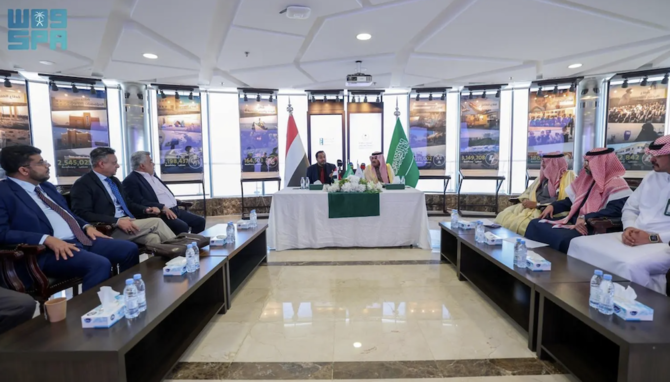
Saudi development program signs deal for 9 projects in Yemen

1 / 2
The Saudi Development and Reconstruction Program for Yemen has signed an agreement with Yemen’s Social Fund for Development to implement nine health and education projects across several governorates. (SPA)
2 / 2
The Saudi Development and Reconstruction Program for Yemen has signed an agreement with Yemen’s Social Fund for Development to implement nine health and education projects across several governorates. (SPA)
Short Url
Updated 01 February 2026
Follow

Saudi development program signs deal for 9 projects in Yemen

  • The deal was signed by SDRPY General Supervisor Ambassador Mohammed bin Saeed Al-Jaber and Social Fund Executive Director Hossam Qaid

RIYADH: The Saudi Development and Reconstruction Program for Yemen has signed an agreement with Yemen’s Social Fund for Development to implement nine health and education projects across several governorates.

The agreement, finalized on Sunday, follows last week’s announcement of a range of initiatives aimed at supporting vital services and strengthening Yemeni state institutions.

The deal was signed by SDRPY General Supervisor Ambassador Mohammed bin Saeed Al-Jaber and Social Fund Executive Director Hossam Qaid, in the presence of Yemen’s ministers of public health, education, and planning and international cooperation, the Saudi Press Agency reported.

Four healthcare projects will be delivered in Lahj, Taiz and Al-Dhale’a, including the construction of rural hospitals in Al-Mawasit in Taiz and in Al-Dhale’a, alongside maternal and child health facilities and an obstetric emergency center in Ras Al-Ara, Lahj.

The facilities will provide services including emergency care, inpatient treatment, maternity services, laboratories and radiology.

Five education projects will see model schools constructed in Marib, Lahj, Al-Dhale’a, Shabwa and Abyan. As well as science and computer laboratories, they will feature sports facilities, staff offices and modern learning environments, with designs adapted to support students with disabilities.

SDRPY said the healthcare projects aim to improve maternal and child health, expand access to specialized medical services and strengthen emergency response capabilities, while also creating employment opportunities.

The education initiatives are intended to raise teaching standards, support student development and enhance practical skills.

To date, the SDRPY has delivered more than 268 projects across the country, spanning education, health, water, energy, transport, agriculture and fisheries, as well as capacity building and support for Yemen’s government institutions.


Saudi Arabia’s KAUST named FIFA’s first research institute in MENA

The canal in the King Abdullah University of Science and Technology campus. (Shutterstock)
Updated 10 February 2026
Follow

Saudi Arabia’s KAUST named FIFA’s first research institute in MENA

  • KAUST President Prof. Sir Edward Byrne said that the university’s selection as the fifth FIFA Research Institute in the world — and the first in the region — marks a significant achievement, reflecting Kingdom’s growing presence in international football

RIYADH: FIFA has designated the King Abdullah University of Science and Technology as its first research institute in the Middle East and Asia to support the development of innovative football research, the Saudi Press Agency reported on Tuesday.

The recognition highlights KAUST’s commitment to integrating sports, academic research and industry through advanced, high-level initiatives grounded in rigorous scientific methodologies, contributing to the advancement of football studies.

KAUST President Prof. Sir Edward Byrne said that the university’s selection as the fifth FIFA Research Institute in the world — and the first in the region — marks a significant achievement, reflecting Saudi Arabia’s growing presence in international football.

The accreditation aligns with national efforts to invest in research and development and promote the knowledge economy, supporting Saudi Vision 2030’s goals of building an advanced sports system based on innovation and sustainability.

The collaboration’s first project focuses on developing advanced AI algorithms to analyze historical FIFA World Cup broadcast footage, transforming decades of match videos into structured, searchable data, according to the KAUST website.

This work opens new opportunities to apply state-of-the-art computer vision techniques and deepen understanding of how football has evolved over time.

The second project uses player and ball tracking data from the FIFA World Cup 2022 in Qatar and the FIFA Women’s World Cup 2023 in Australia and New Zealand to compile comprehensive datasets capturing in-game dynamics.

These datasets provide deeper insights into human movement, playing techniques and performance dynamics through AI-driven analysis.