

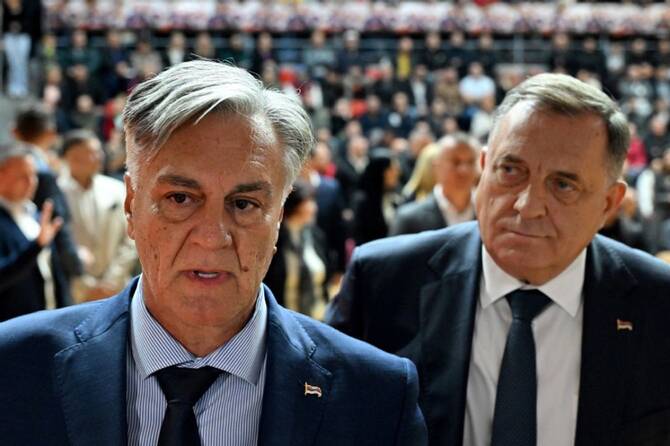

Bosnian Serbs will head to the polls on Sunday to pick a replacement for their entity’s banned president, Milorad Dodik, after he was removed for defying Bosnia’s international peace envoy.
Dodik was ejected from office in August following his conviction for ignoring rulings by the international appointee who oversees a peace deal which has held Bosnia together since the end of its 1990s inter-ethnic war.
The early vote in the Republika Srpska (RS) — one of Bosnia’s two semi-autonomous entities alongside a Bosniak-Croat federation — means the winner will serve for less than a year before general elections in October 2026.
It is seen as a crucial test of support for Dodik’s nationalist party, which has been in power for nearly two decades.
Around 1.2 million eligible voters can choose between six candidates, but there are two main favorites.
Sinisa Karan, a 63-year-old former interior minister, is a close ally and personal choice of Dodik, who remains head of his party, the Union of Independent Social Democrats (SNSD).
The main opposition group, the Serb Democratic Party (SDS), selected the relatively unknown Branko Blanusa, a 56-year-old electrical engineering professor who has repeatedly levelled corruption allegations against Dodik and his party.
The poll comes after years of clashes between Bosnia’s high representative, Christian Schmidt, and Dodik, which many analysts said pushed the country to the brink of its worst political crisis since the 1992-1995 war ended.
Earlier this year, Dodik was convicted and banned from public office for six years for flouting Schmidt’s decisions.
After months of defying the ruling, the 66-year-old leader, who has close ties to the Kremlin, suddenly accepted his removal in October.
Within days, the US dropped sanctions against Dodik and several of his associates, including Karan, that had been in place since 2017.
-’An impossible country’ -
On the campaign trail, Karan has been openly promoted as a continuation of Dodik’s legacy.
The presidential hopeful watched on during a final rally on Thursday, as Dodik, who during the campaign labelled Bosnia an “impossible country,” promised the push for RS statehood would continue.
“Our vision is freedom, and there is no freedom without a state,” Dodik told a crowd in the Bosnian Serb administrative capital, Banja Luka.
Meanwhile, Blanusa has blamed Dodik’s policies for threatening the entity’s future, and accused him of corruption.
“He has humiliated RS institutions for his own interests and wealth,” Blanusa said during a campaign event earlier this week.
- Dodik is ‘all-powerful’ -
But historian and diplomat Slobodan Soja said there was no clear “ideological” difference between the two leading contenders, whom he labelled “unpopular, selfish, and irresponsible.”
Soja said that despite Dodik’s decision to step aside under pressure from Washington, his political sway remained.
“His power remains intact and will only grow over time, as he is simply all-powerful as long as he leads the party.”
On the eve of the vote, Banja Luka residents showed little interest in political debates voicing resignation toward their leaders.
Single mother Milica Djuric said she would vote but without much hope for change.
“I earn 1,000 convertible marks ($589) monthly, I have a child to put through school, and I pay the bills.
“I would like to put them (politicians) in our shoes and give them this salary, so they can see how we live,” the 51-year-old told AFP.
Polls will open at 0600 GMT and close 12 hours later.


