

Three decades after peace deal, Bosnia still struggles with division

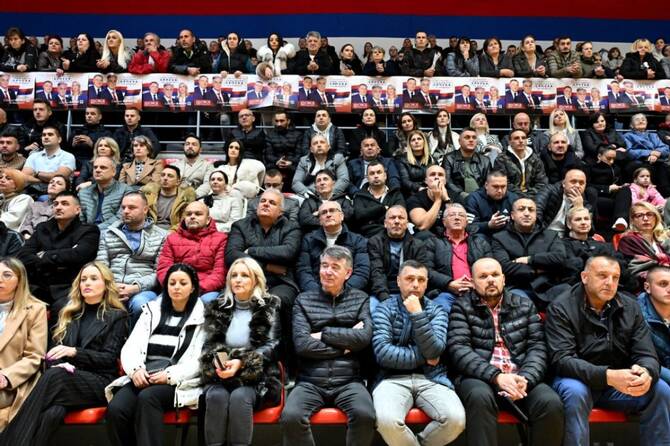
A photo in the town of Foca in eastern Bosnia and Herzegovina shows supporters of the SNSD party (Alliance of Independent Social Democrats) attending a pre-election rally. (AFP)
Short Url
Updated 21 November 2025
Follow

Three decades after peace deal, Bosnia still struggles with division

  • A tripartite presidency presides but has little actual power

SARAJEVO/BRCKO: Franjo Sola remembers November 21, 1995, as the best day of his life, when a US-brokered peace deal ended war in Bosnia and allowed him to leave the army and return to his studies at Sarajevo University.
“I swore to myself that I will celebrate it as my second birthday,” Sola said this week as the Balkan country marks the 30th anniversary of the Dayton peace accord that halted an ethnic conflict between Serbs, Croats and Bosniaks that killed some 100,000 people after Bosnia declared independence from Yugoslavia.
Since then, however, Sola’s optimism has faded. While the deal has maintained peace, Bosnia and Herzegovina remains divided along ethnic lines, its two regions barely held together by a weak umbrella government. Peace has failed to bring prosperity, and hundreds of thousands of young people — including Sola’s son — are estimated to have left in search of better prospects abroad.
“Dayton was good to stop the war but...it was not good for the development of the country,” said Sola, who works as a technical expert for EUFOR, the EU peacekeeping mission that remains in the country to oversee the implementation of the peace deal.
“It should be revised, the country cannot function like this anymore.”

CORRUPTION AND DIVISION HOLD BOSNIA BACK
The Dayton accords, named after the city in Ohio where they were ratified, split Bosnia into two autonomous regions, the Orthodox Serb-dominated Serb Republic and the Federation shared by Catholic Croats and Muslim Bosniaks. A tripartite presidency presides but has little actual power.
The agreement has kept the peace, and Bosnia is now being considered for EU membership — an unthinkable prospect in the 1990s when much of the country’s infrastructure had been destroyed by war.
The economy saw some strong post-war gains, bolstered by aid that poured in for reconstruction, and annual growth today is above 2 percent. Yet development is hamstrung by corruption and slow decision-making.
According to unofficial reports, at least 600,000 people have left the country in the last 12 years, although no-one has an exact figure because the country has not completed a census since 2013.
Bosnia remains politically divided. Until a state court banned him from public office in February, Milorad Dodik, the former head of the Serb Republic, had long sought to secede from Bosnia and join Serbia.
In the Croat village of Donja Skakava in northern Bosnia, many people have left. Most Bosnian Croats have been able to get Croatian passports, allowing them to move freely around the EU.
“The people have no economic stability whatsoever. The situation has worsened, not improved, after Dayton,” resident Anto Maticic said, standing in front of the remains of houses destroyed in the war. He reckons that at least 80 percent of Croats from the northern Posavina region, bordering Croatia, have moved out.
“Many of them rebuilt their houses but they remain empty,” he said.


Venezuelan activist Javier Tarazona released from prison as US diplomat assumes post

Updated 5 sec ago
Follow

Venezuelan activist Javier Tarazona released from prison as US diplomat assumes post

  • Human rights activist Javier Tarazona was arrested in July 2021
  • He was released shortly after the arrival in Caracas of US charge d’affaires

CARACAS: Venezuelan human rights activist Javier Tarazona, an ally of opposition leader María Corina Machado, was released from prison after the government promised to free political prisoners in an amnesty bill, rights organizations and family members said Sunday.
Tarazona, the director of the Venezuelan nonprofit human rights group FundaRedes, was arrested in July 2021, after reporting to authorities that he had been harassed by national intelligence officials. Two other activists of the group were also detained at the time.
Venezuela’s Foro Penal, a rights group that monitors the situations of political prisoners in the country, said Sunday that 317 people jailed for political reasons had been released as of noon local time Sunday, and 700 others were still waiting to be freed.
“After 1675 days, four years and seven months, this wishful day has arrived. My brother Javier Tarazona is free,” José Rafael Tarazona Sánchez wrote on X. “Freedom for one is hope for all.”
Tarazona was released shortly after the arrival in Caracas of US Charge d’Affaires Laura Dogu, who will reopen the American diplomatic mission after seven years of severed ties. It comes after US President Donald Trump ordered a military action that removed the South American country’s former President Nicolás Maduro from office and brought him to trial in the US
Dogu, who was previously ambassador in Nicaragua and Honduras, arrived in Venezuela one day after the country’s interim president, Delcy Rodríguez, announced an amnesty bill to release political prisoners. That move was one of the key demands of the Venezuelan opposition.
Venezuela’s government had accused Tarazona of terrorism, betraying the nation and hate speech, all frequent accusations it makes against real or potential opposition members. Tarazona was vocal against illegal armed groups on the country’s border with Colombia and their alleged connection to high-ranked members of the Maduro administration.
Amnesty International reported that Tarazona’s health has deteriorated due to lack of medical attention during his time in prison.
“All of Venezuela admires you and respects your bravery and your commitment,” Machado said on X. “You, better than anyone, know that there will be justice in Venezuela. Freedom for all political prisoners.”
Venezuela’s government denies it jails members of the opposition and accuses them of conspiring to bring it down.