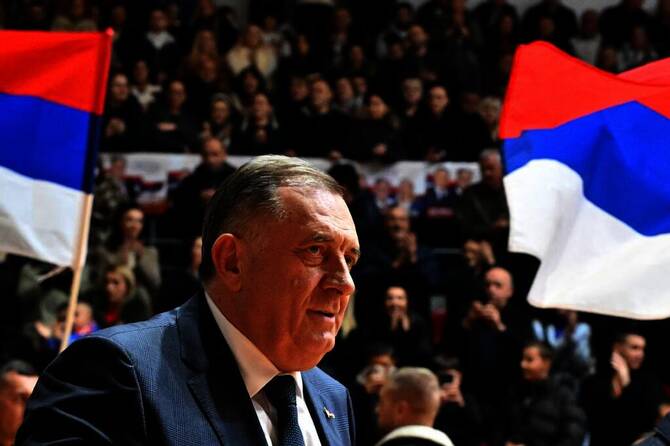
SARAJEVO: The Bosnia’s Serb statelet’s snap presidential election on Sunday signals an end to the overt political leadership of Milorad Dodik – a populist who regularly threatened to break away from Bosnia.
Once seen as a moderate by Western diplomats, Dodik was forced from office over his tense relationship with the international envoy charged with maintaining a peace treaty that has held the country together since its 1990s war.
Although it may be the end of Dodik’s time in public office, his chosen replacement is a close ally, and many observers see the 66-year-old’s step back as a political maneuver rather than a retirement.
Here are the main steps that led to Sunday’s vote.
‘A tourist with no power’
Since the end of the 1992-1995 war, Bosnia has been divided into Serb and Bosniak-Croat entities, linked by central institutions.
Reforms aimed at strengthening the central state were often imposed by a high representative – an international appointment granted sweeping powers to maintain the Dayton Peace Accords that ended the conflict 30 years ago.
Bosniaks, or Bosnian Muslims, have consistently advocated for a stronger central state, while Bosnian Serbs, who mainly live in Republika Srpska (RS), largely opposed the transfer of power away from the entities.
When former German agriculture minister Christian Schmidt arrived to become high representative in 2021, Dodik immediately accused him of being “illegitimate.”
Dodik claimed Schmidt had not received the necessary UN Security Council approval due to vetoes by Russia and China.
But Schmidt remained undeterred, declaring an intent to use all “political tools” at his disposal to make Bosnia a more functional state, anchored to the European Union.
Dodik, with close ties to the Kremlin, painted Schmidt’s moves as a direct challenge to Republika Srpska and labelled him a “tourist with no power.”
‘Existential threat’
Facing pushback from Dodik, Schmidt, within months of his appointment, told the Security Council that Bosnia faced “the greatest existential threat of the post-war era.”
In April 2022, Schmidt suspended a law that would have allowed the Serb entity to seize state assets within its territory, which covers over half the country.
Over a year later, he moved to repeal laws passed by the RS parliament that allowed the entity to ignore his office’s decisions and those made by Bosnia’s constitutional court.
The high representative made it a punishable offense to ignore his decisions; offenders could be imprisoned for up to five years and banned from public office.
Open crisis
For ignoring these rulings, Dodik was indicted in August 2023. After a lengthy court process, which he said aimed at “eliminating him from the political arena,” he was sentenced to one year in prison and banned from office for six years in February.
The political crisis escalated as Dodik decried the decision, while his government responded with new laws that rejected the authority of Bosnia’s central judiciary and police.
Despite prosecutors demanding his arrest on potential sedition charges, no police force dared arrest him for fear of inflaming a wider conflict.
A court confirmed his conviction on appeal, but Dodik managed to convert his prison sentence to fines – his political ban remained.
Washington’s hand
The 66-year-old was initially defiant, announcing a series of referendums – including one on the potential secession of the entity from Bosnia.
“I have no intention of leaving,” he said, stating that he would block any vote for his replacement. Fears grew of an escalation.
But, at the end of September, he reversed course. The RS parliament agreed to early elections, repealed the controversial laws that had sparked the crisis, and Dodik stood aside for an interim president.
Ten days later, the United States lifted sanctions on Dodik and his associates, in place since 2017, over his separatist policies.
Historian and diplomat Slobodan Soja said it was clear that Dodik had “capitulated to have sanctions lifted” while remaining head of the party and maintaining an “absolute domination over the territory of the RS.”
Since the end of the war, Washington has remained focused on the preservation of the Dayton agreement and the maintenance of peace in the Balkans, Soja said.
“Dodik’s behavior endangered both, which is why he had to be stopped, but not removed.”

Provocative Bosnian Serb populist steps behind the curtain
Short Url
https://arab.news/5r72x
Provocative Bosnian Serb populist steps behind the curtain
- Milorad Dodik forced from office over his tense relationship with the international envoy charged with maintaining a peace treaty that has held the country together since its 1990s war
Russian pensioners turn to soup kitchen as war economy stutters
SAINT PETERSBURG: Dishes clatter, steam bursts from large cooking pots and music is seeping through the bustling chatter of Russian pensioners, hunched over bowls of free meals in a Saint Petersburg soup kitchen.
The general mood is upbeat but the place, at full capacity, is a testament to financial hardships plaguing an ever-increasing number of Russia’s elderly people, struggling to make ends meet as the country’s war economy stutters.
Nina, a 77-year-old retired engineer, said she could no longer go to the supermarket, getting her lunch and dinner from the soup kitchen instead, as she was not able to afford her own groceries.
“I haven’t been to a shop for three years because I don’t have the money. There’s simply no point in going,” she told AFP, her voice resolute but eyes glistening.
“Should I just go, look around and leave?,” she asked.
The cost of living in Russia — particularly in large cities — has skyrocketed in the four years since Moscow launched its full-scale offensive in Ukraine.
Huge spending on the military helped Russia buck predictions of economic collapse, but has pushed up inflation — a headache for the Kremlin which has aimed to shield citizens from the fallout of its war.
Prices have surged by a combined 45 percent since Russia launched its offensive, according to official data.
And though President Vladimir Putin recently hailed a cooling of inflation amid high interest rates, pensioners in the Saint Petersburg soup kitchen say their situation is still dire.
- ‘Poor boys’ -
On a bright winter day, AFP met former accountants, doctors and engineers turning to the free bowls of soup and pasta on offer.
Zinaida, a 77-year-old former paediatrician, told AFP her pension was 26,400 rubles ($345) a month.
“Over the last two to three years, we have seen food prices rise,” Zinaida said, attributing the surge to raising taxes.
In order to plug holes in Russia’s stretched public finances, the Kremlin has tapped the pockets of its citizens, raising the nationwide sales tax from 20 to 22 percent, starting this year.
For many pensioners like Zinaida, juggling monthly expenses has become increasingly tricky.
“By our age, everyone has a whole load of illnesses,” she said, and the medications were “very expensive.”
“You work just to pay for the utilities and the pharmacy. There is almost nothing left for anything else.”
That sentiment is shared by Anna, 66, who, despite a career as a surgeon, said she struggled to pay her bills in retirement.
“When you go to the pharmacy, you start to wonder if you’ll be able to buy anything for lunch.”
The Central Bank, which has hiked borrowing costs in a bid to tame price rises, expects annual inflation to ease to Moscow’s four-percent target only in 2027.
That is just one of the Russian economy’s worsening indicators as the war in Ukraine drags into its fifth year.
Growth slowed dramatically to one percent in 2025, Putin said earlier this week — down from 4.3 a year prior.
But for Tatyana, a former accountant, “it’s only fair that things should get more expensive.”
“We have this war going, with our poor boys there. May God grant them all good health.”
The general mood is upbeat but the place, at full capacity, is a testament to financial hardships plaguing an ever-increasing number of Russia’s elderly people, struggling to make ends meet as the country’s war economy stutters.
Nina, a 77-year-old retired engineer, said she could no longer go to the supermarket, getting her lunch and dinner from the soup kitchen instead, as she was not able to afford her own groceries.
“I haven’t been to a shop for three years because I don’t have the money. There’s simply no point in going,” she told AFP, her voice resolute but eyes glistening.
“Should I just go, look around and leave?,” she asked.
The cost of living in Russia — particularly in large cities — has skyrocketed in the four years since Moscow launched its full-scale offensive in Ukraine.
Huge spending on the military helped Russia buck predictions of economic collapse, but has pushed up inflation — a headache for the Kremlin which has aimed to shield citizens from the fallout of its war.
Prices have surged by a combined 45 percent since Russia launched its offensive, according to official data.
And though President Vladimir Putin recently hailed a cooling of inflation amid high interest rates, pensioners in the Saint Petersburg soup kitchen say their situation is still dire.
- ‘Poor boys’ -
On a bright winter day, AFP met former accountants, doctors and engineers turning to the free bowls of soup and pasta on offer.
Zinaida, a 77-year-old former paediatrician, told AFP her pension was 26,400 rubles ($345) a month.
“Over the last two to three years, we have seen food prices rise,” Zinaida said, attributing the surge to raising taxes.
In order to plug holes in Russia’s stretched public finances, the Kremlin has tapped the pockets of its citizens, raising the nationwide sales tax from 20 to 22 percent, starting this year.
For many pensioners like Zinaida, juggling monthly expenses has become increasingly tricky.
“By our age, everyone has a whole load of illnesses,” she said, and the medications were “very expensive.”
“You work just to pay for the utilities and the pharmacy. There is almost nothing left for anything else.”
That sentiment is shared by Anna, 66, who, despite a career as a surgeon, said she struggled to pay her bills in retirement.
“When you go to the pharmacy, you start to wonder if you’ll be able to buy anything for lunch.”
The Central Bank, which has hiked borrowing costs in a bid to tame price rises, expects annual inflation to ease to Moscow’s four-percent target only in 2027.
That is just one of the Russian economy’s worsening indicators as the war in Ukraine drags into its fifth year.
Growth slowed dramatically to one percent in 2025, Putin said earlier this week — down from 4.3 a year prior.
But for Tatyana, a former accountant, “it’s only fair that things should get more expensive.”
“We have this war going, with our poor boys there. May God grant them all good health.”
© 2026 SAUDI RESEARCH & PUBLISHING COMPANY, All Rights Reserved And subject to Terms of Use Agreement.


