What did countries agree to at COP30?

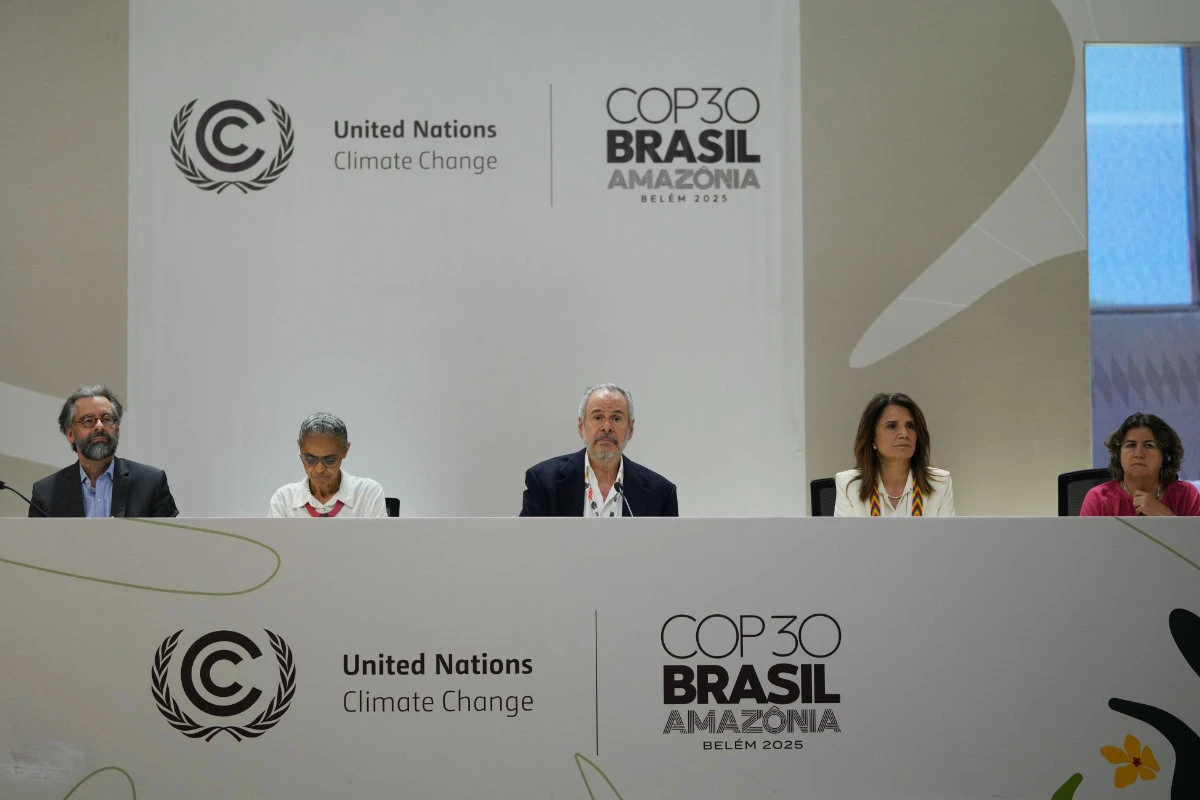
Brazil environment minister Marina Silva (second from left), COP30 President Andrea Correa do Lago (center) and COP30 CEO Ana Toni (second from right), attend a news conference at the COP30 UN Climate Summit on Nov. 22, 2025, in Belem, Brazil. (AP Photo)
Short Url
Updated 23 November 2025
Follow

What did countries agree to at COP30?
BELÉM, Brazil: The COP30 climate summit has drawn to a close after two weeks in the Amazonian city of Belem where protests, street marches and even a fire caused unexpected moments of drama.
But beneath enormous tents erected over a former airport at the edge of the rainforest, nations also adopted some decisions on how to battle climate change.
Here are the main negotiated outcomes, and the voluntary commitments, made during the summit attended by nearly 200 nations:

Fossil fuels

The thorniest issues were bundled into a “mutirao” pact — the summit’s slogan, drawn from the Tupi-Guarani word for “collective effort.”
The agreement included an initiative for countries to collaborate on a voluntary basis to reduce carbon emissions and strive to limit global warming to 1.5C relative to pre-industrial levels.
It also noted a commitment made by all nations at COP28 in Dubai to “transition away from fossil fuels” — but this exact phrase, which has become politically sensitive, was not included.
Despite pressure from more than 80 nations from Europe to Latin American to the Pacific, the conference did not adopt a “roadmap” to phase out fossil fuels.
Instead, COP30 president Andre Correa do Lago offered to create one for countries willing to join on a voluntary basis, and another plan to halt deforestation.

Finance

The world’s poorest nations have long complained they lack the finance for “adaptation” — measures to protect their economies from rising seas, such as building sea walls, and other impacts of climate change.
In a win for developing countries at COP30, the final agreement “calls for efforts to at least triple adaptation finance by 2035.”
In 2024, rich countries agreed to provide $300 billion a year by 2035 in climate finance to developing nations, with no specific amount earmarked for adaptation.
Most of that goes to projects that reduce greenhouse gas emissions, such as renewable energy, and not to adaptation — something developing nations have long complained puts them at a disadvantage.
The “tripling” goal agreed in Belem could mean $120 billion from that $300 billion is earmarked for adaptation, but close observers said clarity was still needed around that target.

Trade

For the first time, trade has been included as a pillar of the final text, with a three-year dialogue to take place under the climate framework.
This reflected concerns from countries including China that trade measures — like taxes on carbon-intensive goods — could erode export revenues or throw up barriers to green technology sales.

Forests

At COP30, Brazil launched a new global investment vehicle that proposes paying out a share of profits to forest-rich countries for every hectare of trees they leave standing.
Brazilian President Luiz Inacio Lula da Silva announced during a leaders’ summit in Belem last week — even before COP30 officially started — the launch of the Tropical Forests Forever Facility.
The TFFF attracted $5.5 billion in pledges from Norway, Germany, Indonesia, France and Brazil — the biggest contributors.
Ultimately, Brazil is seeking to raise $125 billion in public and private investment, but said the fund could start working even without the full $25 billion in startup capital from governments.

Methane pledges

Slashing methane emissions — the second-largest contributor to climate change after carbon dioxide — is considered one of the fastest ways to curb global warming.
Although it remains in the atmosphere for about 12 years, the “super pollutant” is roughly 80 times more potent than CO2 over a 20-year period.
At COP30, seven countries — Britain, France, Canada, Germany, Norway, Japan and Kazakhstan — signed a statement vowing to achieve “near zero” methane emissions across the fossil fuel sector.


Kyiv under ‘massive’ missile attack, Russian village evacuated after drone strike

Updated 6 sec ago
Follow

Kyiv under ‘massive’ missile attack, Russian village evacuated after drone strike

  • "A mass attack on the capital is still underway," Kyiv Mayor Vitali Klitschko announced on Telegram early Thursday
  • Simultaneously, a Ukrainian drone attack deep inside Russia ignited a fire at a Ministry of Defense facility in the Volgograd region

KYIV/MOSCOW: The conflict between Russia and Ukraine escalated sharply early Thursday as both sides launched significant aerial assaults, targeting critical infrastructure and residential areas.

The Ukrainian capital, Kyiv, came under a “massive” attack from Russian missiles, officials said, while Russian authorities ordered the evacuation of a village in the Volgograd region following a drone strike on a military facility.

"A mass attack on the capital is still underway," Kyiv Mayor Vitali Klitschko announced on Telegram early Thursday. He reported hits on both residential and non-residential buildings on both sides of the Dnipro River, which bisects the city.

According to preliminary reports, falling fragments struck near two residential buildings in one district. While no fires broke out and no immediate casualties were reported, emergency medical teams were dispatched to the affected areas.

Tymur Tkachenko, head of the capital’s military administration, confirmed at least one hit in an eastern suburb, as witnesses reported explosions resounding across the city.

The southeastern city of Dnipro was also targeted. Regional governor Oleksandr Ganzha stated that while some private homes and cars sustained damage, there were no indications of casualties. Air raid alerts remained in effect in both Kyiv and Dnipro well after midnight.

Drone Strike in Russia 

Simultaneously, a Ukrainian drone attack deep inside Russia ignited a fire at a Ministry of Defense facility in the Volgograd region.

"Falling debris caused a fire on the grounds of a Ministry of Defense facility near the village of Kotluban," Governor Andrey Bocharov posted on Telegram.

Authorities declared an immediate evacuation of the nearby village "to ensure civilian safety from the threat of detonation during firefighting," Bocharov added.

The exchange of strikes follows a deadly day in eastern Ukraine. On Wednesday, a Russian strike on the city of Bogodukhiv in the Kharkiv region killed four people, including three young children.

Regional military head Oleg Synegubov reported that two one-year-old boys and a two-year-old girl were killed, along with a 34-year-old man. A 74-year-old woman and a 35-year-old pregnant woman were also wounded in the attack. The Kharkiv region has seen intensified Russian attacks on transport and energy infrastructure in recent weeks.

The ongoing violence stands in stark contrast to diplomatic efforts. Ukrainian and Russian officials have been holding US-mediated talks in Abu Dhabi aimed at ending the four-year invasion. While the two sides successfully conducted a prisoner swap last week, a comprehensive agreement to end the conflict remains elusive.

The human toll continues to mount. According to the UN Human Rights Monitoring Mission in Ukraine (HRMMU), approximately 15,000 Ukrainian civilians have been killed since Russia invaded in February 2022. The agency noted that 2025 was the deadliest year of the conflict so far, with more than 2,500 civilians killed.