

Saudi company eyes multi-sector projects in Pakistan worth $200 million each — ministry

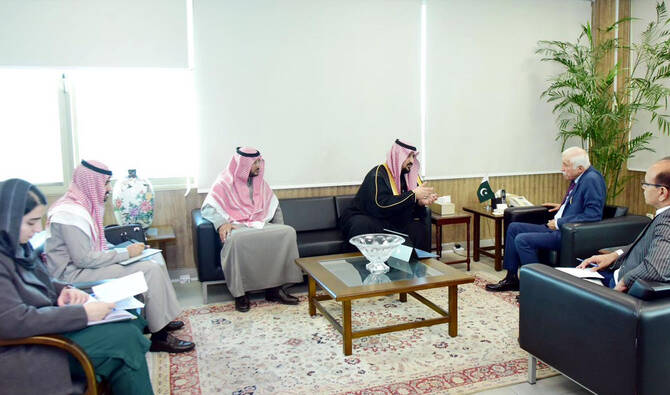
Federal Minister for the Board of Investment Qaiser Ahmed Sheikh (2nd from the right) meets with a KYAN delegation from Saudi Arabia in Islamabad on February 11, 2026. (PID/X)
Short Url
Updated 12 February 2026
Follow

Saudi company eyes multi-sector projects in Pakistan worth $200 million each — ministry

  • Delegation from Saudi firm Kyan explores investment in energy, mining, IT and agriculture
  • Talks come amid Pakistan’s push to attract Gulf capital and boost foreign investment inflows

ISLAMABAD: A Saudi company is exploring potential multi-sector investment projects in Pakistan with an estimated minimum value of $200 million per scheme, Pakistan’s ministry of information said on Wednesday.

The development comes as Pakistan seeks to attract increased foreign direct investment from Gulf countries, particularly Saudi Arabia, as part of efforts to stabilize its economy, improve investor confidence and expand industrial capacity. Saudi Arabia has in recent years pledged billions of dollars in potential investments across Pakistan’s mining, energy and infrastructure sectors, though several projects remain at exploratory or negotiation stages.

According to the ministry of Information, a delegation from Saudi firm Kyan visited Islamabad and expressed interest in investing in sectors including energy, mining, information technology, agriculture and livestock. The delegation participated in the “Indus AI Week” organized by the Ministry of Information Technology and Telecommunication and held meetings with Federal Minister for Board of Investment Qaiser Ahmed Sheikh.

“The delegation shared proposals for various potential projects with an estimated minimum investment of USD 200 million for each project and also conveyed their interest in bringing additional Saudi investors to Pakistan,” the information ministry said. 

Welcoming the delegation, Sheikh highlighted Pakistan’s market size and geographic position.

“With a population of over 250 million, Pakistan represents a large and dynamic market,” the minister said, adding that the country’s location provides access to landlocked Central Asian states, making it an attractive hub for regional trade and investment.

The ministry statement said the Board of Investment offered facilitation through its Business Facilitation Center, which provides a single-window mechanism for investor approvals and coordination. Sheikh also assured the delegation of support in arranging meetings with the business community and visits to Special Economic Zones, where incentives include income tax and import duty exemptions.

The minister referred to recent engagements between Pakistani and Saudi officials and reiterated that both countries could work to unlock new avenues of bilateral investment and economic cooperation, according to the statement.

Saudi Arabia is among Pakistan’s largest sources of worker remittances and has emerged as a key partner in Islamabad’s efforts to secure external financing and long-term investment commitments in recent years.



Return of millions of Afghans from Pakistan and Iran pushes Afghanistan to the brink, UN warns

Updated 5 sec ago
Follow

Return of millions of Afghans from Pakistan and Iran pushes Afghanistan to the brink, UN warns

  • Afghan authorities provide care packages for those returning that include food aid, cash, a telephone SIM card and transportation
  • But the returns have strained resources in a country struggling with a weak economy, severe drought and two devastating earthquakes

GENEVA: The return of millions of Afghans from neighboring Pakistan and Iran is pushing Afghanistan to the brink, the U.N. refugee agency said on Friday, describing an unprecedented scale of returns.

A total of 5.4 million people have returned to Afghanistan since October 2023, mostly from the two neighboring countries, UNHCR’s Afghanistan representative Arafat Jamal said, speaking to a U.N. briefing in Geneva via video link from Kabul, the Afghan capital.

“This is massive, and the speed and scale of these returns has pushed Afghanistan nearly to the brink,” Jamal said.

Pakistan launched a sweeping crackdown in Oct. 2023 to expel migrants without documents, urging those in the country to leave of their own accord to avoid arrest and forcible deportation and forcibly expelling others. Iran also began a crackdown on migrants at around the same time.

Since then, millions have streamed across the border into Afghanistan, including people who were born in Pakistan decades ago and had built lives and created businesses there.

Last year alone, 2.9 million people returned to Afghanistan, Jamal said, noting it was “the largest number of returns that we have witnessed to any single country.”

Afghanistan’s Taliban rulers have criticized the mass expulsions.

Afghanistan was already struggling with a dire humanitarian situation and a poor human rights record, particularly relating to women and girls, and the massive influx of people amounting to 12% of the population has put the country under severe strain, Jamal said.

Already in just the month and a half since the start of this year, about 150,000 people had returned to Afghanistan, he added.

Afghan authorities provide care packages for those returning that include some food aid, cash, a telephone SIM card and transportation to parts of the country where they might have family. But the returns have strained resources in a country that was already struggling to cope with a weak economy and the effects of a severe drought and two devastating earthquakes.

In November, the U.N. development program said nine out of 10 families in areas of Afghanistan with high rates of return were resorting to what are known as negative coping mechanisms — either skipping meals, falling into debt or selling their belongings to survive.

“We are deeply concerned about the sustainability of these returns,” Jamal said, noting that while 5% of those who return say they will leave Afghanistan again, more than 10% say they know of someone who has already left.

“These decisions, I would underscore, to undertake dangerous journeys, are not driven by a lack of a desire to remain in the country, on the contrary, but the reality that many are unable to rebuild their viable and dignified lives,” he said.
