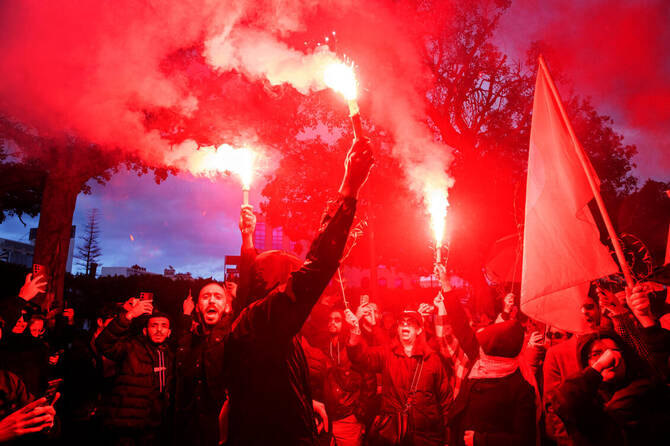
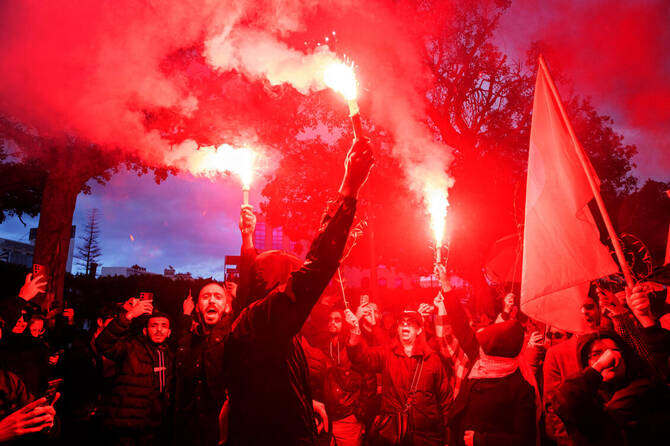
TUNIS: Tunisians took to the streets of downtown Tunis on Saturday over what they described as President Kais Saied ‘s increasingly authoritarian rule and demanding the release of all jailed political prisoners.
The rally, held under the banner “Against Injustice,” brought together families of political detainees and activists from different ideological backgrounds.
The demonstration drew more than 1,000 protesters, some dressed in black and chanting anti-regime slogans, including “The people want to overthrow the regime,” “What a great country! Oppression and tyranny!” and “No fear no terror, the street belongs to the people.”
The protest came as part of a broader surge in protests nationwide over political and economic turmoil under Saied’s rule. On Thursday, Tunisian journalists protested against the widening crackdown on the freedom of the press and the temporary suspension of several prominent civil society organizations.
Protesters also called out Saied’s interference in the judiciary and accused him of using the police to target political opponents.
Ayoub Amara, one of the organizers, told reporters on Saturday that the protest aimed to highlight the plight of those held in Tunisian prisons for their political opinions. He said it also touched on other broader grievances, including environmental protests convulsing the phosphate-producing city of Gabes and arbitrary arrests under anti-terrorism laws.
“All the progress of the past 14 years has been overturned,” Amara said. ” Tunisia is big enough for all Tunisians, and no single person can rule it according to his whims.”
Monia Brahim, the wife of jailed opposition figure Abdelhamid Jlassi, said she joined the march because she believes “many Tunisians are facing deep injustice.”
“I came to defend my rights as a citizen,” she told The Associated Press. “Political prisoners know for a fact that they are in prison to pay the price for their principles, their constitutional right for civil and political activism, and are being held hostage by the regime established today in Tunisia.”
Among those detained, some are currently on hunger strike including constitutional law professor Jawher Ben Mbarek who has been striking for over 20 days.
Several rights groups have raised increasing alarm over the growing scale of repression in Tunisia. Human Rights Watch has said that over 50 people, including politicians, lawyers, journalists and activists, have been subjected to arbitrary arrest or prosecution since late 2022, for exercising their rights to freedom of expression, peaceful assembly or political activity.
The rights group also warned that broad anti-terrorism and cybercrime laws were being utilized to criminalize dissent and tame all forms of free speech.
Saied, who suspended parliament and consolidated all branches of power in July 2021, said his actions were necessary to root out corruption, eliminate “traitors” and restore state institutions.


![]()
Hundreds protest in Tunisia over president’s escalating crackdown on freedoms
Short Url
https://arab.news/z57wp
Hundreds protest in Tunisia over president’s escalating crackdown on freedoms
- The rally, held under the banner “Against Injustice,” brought together families of political detainees and activists from different ideological backgrounds
- Protesters also called out Saied’s interference in the judiciary and accused him of using the police to target political opponents


Latest updates


© 2026 SAUDI RESEARCH & PUBLISHING COMPANY, All Rights Reserved And subject to Terms of Use Agreement.