CHENGDU: French first lady Brigitte Macron caught up with an old friend — a giant panda born in France — at the tail end Friday of a visit to China with President Emmanuel Macron.
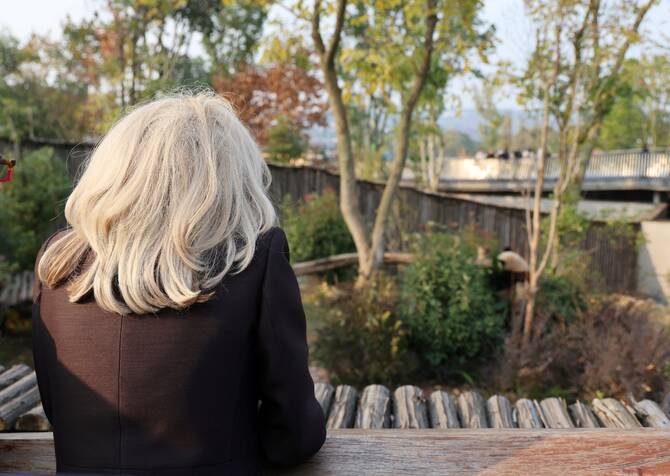
At a panda reserve in southwest China that Yuan Meng now calls home, the first lady marveled at how big he has grown. She helped chose his name — which means “accomplishment of a dream” — when he was born in a French zoo in 2017.
“When they’re born, they’re like this,” she said, holding up two fingers a short distance apart. Meanwhile, the chunky male roamed in his enclosure, feasting on bamboo and ignoring bystanders who cried out his name, hoping to elicit a reaction.
“They have a very independent character,” she said. “They do only what they want.”
For decades, China has deployed what’s often called “panda diplomacy” to smooth and promote relations with other countries, gifting the animals to friendly nations and lending pandas to zoos overseas on commercial terms.
Emmanuel Macron’s state visit this week to China, his fourth as president, included meetings with Chinese leader Xi Jinping and other officials, discussing Russia’s war in Ukraine, trade ties and other issues.
The China Wildlife Conservation Association said during the visit that it signed a letter of intent to send two of the animals to the Beauval Zoo south of Paris in 2027 under what would be a new 10-year round of panda cooperation with France.
The French zoo sent two 17-year-old pandas — Huan Huan, a female, and her partner Yuan Zi — back to China last month after 13 years on loan in France.
Yuan Meng was their cub, conceived using artificial insemination.
Despite being made in France, he officially belonged to the Chinese government. Yuan Meng bid ‘’adieu’’ to France in 2023, sent off to a new life in the Chengdu Research Base of Giant Panda Breeding in southwest China where Brigitte Macron, considered to be his “godmother,” dropped in to see him.
Huan Huan and Yuan Zi also produced female twins in France in 2021.
Huanlili and Yuandudu are also expected to leave the Beauval Zoo for China in the future. The China Wildlife Conservation Association has previously said that it expects them to remain at the French zoo until January 2027.

French first lady Brigitte Macron visits an old friend in China: A giant panda called Yuan Meng
https://arab.news/2qce3
French first lady Brigitte Macron visits an old friend in China: A giant panda called Yuan Meng
- For decades, China has deployed what’s often called “panda diplomacy” to smooth and promote relations with other countries, gifting the animals to friendly nations and lending pandas to zoos overseas on commercial terms
94 million need cataract surgery, but access lacking: WHO
- Of the 94 million affected, fewer than 20 percent are blind, while the rest suffer from impaired vision
GENEVA: More than 94 million people suffer from cataracts, but half of them do not have access to the surgery needed to fix it, the World Health Organization said Wednesday.
Cataracts — the clouding of the eye’s lens that causes blurred vision and can lead to blindness — are on the rise as populations get older, with age being the main risk factor.
“Cataract surgery — a simple, 15-minute procedure — is one of the most cost-effective medical procedures, providing immediate and lasting restoration of sight,” the WHO said.
It is one of the most frequently performed surgeries undertaken in high-income countries.
However, “half of the world’s population in need of cataract surgery don’t have access to it,” said Stuart Keel, the UN health agency’s technical lead for eye care.
The situation is worst in the WHO’s Africa region, where three in four people needing cataract surgery remain untreated.
In Kenya, at the current rate, 77 percent of people needing cataract surgery are likely to die with their cataract blindness or vision impairment, said Keel.
Across all regions, women consistently experience lower access to care than men.
Of the 94 million affected, fewer than 20 percent are blind, while the rest suffer from impaired vision.
- 2030 vision -
The WHO said that over the past two decades, global cataract surgery coverage had increased by 15 percent.
In 2021, WHO member states set a target of a 30-percent increase by 2030.
However, current modelling predicts that cataract surgery coverage will rise by only about 8.4 percent this decade.
To close the gap, the WHO urged countries to integrate eye examinations into primary health care and invest in the required surgical equipment.
States should also expand the eye-care workforce, training surgeons in a standardised manner and then distributing them throughout the country, notably outside major cities.
The WHO was on Wednesday launching new guidance for countries on how to provide quality cataract surgery services.
It will also issue guidance to help support workforce development.
Keel said the main issue was capacity and financing.
“We do need money invested to get rid of this backlog, which is nearly 100 million people,” he told a press conference.
While age is the primary risk factor for cataracts, others include prolonged UV-B light exposure, tobacco use, prolonged corticosteroid use and diabetes.
Keel urged people to keep up regular eye checks as they get older, with most problems able to be either prevented or diagnosed and treated.
The cost of the new lens that goes inside the eye can be under $100.
However, out-of-pocket costs can be higher when not covered by health insurance.
“Cataract surgery is one of the most powerful tools we have to restore vision and transform lives,” said Devora Kestel, head of the WHO’s noncommunicable diseases and mental health department.
“When people regain their sight, they regain independence, dignity, and opportunity.”


