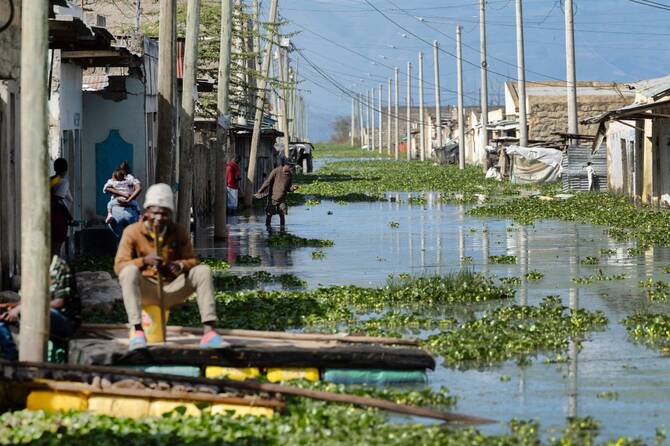
NAIVASHA: The tourist boats that normally ply Kenya’s famed Lake Naivasha have had a different task in recent weeks: evacuating hundreds of flooded homes.
Although the lake’s level has been rising for more than a decade and has repeatedly breached its banks, locals in the modest district of Kihoto are still astonished by the scale this year.
“It hasn’t happened like this before,” said one resident, Rose Alero.
The Rift Valley lake has traveled up to 1.5 kilometers inland, say local officials, an unprecedented distance.
“People are suffering,” said Alero, a 51-year-old grandmother, adding that many neighbors were sick.
In her home, the water is waist-deep, and toilets are overflowing throughout the district.
“People are stuck... they have nowhere to go.”
Others have lost everything. Hundreds of homes are completely submerged, churches in ruins, and police stations underwater, surrounded by floating vegetation.
During a sudden rush of water, children were forced to leave school on makeshift rafts.
Joyce Cheche, head of disaster risk management for Nakuru County, estimates that 7,000 people have been displaced by the rising waters, which have also impacted wildlife and threaten tourism and other businesses.
The county has assisted with the transportation of victims and implemented health measures, she said, but there has been no financial compensation for now.
Workers in the flower sector — a major exporter — are refusing to show up for fear of cholera and landslides.
She also mentioned the risk of dangerous encounters with hippos, who are numerous in the lake.
“We didn’t see it coming,” said Cheche.
On the lake’s edge, the bare trunks of once-verdant acacia trees lie submerged in water that continues to spread at around a meter per day.
This phenomenon is observed in other lakes in the Rift Valley and has displaced hundreds of thousands of people.
Numerous studies attribute it primarily to increased rainfall caused by climate change.
But Kenyan geologist John Lagat, regional manager at the state-owned Geothermal Development Corporation, says the main cause is tectonics as the lakes lie along a long geological fault.
When English settlers arrived at the end of the 19th century, the lake was even larger than it is today before shifting plates reduced its size to just one kilometer in diameter by 1921.
Further tectonic shifts meant underground outflows were increasingly sealed, trapping the water, he said, though he added that increased rainfall and land degradation caused by population growth were playing a “substantial” role in flooding, too.
“We are very worried,” said Alero in her flooded home, fearing the next rainy season.
“We can’t tell what will happen.”


Thousands of Kenyans displaced by Lake Naivasha flooding
https://arab.news/88znm
Thousands of Kenyans displaced by Lake Naivasha flooding

- Hundreds of homes are completely submerged, churches in ruins, and police stations underwater, surrounded by floating vegetation


US Justice Department official eyes cases against Cuba leaders as Trump floats ‘friendly takeover’
- “Working group” formed to build cases against people connected to the Cuban government
- Trump’s has increasingly displayed aggressive stance against Cuba’s communist leadership
MIAMI: The top Justice Department prosecutor in Miami is considering criminal investigations of Cuban government officials, according to people familiar with the matter. The inquiry comes as President Donald Trump has raised the possibility of a “friendly takeover” of the communist-run island.
Jason Reding Quiñones, the US attorney for the Southern District of Florida, has created a “working group” that includes federal prosecutors and officials from the Drug Enforcement Administration and other agencies to try to build cases against people connected to the Cuban government and its Communist Party, according to one of the people. They spoke on the condition of anonymity because they were not authorized to publicly discuss the effort.
It was not immediately clear which Cuban officials the office is targeting or what criminal charges prosecutors may be looking to bring.
The Justice Department said in a statement Friday that “federal prosecutors from across the country work every day to pursue justice, which includes efforts to combat transnational crime.”
The effort is taking place against the backdrop of Trump’s increasingly aggressive stance against Cuba’s communist leadership.
Emboldened by the US capture of Cuba’s close ally, Venezuelan President Nicolás Maduro, Trump last month said his administration was in high-level talks with officials in Havana to pursue “a friendly takeover” of the country. He repeated those claims this week, saying his attention would turn back to Cuba once the war with Iran winds down.
“They want to make a deal so bad,” Trump said of Cuba’s leadership.
While Cuba has faded from Washington’s radar as a major national security threat in recent decades, it remains a priority in the US Attorney’s office in Miami, whose political, economic and cultural life is dominated by Cuban-American exiles.
The FBI field office has a dedicated Cuba group that in 2024 was instrumental in the arrest of former US Ambassador Victor Manuel Rocha on charges of serving as a secret agent of Cuba stretching back to the 1970s.
In recent weeks, several Miami Republicans, in addition to Florida Sen. Rick Scott, have called on the Trump administration to reopen its criminal investigation into the 1996 shootdown of four planes operated by anti-communist exiles.
In a letter to Trump on Feb. 13, lawmakers including Reps. Maria Elvira Salazar and Carlos Gimenez highlighted decades-old news reports indicating that former President Raúl Castro — the head of Cuba’s military at the time — gave the order to shoot down the unarmed Cessna aircraft.
“We believe unequivocally that Raúl Castro is responsible for this heinous crime,” lawmakers wrote. “It is time for him to be brought to justice.”
While no indictment against Castro has been announced, Florida’s attorney general said this week that he would open a state-level investigation into the crime.
The Trump administration has also accused Cuba of not cooperating with American counterterrorism efforts, adding it alongside North Korea and Iran to a select few nations the US considers state sponsors of terrorism.
The designation stems from Cuba’s harboring of US fugitives and its refusal to extradite several Colombian rebel leaders while they were engaged in peace talks with the South American nation.


