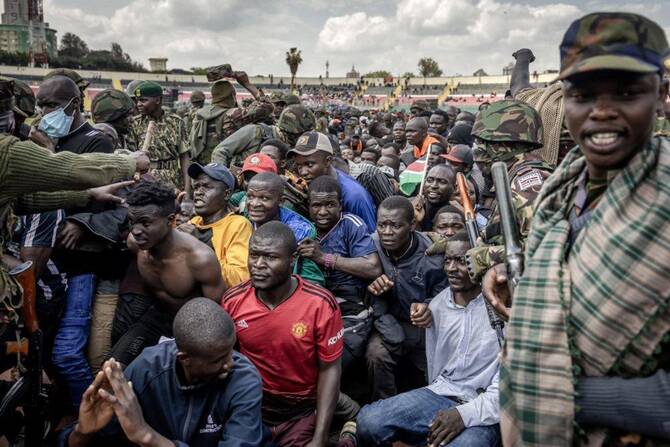
NAIROBI: Kenya said on Wednesday over 200 of its citizens are fighting for Russia in Moscow’s war in Ukraine, and that recruiting agencies are still actively working to lure more Kenyans into the conflict.
Ukraine last week said that more than 1,400 citizens from three dozen African countries are fighting alongside Russian forces in Ukraine with some recruited through deception.
Russia was enticing Africans to sign contracts that Ukraine’s foreign minister, Andriy Sybiha described as “equivalent to ... a death sentence,” and urged African governments to caution their citizens.
“Recruitment exercises in Russia have reportedly expanded to include African nationals, including Kenyans,” Kenya’s ministry of foreign affairs said in a statement.
“Over two hundred Kenyans may have joined the Russian military... recruitment networks are still active in both Kenya and Russia,” the statement said.
Moscow’s embassy in Nairobi did not immediately respond to a request for comment.
According to the ministry, Kenya’s embassy in Moscow has recorded injuries among some of the recruits, who were allegedly promised up to $18,000 to cover costs for visas, travel, and accommodation.
A security raid carried out near Nairobi in September rescued 21 Kenyans who, the ministry said, were being prepared for deployment to the war. One person was arrested and is facing prosecution in connection with the incident.
The ministry said that those rescued had been misled about the nature of their work, believing they were recruited for non-combat roles such as assembling drones, handling chemicals and painting.

Kenya says over 200 of its nationals are fighting for Russia in Ukraine war
Short Url
https://arab.news/mg3rv
Kenya says over 200 of its nationals are fighting for Russia in Ukraine war
- Ukraine last week said that more than 1,400 citizens from three dozen African countries are fighting alongside Russian forces in Ukraine
- Russia was enticing Africans to sign contracts that Ukraine’s foreign minister, Andriy Sybiha, described as ‘equivalent to ... a death sentence’
Robotics build path from rural Kenya to world stage
LAIKIPIA: Jeremiah Kithinji had never touched a computer before he finished high school. A decade later, he is teaching robotics, and even took a team of rural Kenyans to the World Robotics Olympiad in Singapore.
In a classroom in Laikipia county — a sparsely populated grasslands region of northern Kenya known for its rhinos and cheetahs — pupils are busy snapping together wheels, motors and sensors to assemble a robot.
Guiding them is Kithinji, 27, who runs a string of robotics clubs in the area that have taken some of his pupils far beyond the rural landscapes outside.
In November, he took a team of three to Singapore for the Olympiad, where he also served as the competition’s first Kenyan judge. They presented a simulated space mission with a robot that could launch a model satellite and collect space debris.
Singapore was an eye-opening experience for Kithinji, who was educated in a modest rural school without access to computers.
“I felt this country is so advanced. Interacting with the people showed me how much they care about their nation, and it made me think about how I can instil the same mindset in my students,” he told AFP.
Kenya has pushed science and engineering in its latest curriculum, but lacks the resources for robotics training.
The clubs in Laikipia, which reach around 200 pupils, are funded by a US nonprofit, Science in a Suitcase, which helped train Kithinji and funded the trip to Singapore.
They have inspired Natalia Wangari, 14.
“In the future, when I become a neurosurgeon, I won’t have to perform every surgery myself. I can build a robot that acts as a doctor. I’ll just need to code it, and it will do the surgery itself,” she told AFP.
- Robots adapted to Kenya -
Kithinji hopes robotics can provide solutions to some of Kenya’s specific challenges.
He previously coached a team at the African Olympiad in South Africa in 2024, where they designed agricultural robots that can operate farming tools and irrigate fields, and sees particular benefits for rural hospitals — assisting in surgeries and delivering medication.
He dreams of more support and collaborators to expand his robotics program across the country.
For now, his pupils are focused on winning a place at the next Olympiad, in Puerto Rico, and they are brainstorming ideas for this year’s theme: robots meet culture.
But whatever happens, he is happy they are taking control of modern technology.
“The skills these kids are developing — critical thinking, problem-solving and technical skills... are the future skills our country needs,” he said.
“I want our kids to create the technology, not just consume it.”
In a classroom in Laikipia county — a sparsely populated grasslands region of northern Kenya known for its rhinos and cheetahs — pupils are busy snapping together wheels, motors and sensors to assemble a robot.
Guiding them is Kithinji, 27, who runs a string of robotics clubs in the area that have taken some of his pupils far beyond the rural landscapes outside.
In November, he took a team of three to Singapore for the Olympiad, where he also served as the competition’s first Kenyan judge. They presented a simulated space mission with a robot that could launch a model satellite and collect space debris.
Singapore was an eye-opening experience for Kithinji, who was educated in a modest rural school without access to computers.
“I felt this country is so advanced. Interacting with the people showed me how much they care about their nation, and it made me think about how I can instil the same mindset in my students,” he told AFP.
Kenya has pushed science and engineering in its latest curriculum, but lacks the resources for robotics training.
The clubs in Laikipia, which reach around 200 pupils, are funded by a US nonprofit, Science in a Suitcase, which helped train Kithinji and funded the trip to Singapore.
They have inspired Natalia Wangari, 14.
“In the future, when I become a neurosurgeon, I won’t have to perform every surgery myself. I can build a robot that acts as a doctor. I’ll just need to code it, and it will do the surgery itself,” she told AFP.
- Robots adapted to Kenya -
Kithinji hopes robotics can provide solutions to some of Kenya’s specific challenges.
He previously coached a team at the African Olympiad in South Africa in 2024, where they designed agricultural robots that can operate farming tools and irrigate fields, and sees particular benefits for rural hospitals — assisting in surgeries and delivering medication.
He dreams of more support and collaborators to expand his robotics program across the country.
For now, his pupils are focused on winning a place at the next Olympiad, in Puerto Rico, and they are brainstorming ideas for this year’s theme: robots meet culture.
But whatever happens, he is happy they are taking control of modern technology.
“The skills these kids are developing — critical thinking, problem-solving and technical skills... are the future skills our country needs,” he said.
“I want our kids to create the technology, not just consume it.”
© 2026 SAUDI RESEARCH & PUBLISHING COMPANY, All Rights Reserved And subject to Terms of Use Agreement.


