

Eastern Province signs $1.35bn investment deals at Cityscape Global 2025 

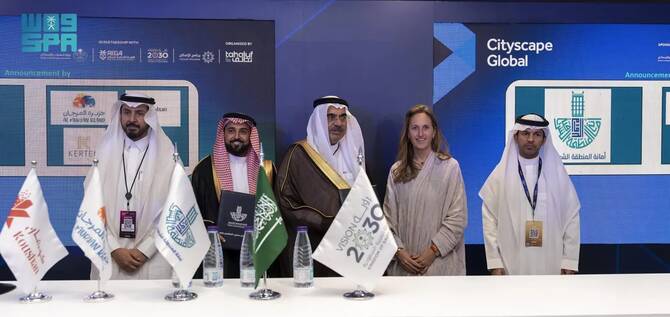
The signing ceremony, overseen by Eastern Province Mayor Fahad bin Mohammed Al-Jubair, featured several strategic investment agreements for high-profile projects. SPA
Short Url
Updated 18 November 2025
Follow

Eastern Province signs $1.35bn investment deals at Cityscape Global 2025 

DAMMAM: Saudi Arabia’s Eastern Province Municipality signed 14 investment and development deals, including memoranda of understanding worth over SR5 billion ($1.35 billion), during its participation in Cityscape Global 2025 in Riyadh. 

The signing ceremony, overseen by Eastern Province Mayor Fahad bin Mohammed Al-Jubair, featured several strategic investment agreements for high-profile projects, according to the Saudi Press Agency. 

The deals reflect the municipality’s efforts to attract local, Gulf, and international investors, underscoring the Eastern Province’s growing appeal as a destination for private-sector-led development, enhanced quality of life, economic growth, and job creation for Saudi citizens. 

The agreements included contracts to establish and develop mobile vendor incubator sites under the “Roaming Seller” initiative, in partnership with Princess Nojoud bint Hathloul Al Abdulaziz, general supervisor of the Street Vendors Support, Empowerment, and Development file at the Ministry of Municipalities and Housing, and the Economic Families Association. 

An investment contract was also signed with Center3, a subsidiary of Saudi Telecom Co., to establish digital data centers supporting digital transformation and technological infrastructure for smart cities. 

The deals further include investments in entertainment, tourism, and retail projects in Half Moon Bay with local, Gulf, and European investors. These involve amusement parks in partnership with a Kuwaiti investor and the launch of the first outlet shopping complex in the Eastern Province. 

A soon-to-be-announced flagship project in Half Moon Bay will bring together Saudi, Gulf, and British partners to develop a global outlet featuring more than 100 international brands, amusement parks, children’s play areas, a themed “Last Exit” food park, art and fashion academies, multi-use facilities, and a mini-golf course. 

The project is expected to significantly boost the region’s tourism and entertainment sectors. 

Additional agreements include developing coastal resorts and open beaches to meet Blue Flag environmental standards, alongside air pollution monitoring stations and carbon credit initiatives to support sustainability. 
 
Tourism resorts in Al-Khafji Governorate were also agreed upon with Gulf investors. MoUs were signed with GCC Lab Co. for Technical Services to study inspection and certification mechanisms and with the Saudi Technology and Security Comprehensive Control Co. to digitally manage construction waste, contributing to improved quality of life and regional economic growth. 

An agreement between a local recycling company and GIB Capital was signed to finance the company’s environmental projects with the municipality, focusing on renewable energy production. 

Another investment deal was finalized for the management and operation of Marjan Island Resort on Dammam Corniche, supporting tourism, entertainment, and luxury hospitality. 


Saudi ports brace for cargo surge as shipping lines reroute

Updated 09 March 2026
Follow

Saudi ports brace for cargo surge as shipping lines reroute

RIYADH: Preliminary estimates suggest that several global shipping lines could reroute part of their operations to Saudi Arabia’s Red Sea ports, potentially adding 250,000 containers and 70,000 vehicles per month, according to Rayan Qutub, head of the Logistics Council at the Jeddah Chamber of Commerce, in an interview with Al-Eqtisadiah.

“Any disruption in the Strait of Hormuz not only affects maritime traffic in the Arabian Gulf but could also reshape global trade routes,” Qutub said, highlighting the strait’s status as one of the world’s most critical maritime chokepoints for energy and goods transport.

With rising regional tensions, international shipping companies are reassessing their routes, adjusting shipping lines, or exploring alternative sea lanes. This signals that the current challenges extend beyond the Arabian Gulf, impacting the global supply chain as a whole.

Limited impact on US, European shipments

The effects of these developments will not be uniform across trade routes. Qutub noted that goods from China and India, which rely heavily on routes through the Arabian Gulf, are most vulnerable to disruption. In contrast, shipments from Europe and the US typically traverse western maritime routes via the Suez Canal and the Red Sea, making them less susceptible to regional disturbances.

Saudi Arabia’s strategic location, he emphasized, strengthens the resilience of regional trade. The Kingdom operates an integrated network of Red Sea ports — including Jeddah, Rabigh, Yanbu, and Neom — that have benefited from substantial infrastructure upgrades and technological enhancements in recent years, boosting their capacity to absorb increased cargo volumes.

Red Sea bookings

Several major carriers, including MSC, CMA CGM, and Maersk, have already opened bookings to Saudi Red Sea ports, signaling a shift in operational focus to these strategically positioned hubs.

However, Qutub warned that rerouted shipments could increase sailing times. Cargo from Asia, which normally takes 30-45 days, might now require longer voyages via the Cape of Good Hope and the Mediterranean, potentially extending transit to 60-75 days in some cases.

These changes are also reflected in rising shipping costs, driven by longer routes, higher fuel consumption, and increased insurance premiums — a typical response when global trade patterns shift due to geopolitical pressures.

Qutub emphasized that Saudi Arabia’s transport and logistics sector is managing these developments through coordinated government oversight. The Ministry of Transport and Logistics, the Logistics National Committee, and the Logistics Partnership Council recently convened to evaluate the impact on trade and supply chains. Regular weekly meetings have been established to monitor developments and implement solutions to safeguard the stability of supplies and continuity of trade.

He noted that the Kingdom’s logistical readiness is the result of long-term strategic investments, encompassing ports, airports, road networks, rail systems, and logistics zones. Today, Saudi logistics integrates maritime, land, rail, and air transport, enabling a resilient response to global disruptions.

Qutub also highlighted the need for the private sector to continuously review logistics and crisis management strategies, develop alternative plans, and manage strategic stockpiles. Such measures are essential to mitigate temporary fluctuations in global trade and ensure smooth supply chain operations.