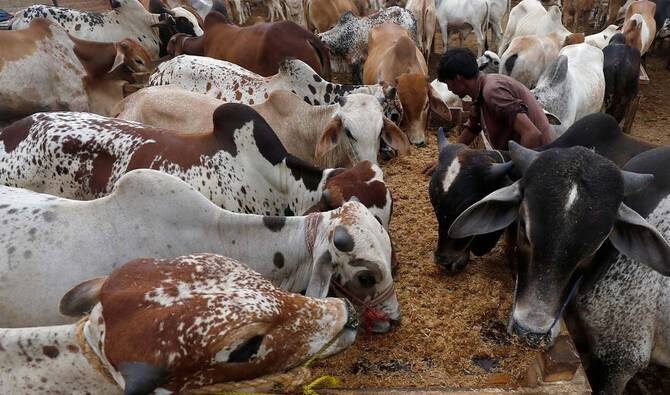

KARACHI: Pakistan is expected to generate a record 7.5 million hides worth nearly Rs8.7 billion [$31 million] this year after the recent Eid Al-Adha festival, according to data by the Pakistan Tanners Association (PTA), marking a recovery in prices over the years despite the leather sector struggling with spoilage, rising costs and a weaker global demand.
Cow hides are a valuable commodity in Pakistan, with millions each year processed in tanneries to make leather for shoes, belts, wallets, bags, jackets, and other finished goods. According to the PTA’s data, the total number of animals that were sacrificed for this year’s Eid Al-Adha are projected to surge to a record 7.47 million this fiscal year, up nearly 17 percent from a decade ago.
However, while Pakistanis are sacrificing more animals during Eid, data shows that total leather export revenues have plunged by more than 17 percent to $828 million over the same period. Raiyan Mohammad, secretary of the PTA’s south zone, raw material prices have clawed back some ground compared to last year. Average cow hides prices rose to Rs2,000 ($7.18) from Rs1,200 ($4.30) last year, while goat skins increased to Rs600 ($2.15) from Rs325 ($1.17). The rise, however, is not that impressive. As per PTA’s data, premium cow hides usually fetched between Rs3,000 and Rs4,500 during the 2015-2017 era.
Industry officials attribute the long-term decline to a combination of macroeconomic headwinds and local structural failures. A global economic slowdown, driven by geopolitical instability, has dampened international demand. However, Mohammad says Eid Al-Adha falling in the peak summer months has also had a devastating impact on the leather sector, as it leads to hides being spoiled in the intense heat.
“Ten or 15 years ago, Eid used to fall during the cooler winter months,” Mohammad told Arab News. “Now, the lunar cycle has shifted the festival into the absolute peak of summer. It will likely stay in this summer window for the next six to eight years.”
Pakistan lacks an organized, centralized slaughtering infrastructure. Due to this, millions of sacrifices take place every Eid at homes or in the country’s streets rather than modern abattoirs. Most fresh hides without immediate; proper salting ultimately get spoiled. Tanners, anticipating degraded quality, deliberately bid lower.
This year, Pakistan is expected to generate up to 2.8 million hides of cows and bulls, 4.3 million goat skins, 500,000 sheepskins and around 30,000 camel hides.
According to Mohammad, the importance of organized slaughterhouses cannot be understated.
“If we established an organized slaughtering infrastructure like the Saudi Arabia, or Turkiye, a huge portion of this resource would be saved from rotting,” he explained, noting that it would also slash the industry’s reliance on imported raw hides.
Mohammad pointed out another factor that has made matters worse for the leather industry: a generational shift from leather toward synthetic materials in footwear, garments and industrial gloves.
Despite the lower leather export figures, data from the last nine fiscal years shows a structural shift away from raw material supply toward high-margin, value-added manufacturing. While tanned leather exports plummeted nearly 60 percent from $352.12 million in FY16 to $143.60 million in FY24, finished leather products and footwear rose to $694.20 million.
The data shows that tanneries are sending raw materials to local manufacturers and producers rather than exporting the items.
ECONOMICS OF HIDE COLLECTION
The economics of hide collection have transformed drastically over the years. In the past, when market values peaked, the hide collection process was highly competitive, occasionally sparking violent turf wars between rival political groups and religious charities fighting in Karachi.
Today, that intense competition has vanished. Charities, traditionally the largest collectors of Eid hides, note that while they continue the practice of collecting animal hides, the economic returns have reduced.
The Al-Khidmat Foundation, one of Pakistan’s largest charitable organizations, reported collecting over 352,000 hides nationwide, including 131,000 in Karachi alone. This marks a steady rise from last year’s haul of 341,000 hides nationwide and 127,000 in Karachi.
However, hides are no longer a primary source of funding for these organizations.
“It has become a tradition that keeps our volunteers engaged,” the charity’s spokesperson Shoaib Hashmi told Arab News, noting that strict government regulations have also barred smaller organizations from collecting skins.
“But if large organizations don’t collect them, the summer heat will simply cause many of these skins to go to waste.”