

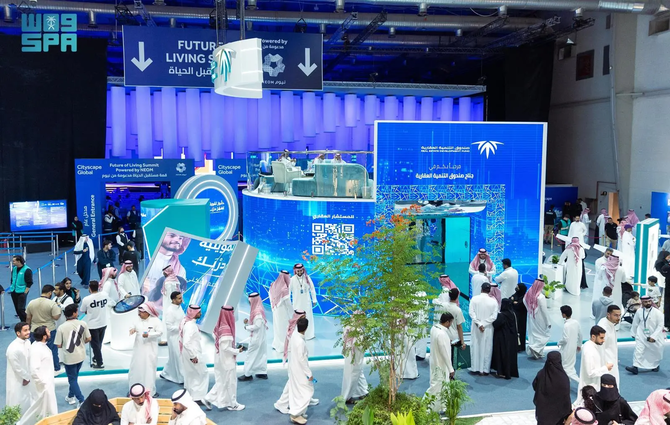

RIYADH: Saudi Arabia’s National Housing Co. secured 21 new agreements and partnerships with various local and international companies on the second day of Cityscape, expanding its investment momentum.
This brings the value of the total deals signed by the firm on the first and second day of the event to over SR5 billion (1.33 billion), according to a statement.
The deals aim to enhance the quality of infrastructure and services provided within its urban destinations and include the fields of supply, logistics, and interior design, the Saudi Press Agency reported.
The agreements contribute to achieving NHC’s aspirations to build integrated and sustainable destinations that meet global ambitions.
The Kingdom’s real estate is vital to the country’s economy, contributing around 7 percent of gross domestic product and supporting numerous additional sectors.
Among the most prominent of these agreements that support the solutions division, NHC signed a strategic partnership with “Solutions by stc” to develop technical services for the “Sakani” and “Balady” platforms.
It also signed a deal with Sakani Foundation to inspect buildings, with local real estate developer Ardara to assess sustainability, with LX and K-water companies to transfer knowledge, and with 2GIS to provide technical services.
The firm inked a pact with the Public Investment Fund’s ROSHN real estate company to benefit from Sakani services and assess sustainability.
NHC also signed an agreement with Takamol in the professional accreditation program to achieve an integrated residential environment that meets the needs of individuals and society.
The deal comes within the framework of the two companies’ strategy to improve the quality of the residential landscape and enhance constructive cooperation between organizations in the housing sector. This aligns with national efforts to promote sustainable development and deliver suitable housing.
The company also agreed to cooperate with the General Authority for Roads in implementing new routes and their mechanisms in NHC destinations to enhance sustainability.
NHC also saw a cooperation with Al-Fahhad Co. to develop the cleaning and maintenance system for its destinations.
Additionally, NHC signed a group of investment agreements to implement residential projects and build community centers in its urban destinations with Dar Wa Emaar, Ajdan Real Estate Development, Maya Real Estate Development and Investment, Rashed Abdul Rahman Al-Rashed & Sons Group, and Mohammed Al-Habib Real Estate Co.
In the supply chain sector, the company signed agreements with local and international companies, including Bahra Electric Co., to provide cables and wires, and Al-Nasser Group to deliver lighting products that are characterized by efficiency and high quality, which enhances energy consumption efficiency.
The agreements also included partnerships with leading global companies in the manufacture of electrical appliances, including Legrand, Panasonic, and Siemens to ensure the provision of high-quality equipment according to the highest technical standards.
To enhance the efficiency of privacy and security in NHC destinations, the company signed an agreement with Al-Kuhaimi Metal Industries Ltd. to supply metal doors. The step improves the reliability of the destinations and meets the safety and security requirements of residents.
The partnerships also included an agreement with Al-Hayat Building Materials Co. to supply sanitary ware to improve the quality of interior finishes and provide a distinctive living experience.
The housing organization also signed a memorandum of understanding with Mask to invest in developing areas and logistics services, which contributes to improving the efficiency of construction and supply operations and enhancing the flexibility of the supply chain.
Another MoU was also concluded with Madar to provide innovative interior designs that meet the tastes of residents and reflect a distinctive architectural identity that adds a unique character to NHC destinations.
During the gathering, which kicked off on Nov. 11 in Riyadh and runs until Nov. 14, the Real Estate Development Fund reported that the housing support program and the various financing solutions and advantages it provides in partnership with financing entities recorded a 190 percent growth in financing contracts provided to Sakani beneficiaries.
In comparison, the total value of real estate financing recorded an increase of 225 percent compared to the same period last month, during the first and second days of the exhibition.
Sakani is a program that facilitates the process of owning a home, offers affordable housing options and helps with financing.
The housing support programs provide a competitive opportunity on the sidelines of Cityscape to enable beneficiaries to sign financing contracts with solutions and advantages, including the lowest profit margin of up to 2.59 percent, in addition to housing support packages that provide immediate non-refundable support of up to SR150,000.
The results achieved on the first two days of Cityscape in empowering housing support beneficiaries embody the effectiveness of strategic partnerships with financing entities and property development companies.
The results also reflect the pioneering role of REDF in partnership with financing entities and the movement witnessed by the real estate funding and development sector, which resulted in the diversity of housing products and monetary solutions that achieve the aspirations of support beneficiaries.
REDF signed four MoUs at the event to strengthen partnerships in real-estate financing and investment.
The MOUs, inked with Jadwa Investment, Value Capital, ANB Capital, and the Knowledge Economic City, aim to support the fund’s strategic goals of helping beneficiaries acquire suitable housing.
REDF’s Chief Executive Mansour bin Madi said the partnerships will explore opportunities and create investment funds to stimulate real-estate investment and finance housing projects.
He highlighted REDF’s commitment to working with financial institutions to enable the development of high-quality, affordable housing.
Also happening on the sidelines of the exhibition, Kuwait’s Minister of Municipality and Housing Abdullatif Al-Mishari discussed with Saudi Arabia’s Minister of Municipal and Rural Affairs and Housing Majid Al-Hojail cooperation in the real estate sector.
The meeting touched on housing experiences and the ministry’s programs, such as housing support, guarantees, and property development, in addition to exchanging visions on expanding construction and supporting real estate developers, said the Saudi minister in a post on X.
He also said they agreed to form a joint working team between the two countries to transfer experiences in several tracks that serve the real estate sector and enhance the integration of efforts to achieve sustainable development in this field.
Also taking place at the event, the Real Estate Registry concluded seven memoranda of cooperation and agreements as part of its efforts to strengthen the relationship and communication with the public and private sectors, establish strategic partnerships with actors in the housing system, and enable technology companies to access property registry data.
The first pact was with the REDF to enhance cooperation and partnership between the fund and the Real Estate Registry to facilitate the journey of the former’s beneficiaries from the latter’s services.
It also signed a memorandum of cooperation with the Hail Region Development Authority to support and accelerate the real estate registration process, and three memoranda of cooperation with Talaat Moustafa Group-Saudi, Al-Majdiah Residence, and Sijil to facilitate the property registration process and improve the beneficiaries’ journey and direct linking with the registry services.
At the level of real estate technology companies, the entity further signed agreements with two property platforms, Nuzul and ReInvest, to enable them to link with registry services, access data, and benefit from it in developing innovative products and services that enrich the sector.
Cityscape Global 2024 is a testament to Saudi Arabia’s rapid development and commitment to excellence. As the Kingdom positions itself as a global leader in real estate, the global forum will drive the sector to new heights, aligned with the country’s Vision 2030 and its pursuit of creating thriving, sustainable communities.


