

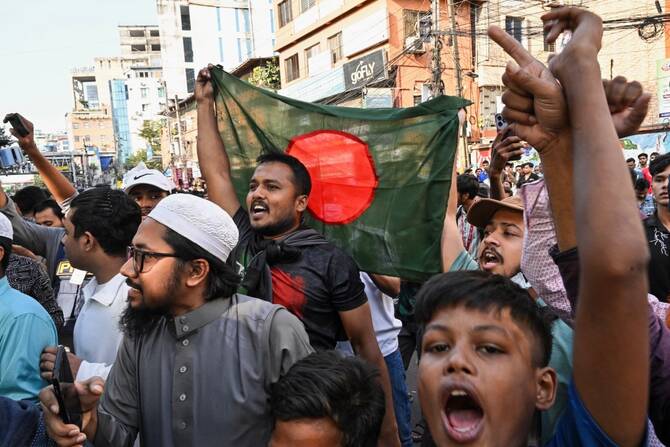

DHAKA: A special tribunal in Dhaka on Monday sentenced former Prime Minister Sheikh Hasina to death after a months-long trial over a deadly crackdown on student-led protests that deposed her last year.
Initially peaceful demonstrations began in early July 2024, triggered by the reinstatement of a quota system for the allocation of civil service positions. Two weeks later, they were met with a communications blackout and a violent crackdown by security forces.
In early August, as protesters defied a nationwide curfew, Hasina resigned and fled to India, ending 15 years in power of her Awami League party-led government.
The UN’s human rights office estimated that at least 1,400 people were killed during the protests, with the majority shot dead from military rifles.
Bangladesh’s domestic International Crimes Tribunal opened the fugitive leader’s trial in June, charging her and several of her closest aides with crimes against humanity.
As it announced Hasina’s death sentence on Monday, the court said the deadly attacks during the student-led protests were “directed against the civilian population” and were widespread and systematic.
“Sheikh Hasina ordered law enforcement agencies to use drones to locate congregating protesters and helicopters and lethal weapons to kill them,” the court said, finding her guilty on three counts: incitement, order to kill, and inaction to prevent the atrocities.
“We have decided to inflict her with only one sentence that is the sentence of death,” Judge Golam Mortuza Mozumder said, reading the verdict.
Ex-Home Minister Asaduzzaman Khan, who like Hasina is self-exiled in India, also got the death sentence for crimes against humanity. Ex-police chief Al-Mamun, who turned himself in and became a state witness, was sentenced to five years.
“With this verdict, the July revolution martyrs got justice. Two of the accused in this case have been awarded with the highest punishment: the death sentence,” Attorney General Mohammad Asaduzzaman told reporters in Dhaka.
“It’s a milestone verdict that will bring peace. It’s a message for our future. According to the law, the sentence will start functioning on the day of her arrest.
“The state will do everything under the purview of law to bring the accused back in the country ... There is no opportunity to file an appeal while in absentia, not only in Bangladesh — anywhere in the world.”
The accused have 30 days to appeal to the Supreme Court, but this cannot be done from abroad. They have to first return to Bangladesh and surrender to the ICT.
If they do not, the Bangladeshi government is going to seek Hasina’s and Khan’s extradition.
“Without surrendering, they don’t possess the right of appeal,” ICT Chief Prosecutor Tajul Islam said in a conference after the court reading.
“According to the extradition treaty 2013 signed with India, Bangladesh will request the repatriation of those accused of crimes against humanity in the country.
“The second process is through Interpol. Since the accused have been convicted and sentenced to death by a competent Bangladeshi court, the country can seek assistance from Interpol in this matter.”


