

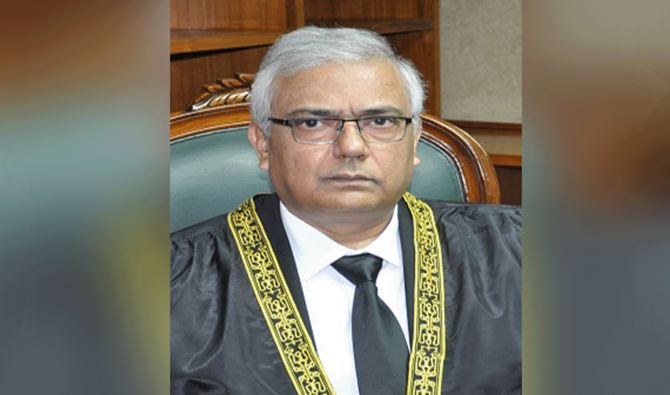
Justice Amin-Ud-Din Khan appointed Pakistan’s first Constitutional Court chief justice

An undated image of newly appointed Chief Justice Constitutional Court of Pakistan, Justice Amin ud Din Khan uploaded on the website of Supreme Court of Pakistan. (Website)
Short Url
Updated 13 November 2025
Follow

Justice Amin-Ud-Din Khan appointed Pakistan’s first Constitutional Court chief justice

  • Federal Constitutional Court will now decide cases involving Pakistan’s constitution, instead of the Supreme Court
  • A top court judge since 2019, Justice Khan has decided thousands of civil cases relating to inheritance, property

ISLAMABAD: President Asif Ali Zardari appointed top court judge Justice Amin-Ud-Din Khan as the first chief justice of the Federal Constitutional Court (FCC) on Thursday, a notification from the law ministry said. 

The FCC was formed after the government made sweeping changes to the military and judicial command structure via the 27th constitutional amendment. The new amendment shifts constitutional cases from the Supreme Court to the FCC while it grants expanded powers to Pakistan’s army chief. 

 “The President of the Islamic Republic of Pakistan is pleased to appoint Mr. Justice Amin-Ud-Din Khan as Chief Justice of the Federal Constitutional Court of Pakistan with effect from the date he makes oath of his office,” a notification from the law ministry read. 

According to the Supreme Court’s website, Justice Khan was born on Dec. 1, 1960 in the eastern city of Multan where he received his education from Kindergarten Muslim School. He completed his secondary education from the Government Muslim High School in 1977. 

He secured his bachelor’s degree in Philosophy in 1981 and completed his L.L.B degree from the University Law College in Multan in 1984 and also secured a diploma in Taxation Law.

Justice Khan obtained the license to practice in Pakistan’s lower courts in 1985 before enrolling as an advocate of the Lahore High Court in 1987. He was later enrolled as an advocate of the Supreme Court of Pakistan in 2001.

He was involved there in mostly civil cases relating to property, preemption and matters of inheritance. 

Justice Khan was elevated to the bench in 2011 and during his stint as judge, he decided thousands of civil cases the Bahawalpur Bench and Multan Bench of the Lahore High Court. 

He was elevated as a judge of the Supreme Court in 2019. 

His appointment to the post takes place hours after two Supreme Court judges, Justice Athar Minallah and Justice Mansoor Ali Shah, resigned in protest. 

The judges took exception to the 27th constitutional amendment, with Justice Shah describing it as a “grave assault” on the constitution. 

The FCC was set up after years of clashes between the executive and the judiciary. Verdicts issued by the top courts over the years ousted prime ministers from office and put the judiciary on a confrontational path with the governments at the time.


Punjab warns of action against hoarders as Islamabad seals petrol stations denying fuel

Updated 4 sec ago
Follow

Punjab warns of action against hoarders as Islamabad seals petrol stations denying fuel

  • Long queues of vehicles were seen outside fuel stations as Pakistan announced a hike in petroleum prices late Friday
  • The Punjab Enforcement Regulatory Authority says fuel stations involved in hoarding will have their licenses revoked

ISLAMABAD: Pakistan’s Punjab province on Saturday warned of action against the ones hoarding petroleum products, while authorities in federal capital of Islamabad sealed seven petrol stations for denying fuel to motorists, amid global supply constraints due to the Middle East tensions.

Global oil markets have been rattled since coordinated strikes by the United States and Israel against Iran began last week, triggering retaliatory attacks across the region, raising fears of disruption of key energy shipping routes and pushing petroleum prices upward.

Pakistan announced a hike of Rs55 ($0.20) per liter in petrol and diesel prices late Friday, with Petroleum Minister Ali Pervaiz Malik and others saying they were monitoring international energy markets and domestic supply conditions to bring down the prices as soon as the conflict is resolved.

In a statement issued from her office, Punjab Chief Minister Maryam Nawaz assured the masses that the province had ample stock of petroleum products and the Punjab Enforcement Regulatory Authority (PERA) had been tasked with ensuring supply in the region.

“A grand operation has been launched against hoarders and profiteers of petroleum products,” the statement said, adding that fuel stations found creating artificial shortages would be immediately sealed and their licenses revoked.

Separately, officials in Islamabad sealed seven petrol stations after long queues of vehicles were seen at some stations on Friday night, according to the Islamabad district administration. It said the city had over 2.5 million liters of petrol and more than 1.5 million liters of diesel available.

“[Fuel stations in] seven cases of refusal to provide petrol to citizens were sealed,” the district administration added.

Pakistan has sent vessels to ports in Saudi Arabia and the United Arab Emirates to secure crude oil supplies, the petroleum minister said late Friday.

“With the help of the Foreign Office, two Pakistan National Shipping Corporation (PNSC) vessels are currently on their way, one toward Yanbu port and the other toward Fujairah port, to bring crude oil from outside the Hormuz region in order to meet Pakistan’s energy needs,” Malik said on Friday night.

In addition, he said, Saudi Arabia’s Aramco had also assured that if Pakistan arranged, a Very Large Crude Carrier (VLCC) can be loaded at Yanbu and stationed near the Pakistani waters.