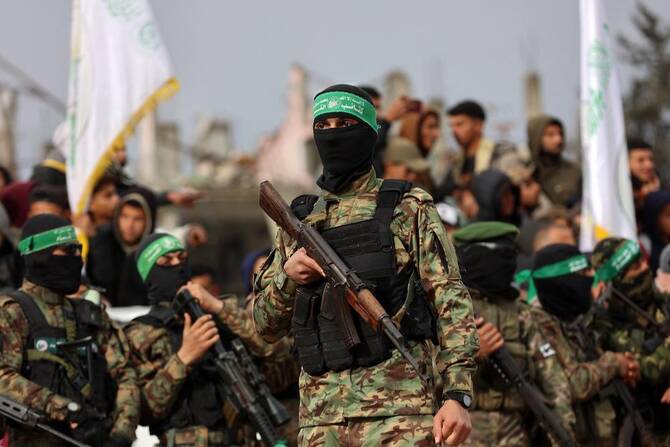
GAZA: Hamas fighters holed up in the Israeli-held Rafah area of Gaza will not surrender to Israel, the group’s armed wing said on Sunday, urging mediators to find a solution to a crisis that threatens the month-old ceasefire. Sources close to mediation efforts told Reuters on Thursday that fighters could surrender their arms in exchange for passage to other areas of the enclave under a proposal aimed at resolving the stalemate.
Egyptian mediators have proposed that, in exchange for safe passage, fighters still in Rafah surrender their arms to Egypt and give details of tunnels there so they can be destroyed, said one of the sources, an Egyptian security official.
Sunday’s statement from Al-Qassam Brigades held Israel responsible for engaging the fighters, who it said were defending themselves.
“The enemy must know that the concept of surrender and handing oneself over does not exist in the dictionary of the Al-Qassam Brigades,” the group said.
US special envoy Steve Witkoff said on Thursday that the proposed deal for about 200 fighters would be a test for a broader process to disarm Hamas forces across Gaza.
Al-Qassam Brigades did not comment directly on the continuing talks over the fighters in Rafah but implied that the crisis could affect the ceasefire.
“We place the mediators before their responsibilities, and they must find a solution to ensure the continuation of the ceasefire and prevent the enemy from using flimsy pretexts to violate it and exploit the situation to target innocent civilians in Gaza,” the group said.
Since the US-brokered ceasefire took effect in Gaza on October 10, the Rafah area has been the scene of at least two attacks on Israeli forces, which Israel has blamed on Hamas. The militant group has denied responsibility.
Rafah has been the scene of the worst violence since the ceasefire took hold, with three Israeli soldiers killed, prompting Israeli retaliation that killed dozens of Palestinians.
Separately, Al-Qassam Brigades said it will hand over the body of deceased Israeli soldier Hadar Goldin in Gaza on Sunday at 2 p.m. (1200 GMT).
Since the ceasefire, Hamas has handed over the bodies of 23 of 28 deceased hostages. Hamas has said the devastation in Gaza has made locating the bodies difficult. Israel accuses Hamas of stalling.
Israel has released to Gaza the bodies of 300 Palestinians, according to the territory’s health ministry.
Local health authorities said on Sunday that one man was killed in an Israeli airstrike in Bani Suhaila east of Khan Younis, south of the enclave. The Israeli military made no immediate comment.
Hamas-led militants seized 251 hostages in the October 7 attacks and killed another 1,200 people, according to Israeli tallies. Israel’s retaliatory offensive has killed nearly 69,000 Palestinians, health officials in the enclave say.


![]()

Hamas says fighters holed up in Rafah will not surrender
Short Url
https://arab.news/4x9nd
Hamas says fighters holed up in Rafah will not surrender
- Egyptian mediators have proposed that, in exchange for safe passage, fighters still in Rafah surrender their arms to Egypt
- Rafah has been the scene of the worst violence since the ceasefire took hold, with three Israeli soldiers killed


Latest updates


© 2026 SAUDI RESEARCH & PUBLISHING COMPANY, All Rights Reserved And subject to Terms of Use Agreement.