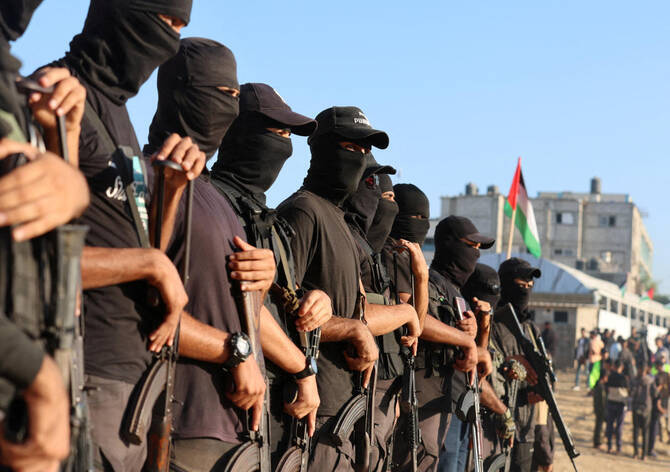
CAIRO: Hamas fighters holed up in the Israeli-held Rafah area of Gaza would surrender their arms in exchange for passage to other areas of the enclave under a proposal to resolve an issue seen as a risk to the month-old truce, according to two sources familiar with the talks.
US special envoy Steve Witkoff said the proposed deal for some 200 fighters would be a test for a broader process to disarm Hamas forces across Gaza.
Since the US-brokered ceasefire took effect in Gaza on October 10, the Rafah area has been the scene of at least two attacks on Israeli forces which Israel has blamed on Hamas; the militant group has denied responsibility.
Egyptian mediators have proposed that, in exchange for safe passage, fighters still in Rafah surrender their arms to Egypt and give details of tunnels there so they can be destroyed, one of the sources, an Egyptian security official, said.
Israel and Hamas have yet to publicly accept mediators’ proposals, the two sources said. A third confirmed that talks on the issue were underway.
The Israeli Prime Minister’s office did not immediately respond to a request for comment on the accounts; Hazem Qassem, a Hamas spokesperson in Gaza, declined to comment.
The attacks in Rafah spiralled into some of the worst violence since the ceasefire took hold, with three Israeli soldiers killed, prompting Israeli retaliation that killed dozens of Palestinians.
Two of the sources said the Hamas fighters in Rafah, which the group’s armed wing has said have been out of contact since March, might be unaware a ceasefire was in place. One of them added that getting the fighters out served the interest of safeguarding the truce.
The sources did not say how many Hamas fighters might be holed up in the Rafah area.
The ceasefire is the first part of US President Donald Trump’s plan to end the Gaza war.
The militant group has released the last 20 living hostages seized in the Hamas-led October 7, 2023, attacks on Israel in exchange for nearly 2,000 Palestinian prisoners; Israeli troops have withdrawn from western areas of Gaza, where Hamas remains in control.
Details of the next phase of Trump’s plan, which requires Hamas to disarm and surrender control of Gaza, have yet to be agreed. The plan foresees Gaza being governed by a technocratic Palestinian committee with international supervision, and the deployment of an international force.
Witkoff, one of the US negotiators on the plan, said work to stand up an international security force would be finished in the next three weeks and that would be the moment for Hamas to decommission its fighters and demilitarize the strip.
“We may see the model of what we’re trying to do (across Gaza)... with these 200 fighters who are trapped in Rafah, and whether they’re going to be able to raise their hands, walk out, turn over their weapons,” Witkoff said at a business conference in Florida. “And so this will be one of the tests.”
Since the ceasefire, Hamas has also handed over the bodies of 22 of 28 deceased hostages. Hamas has said the devastation in Gaza has made locating the bodies difficult. Israel accuses Hamas of stalling.
Israel has released to Gaza the bodies of 285 Palestinians, according to the territory’s health ministry.
Hamas-led militants seized 251 hostages in the October 7 attacks, and killed another 1,200 people, according to Israeli tallies. Israel’s retaliatory offensive has killed nearly 69,000 Palestinians, health officials in the enclave say — 241 of them killed since the ceasefire took hold.


![]()

Mediators propose deal to get Hamas fighters out of Gaza’s Israeli zone, sources say
Short Url
https://arab.news/ybec3
Mediators propose deal to get Hamas fighters out of Gaza’s Israeli zone, sources say
- Witkoff said the proposed deal for some 200 fighters would be a test for a broader process to disarm Hamas forces across Gaza
- Egyptian mediators have proposed that, in exchange for safe passage, fighters still in Rafah surrender their arms to Egypt and give details of tunnels there so they can be destroyed


Latest updates




© 2026 SAUDI RESEARCH & PUBLISHING COMPANY, All Rights Reserved And subject to Terms of Use Agreement.