DAK LAK: Typhoon Kalmaegi brought fierce winds and torrential rains to Vietnam on Friday, killing at least five people and leaving widespread damage across the country’s central provinces, days after the powerful storm battered the Philippines and left scores dead or missing.
As floodwaters receded, recovery work began in battered towns and industrial zones, with local authorities and residents clearing debris and repairing roofs to millions affected across the central Vietnam.
Five people were killed — three in Dak Lak and two in Gia Lai provinces — while three others remained missing in Quang Ngai, according to state media. Six people were injured. Fifty-two houses collapsed and nearly 2,600 others were damaged or had their roofs blown off, including more than 2,400 in Gia Lai alone. Power outages affected more than 1.6 million households.
In the Philippines, where Kalmaegi made landfall earlier this week, President Ferdinand Marcos Jr. declared a state of national emergency on Thursday as the country braced for another potentially powerful storm, Typhoon Fung-wong, known locally as Uwan.
The weather bureau said Fung-wong could expand to an estimated 1,400 kilometers (870 miles) in diameter before making landfall late Sunday or early Monday in northern Aurora province, potentially affecting the densely populated capital region of Manila.
Kalmaegi left at least 188 people dead and 135 missing in the Philippines, according to the Office of Civil Defense, displacing more than half a million people. Nearly 450,000 were evacuated to shelters, and over 318,000 remained there as of Thursday.
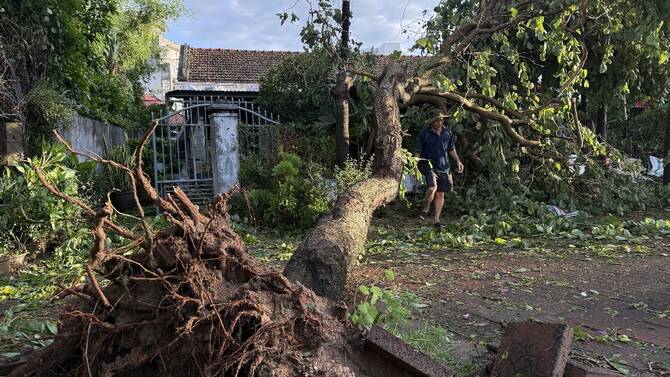
Many areas in Vietnam reported uprooted trees, damaged power lines and flattened buildings as Kalmaegi weakened into a tropical storm and moved into Cambodia on Friday.
Factories lost their roofs and equipment was damaged because of flooding in Binh Dinh province. In hard-hit Quy Nhon, residents woke up to find corrugated metal roofs and household items scattered along the streets.
As the skies cleared and sunlight broke through on Friday morning, residents in Dak Lak province stepped out to assess the wreckage left behind.
Streets were littered with fallen branches and twisted sheets of metal, and muddy water still pooled in low-lying areas where the river had surged to record heights overnight. Shopkeepers dragged out waterlogged goods to dry in the sun, while families swept mud from their doorsteps and patched together missing roof tiles.
Kalmaegi struck Vietnam as the country’s central region was still reeling from floods caused by record-breaking rains. Authorities said more than 537,000 people were evacuated, many by boat, as floodwaters rose and landslides loomed. The storm was forecast to dump up to 24 inches (600 millimeters) of rain in some areas before moving into Laos and northeast Thailand later Friday.
Three fishermen were reported missing Thursday after their boat was swept away by strong waves near Ly Son Island off Quang Ngai province. Search efforts were later suspended due to worsening weather, state media said.
The Philippines experiences about 20 typhoons and storms each year and is among the world’s most disaster-prone countries.
Vietnam, which is hit by around a dozen storms annually, has endured a relentless series this year. Typhoon Ragasa dumped torrential rain in late September, followed by Typhoon Bualoi and Typhoon Matmo, which together left more than 85 people dead or missing and caused an estimated $1.36 billion in damage.
Scientists warn that a warming climate is intensifying storms and rainfall across Southeast Asia, making floods and typhoons increasingly destructive and frequent.


![]()

Typhoon Kalmaegi kills 5 people in Vietnam as the Philippines prepares for a new storm
Short Url
https://arab.news/9w7y8
Typhoon Kalmaegi kills 5 people in Vietnam as the Philippines prepares for a new storm
- Scientists warn that a warming climate is intensifying storms and rainfall across Southeast Asia, making floods and typhoons increasingly destructive and frequent


Latest updates


Recommended


© 2026 SAUDI RESEARCH & PUBLISHING COMPANY, All Rights Reserved And subject to Terms of Use Agreement.