

Education spending surges 251% as students return from autumn break: SAMA

The number of transactions in the education sector increased by 61 percent across the week. Getty
Short Url
Updated 12 December 2025
Follow

Education spending surges 251% as students return from autumn break: SAMA

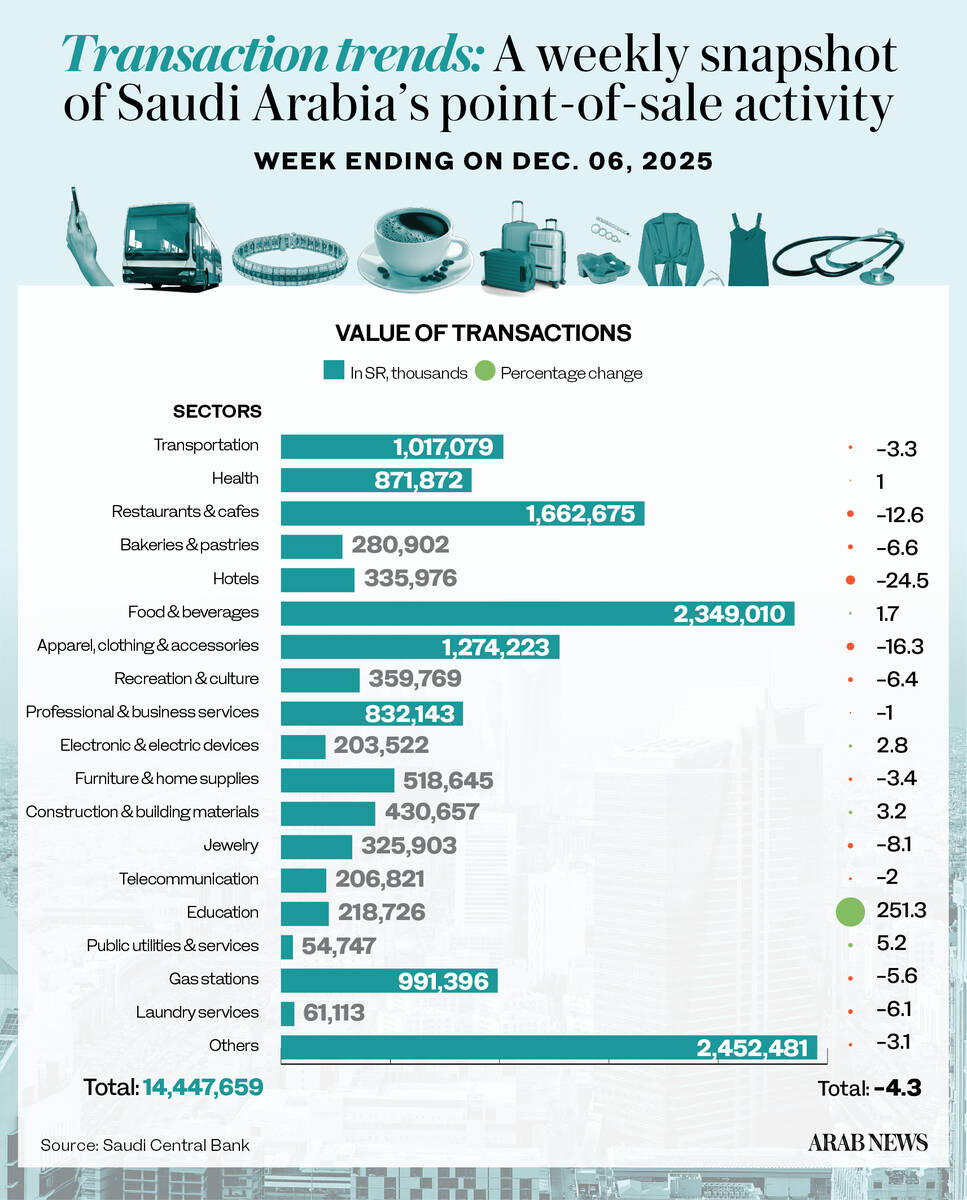
RIYADH: Education spending in Saudi Arabia surged 251.3 percent in the week ending Dec. 6, reflecting the sharp uptick in purchases as students returned from the autumn break.

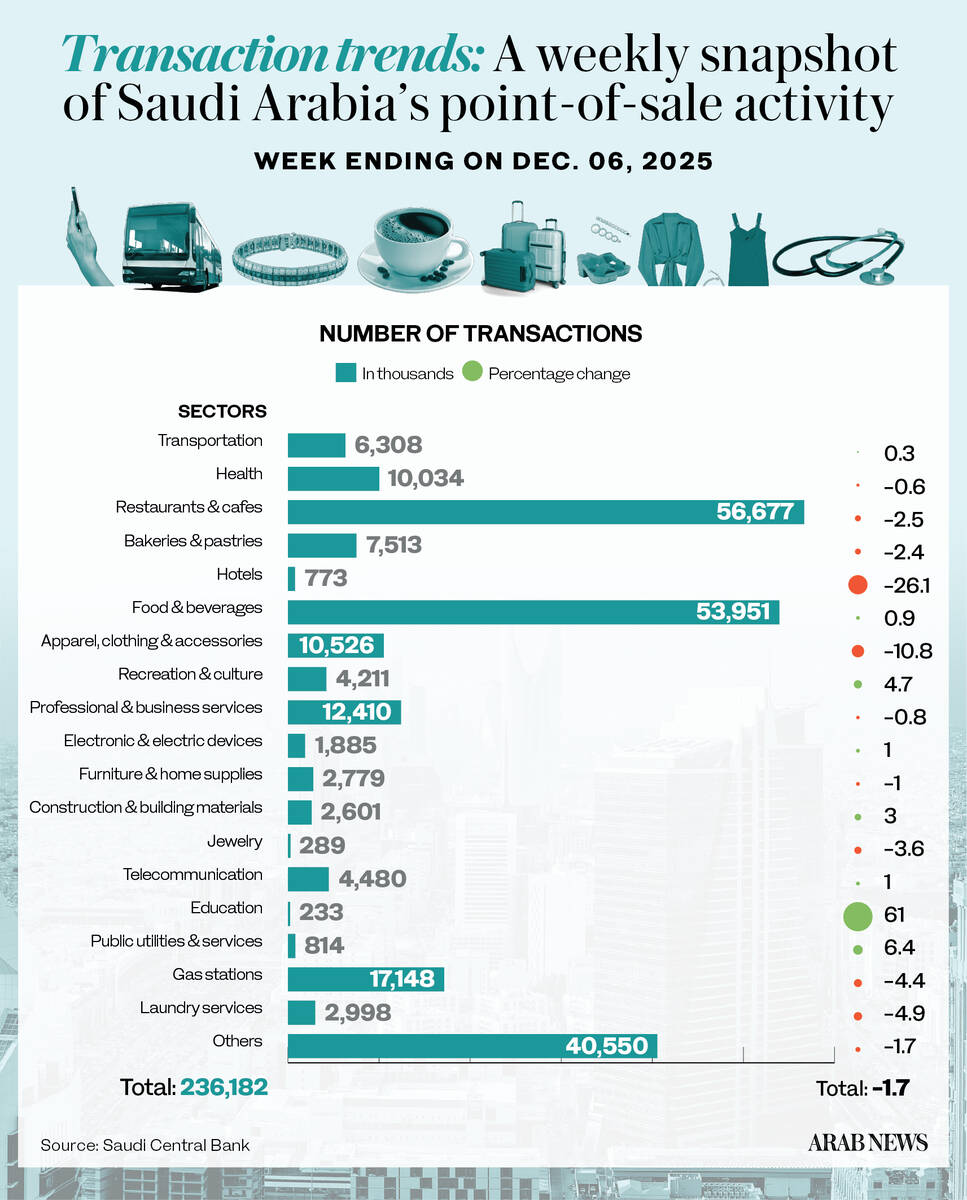
According to the latest data from the Saudi Central Bank, expenditure in the sector reached SR218.73 million ($58.2 million), with the number of transactions increasing by 61 percent to 233,000.

Despite this surge, overall point-of-sale spending fell 4.3 percent to SR14.45 billion, while the number of transactions dipped 1.7 percent to 236.18 million week on week.
The week saw mixed changes between the sectors. Spending on freight transport, postal and courier services saw the second-biggest uptick at 33.3 percent to SR60.93 million, followed by medical services, which saw an 8.1 percent increase to SR505.35 million.

Expenditure on apparel and clothing saw a decrease of 16.3 percent, followed by a 2 percent reduction in spending on telecommunication.

Jewelry outlays witnessed an 8.1 percent decline to reach SR325.90 million. Data revealed decreases across many other sectors, led by hotels, which saw the largest dip at 24.5 percent to reach SR335.98 million. 

Spending on car rentals in the Kingdom fell by 12.6 percent, while airlines saw a 3.7 percent increase to SR46.28 million.

Expenditure on food and beverages saw a 1.7 percent increase to SR2.35 billion, claiming the largest share of the POS. Restaurants and cafes retained the second position despite a 12.6 percent dip to SR1.66 billion.

Saudi Arabia’s key urban centers mirrored the national decline. Riyadh, which accounted for the largest share of total POS spending, saw a 3.9 percent dip to SR4.89 billion, down from SR5.08 billion the previous week.

The number of transactions in the capital settled at 74.16 million, down 1.4 percent week on week.
In Jeddah, transaction values decreased by 5.9 percent to SR1.91 billion, while Dammam reported a 0.8 percent surge to SR713.71 million.

POS data, tracked weekly by SAMA, provides an indicator of consumer spending trends and the ongoing growth of digital payments in Saudi Arabia. 

The data also highlights the expanding reach of POS infrastructure, extending beyond major retail hubs to smaller cities and service sectors, supporting broader digital inclusion initiatives. 

The growth of digital payment technologies aligns with the Kingdom’s Vision 2030 objectives, promoting electronic transactions and contributing to the nation’s broader digital economy. 


Saudi National Development Fund sees 45 agreements worth $1.6bn at Momentum 2025

Updated 12 December 2025
Follow

Saudi National Development Fund sees 45 agreements worth $1.6bn at Momentum 2025

RIYADH: Saudi Arabia’s National Development Fund and its affiliates signed 45 agreements with a total value of SR6 billion ($1.59 billion), with several local and international partners at the conclusion of the Momentum 2025 development finance conference.

The event, held from Dec. 9 to 11 at the King Abdulaziz International Conference Center in Riyadh, was organized by the NDF under the patronage of Prince Mohammed bin Salman bin Abdulaziz Al Saud, crown prince, prime minister, and chairman of the NDF board of directors.

The new agreements seek to accelerate the pace of investment, empower the private sector, and unlock new opportunities in priority sectors including small and medium sized enterprises, tourism, and sustainable development.

On the institutional level, the fund signed two strategic agreements with two leading global partners in technology and professional services, aiming to enable artificial intelligence, data, and digital solutions within the development finance ecosystem. 

The two memorandum of understandings aim to enhance the institutional capabilities of the fund, encourage innovation in products and services, and improve the efficiency and overall impact of development financing in the Kingdom.

The NDF signed a memorandum of understanding through the National Infrastructure Fund aimed at unifying the efforts of the development system to support small enterprises by cooperating on designing a developmental financing model for SMEs.

The Saudi SME Bank signed 19 cooperation agreements and MoUs with a value exceeding SR3 billion, to support the developmental finance system and enhance integration between public and private sector entities.

The Tourism Development Fund concluded 6 agreements with entities from both the government and private sectors, strengthening its partnerships with an impact exceeding SR4 billion. These aim to enhance financing solutions through the “Tourism Enablement Programs” offered by the fund to micro, small, and medium enterprises.

The Cultural Development Fund signed five credit facility agreements within the framework of the “Cultural Financing” program, with a total value exceeding SR63 million, to finance numerous cultural projects.

As part of its efforts to support human capital development, the Human Resources Development Fund concluded 3 agreements aimed at supporting and enabling 2,191 male and female job seekers in multiple sectors, with a value exceeding SR324 million.

The Saudi Industrial Development Fund signed a cooperation agreement with the Saudi Railways Co. to identify cooperation opportunities in enabling the industrial sector, including the railway sector, and supporting investors in localizing goods and services to increase local content.

The Saudi Fund for Development signed five developmental memoranda of understanding with Imam Mohammad Ibn Saud Islamic University, the Islamic Military Counter Terrorism Coalition, and the Middle East Green Initiative, as well as the Saudi Agricultural and Livestock Investment Co., and the Arab Urban Development Institute.

The Investment Events Fund signed a partnership agreement with entertainment firm Legends Global to enhance the events sector by leveraging international expertise in organizing major global events.

The agreements and MoUs signed during the Momentum 2025 conference represent a significant step in the Kingdom’s efforts to build a diverse, inclusive, and sustainable economy.

These partnerships contribute to bridging financing gaps, mitigating risks for strategic projects, and achieving long-term value for Saudi citizens, companies, and communities. Furthermore, they advance global sustainable development goals by aligning public and private capital with national priorities in infrastructure, SMEs, and green growth. 

Dialogue sessions embody development transformation message

The conference agenda included over 35 sessions addressing sustainable investment, climate adaptation, and the role of development finance institutions in expanding economic opportunities. It also featured an exhibition with participation from more than 20 public and private sector entities. 

Over 100 speakers from more than 100 countries participated to discuss ways to develop financing for development efforts, tackle emerging global challenges, and accelerate national and international priorities.

The confernce saw many dialogue sessions and discussions. SPA

The conference concluded with a session titled “The Role of Development Finance Institutions: Enabling Development by Enhancing Financial Capabilities,” which brought together the Governor of the NDF, Stephen Groff, and the CEOs of various development funds and banks.

The session discussions focused on enhancing joint coordination, improving investment readiness, and expanding developmental impact across multiple sectors including tourism, infrastructure, and SMEs.

During the roundtable discussion, participants reviewed the pivotal role led by the Fund and its development ecosystem across various sectors and their role in supporting the economic transformation of the Kingdom.

Groff explained that the strength of this ecosystem lies in the diversity of the funds and the integration of their mandates, adding that achieving the targets of Saudi Vision 2030 requires flexibility in resource allocation and the ability to adapt to national development priorities.

In support of expanding the presence of international companies in the Kingdom and enhancing the competitiveness of the financial sector, the Minister of Investment, Khalid Al-Falih, presented the regional headquarters license to HSBC Bank on the sidelines of the conference, a step that reflects growing confidence in and the attractiveness of the Saudi market to global financial institutions.

To enrich the development sector, the Digital Cooperation Organization launched, on the sidelines of the conference, the Digital Economy Trends 2026 report. The report predicted that the global digital economy will grow by 9.5 percent next year, three times faster than global economic growth.