Pakistan signs agreement with Binance to explore ‘tokenization’ of up to $2 billion assets

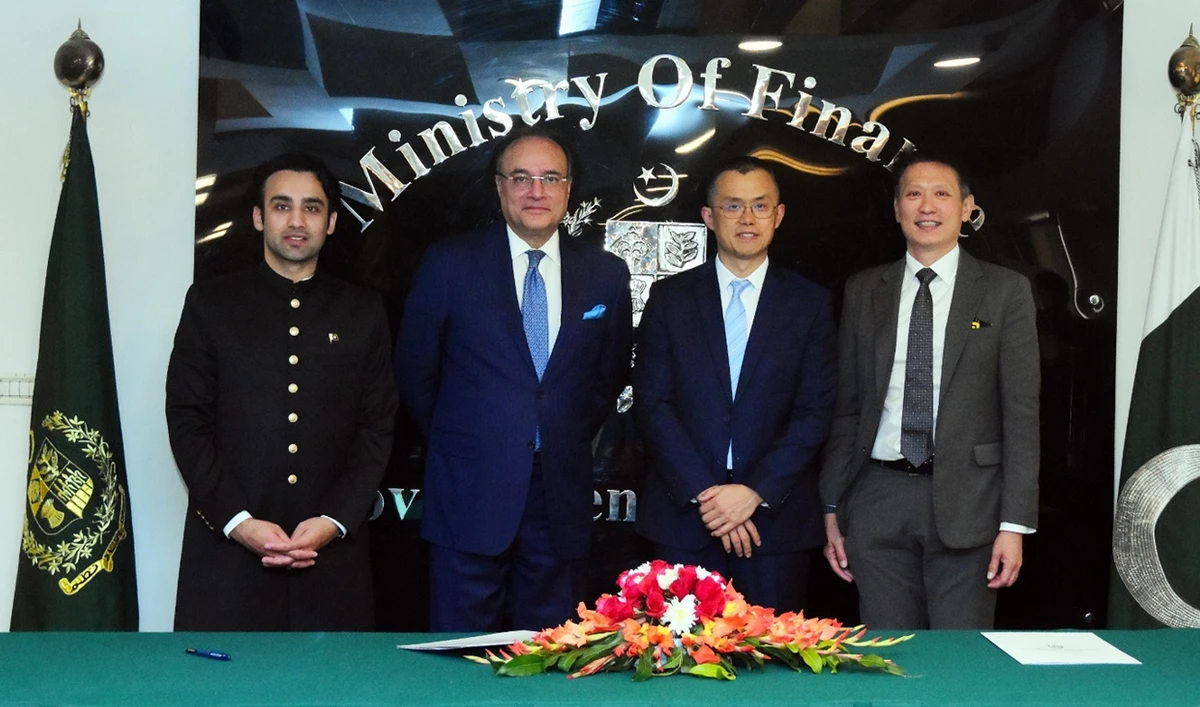
(Left to right) Chairman of Pakistan Virtual Assets Regulatory Authority (PVARA) Bilal Bin Saqib, Pakistan’s Finance Minister Muhammad Aurangzeb, Binance CEO Changpeng Zhao and Binance Co-CEO Richard Teng pose for a group photo after signing a Memorandum of Understanding (MoU) at the Finance Division in Islamabad, Pakistan, on December 12, 2025. (Finance Ministry)
Short Url
Updated 12 December 2025
Follow

Pakistan signs agreement with Binance to explore ‘tokenization’ of up to $2 billion assets

  • Pakistan says collaboration aims to explore secure digital platforms that could facilitate global investors’ participation
  • Pakistan issues clearances to global crypto exchanges Binance and HXT to begin license process in South Asian country

ISLAMABAD: Pakistan and global crypto exchange Binance signed a memorandum of understanding (MoU) on Friday to explore what it said was the “tokenization” of up to $2 billion in sovereign bonds, treasury bills and commodity reserves to boost liquidity and attract investors, the finance ministry said. 

The development took place hours after the Pakistan Virtual Assets Regulatory Authority (PVARA) granted no objection certificates (NOCs) to Binance and HTX, another global crypto exchange. 

“The MoU establishes a framework for exploring potential collaboration on the tokenization and blockchain-based distribution of Pakistan’s real-world and sovereign assets, including government bonds, treasury bills, commodity reserves and other federally owned assets,” the finance ministry said.

“Subject to applicable laws, policies and regulatory approvals, the initiative may involve assets of up to USD 2 billion, with the objective of enhancing liquidity, transparency and international market accessibility.”

The ministry said that as per the MoU, Binance and/or its affiliates may provide technical expertise, advisory support, training and capacity building to enable Pakistan to assess modern, compliant blockchain infrastructure. 

It further said the collaboration aims to explore secure and transparent digital platforms that could facilitate broader participation by international investors, while fully respecting Pakistan’s regulatory framework and sovereign control.

Finance Minister Muhammad Aurangzeb described the agreement as a “strong” sign of Pakistan’s reform trajectory. 

“The next step for us is execution, and we are fully committed to delivering results with speed and quality,” he said. 

NOCs FOR BINANCE, HTX 

The PVARA earlier issued NOCs to HTX and Binance, with the authority saying it had done so following a review process it conducted with public sector stakeholders that focused on governance structures, compliance frameworks, risk management controls and alignment with Pakistan’s emerging regulatory requirements for virtual asset activities.

Pakistan has been moving to regulate its fast-growing crypto and digital assets market by bringing virtual asset service providers (VASPs) under a formal licensing regime. Officials say the push is aimed at curbing illicit transactions, improving oversight and encouraging innovation in blockchain-based financial services.

PVARA said the NOCs allow Binance and HTX to conduct preparatory and engagement activities within Pakistan under “defined regulatory oversight,” clarifying that it does not constitute a “full operating license.”

They also allow Binance and HTX to begin registration on the FMU goAML, Pakistan’s anti–money laundering reporting platform, as reporting entries. The exchanges can now engage with the Securities and Exchange Commission of Pakistan (SECP) regulator to incorporate their subsidiaries in the country.

HTX and Binance can also prepare and submit their full VASP license applications once licensing regulations are promulgated and provide anti-money laundering (AML) registered services after the completion of their goAML registration, PVARA said. 

“PVARA will continue to engage with domestic and international stakeholders as it advances subsequent phases of its regulatory framework,” the authority said.

Anti-fuel smuggling drive boosts Pakistan revenues 82%, PM office says

Updated 9 sec ago
Follow

Anti-fuel smuggling drive boosts Pakistan revenues 82%, PM office says

  • Crackdown targets illegal petroleum trade using GPS tracking and pump registration
  • July–November gains cited as government intensifies tax, customs enforcement

ISLAMABAD: The Pakistani prime minister’s office said on Friday revenues from petroleum products rose 82% between July and November 2025 after a nationwide crackdown on fuel smuggling, as the government steps up enforcement to curb tax evasion and losses that have long strained public finances.

The increase was cited during a weekly performance review of the Federal Board of Revenue (FBR), where Prime Minister Shehbaz Sharif directed authorities to accelerate action against smuggling and tax evasion, according to a statement issued by the PM’s Office.

Fuel smuggling has been a persistent problem in Pakistan, where subsidised or untaxed petroleum products are often trafficked across borders or sold through unregistered pumps, depriving the state of revenue and distorting domestic energy markets. Successive governments have blamed the practice for billions of rupees in annual losses, while international lenders have repeatedly urged tighter enforcement as part of broader fiscal reforms.

“Every year the nation loses billions due to smuggling,” Sharif was quoted as saying in a statement, praising customs authorities for successful operations and noting that revenues from petroleum products increased by 82% from July to November 2025 compared with the same period last year.

The PM said stricter enforcement had brought several goods back into the formal economy, adding that there would be “no leniency” toward those involved in tax evasion or illegal trade.

Officials briefed the prime minister that Pakistan Customs has rolled out a nationwide enforcement framework, including GPS tracking of petroleum product transportation, registration of fuel stations through a digital monitoring system, and legal action against illegal machinery under updated petroleum laws.

The government has also instructed provincial administrations to cooperate fully with federal authorities in shutting down illegal petrol pumps, the statement said.

Sharif said enforcement efforts would continue until smuggling networks were dismantled and tax compliance improved, as the government seeks to strengthen revenues amid ongoing economic reforms.

Pakistan has struggled for years with weak tax collection and a narrow revenue base, forcing repeated bailouts from the International Monetary Fund. Smuggling of fuel, cigarettes, electronics and consumer goods has been identified by policymakers as a major obstacle to improving revenues and stabilising the economy.

Independent research shows that Pakistan loses an estimated Rs750 billion (about $2.7 billion) annually in tax revenue due to illicit trade and smuggling across sectors such as petroleum, tobacco and pharmaceuticals. Broader analyzes suggest total tax revenue losses linked to the informal economy and smuggling may reach as high as Rs3.4 trillion (around $12.1 billion) a year, roughly a quarter of the government’s annual tax targets.

Smuggled petroleum products alone are thought to cost the state about Rs270 billion (around $960 million) a year in lost revenue, underscoring why authorities have focused recent enforcement efforts on fuel tracking and pump registration.