Greenpeace files complaint with EU against Slovak bear culls

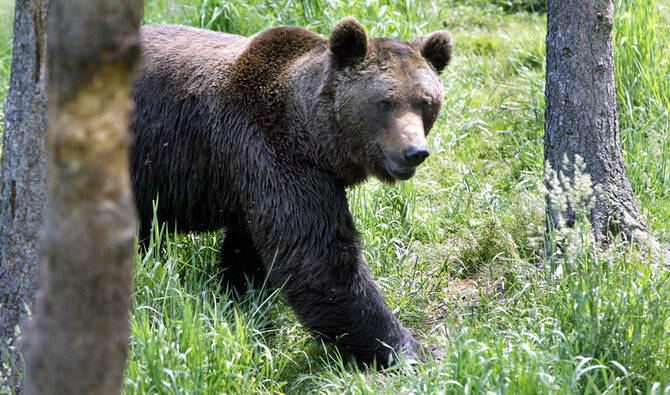
Greenpeace on Thursday said it had filed a complaint with the European Union against Slovakia over bear culling near its border with Poland. (File)
Short Url
Updated 06 November 2025
Follow

Greenpeace files complaint with EU against Slovak bear culls

  • The Slovak government approved the culling of 350 Carpathian brown bears in April
  • Greenpeace “has filed a complaint ... against the Slovak government as these bear shootings occur very close to the border with Poland“

WARSAW: Greenpeace on Thursday said it had filed a complaint with the European Union against Slovakia over bear culling near its border with Poland.
The Slovak government approved the culling of 350 Carpathian brown bears in April, citing dangers to humans as well as rising bear populations.
Greenpeace “has filed a complaint ... against the Slovak government as these bear shootings occur very close to the border with Poland,” where this animal is protected, Katarzyna Bilewska, Greenpeace’s spokeswoman in Poland told AFP on Thursday.
Bears “very often cross the border with Slovakia. The Slovak government’s decision to proceed with mass bear culling... threatens the population of this species living in Poland,” numbering around 130, according to Aleksandra Wiktor, an activist from Greenpeace Poland.
“Bears do not understand the concept of borders,” she said.
Poland officially requested Slovakia to refrain from culling bears at least within a 30-kilometer (19-mile) border zone but this has gone unheeded.
Slovakia is obliged to follow a European Union directive which only allows bear culling when they cause material damage or threaten human life, and only when no other solution is applicable.
Around 20 attacks have been recorded since the beginning of the year in Slovakia, resulting in several injuries.
Slovakia has a population of between 1,000 and 1,275 bears, according to official figures.
Ninety-two bears were culled last year and another 160 this year in the EU member country of 5.4 million inhabitants.


Policewoman honored for soothing crying baby when her mother fell unconscious at Beirut airport

Updated 14 sec ago
Follow

Policewoman honored for soothing crying baby when her mother fell unconscious at Beirut airport

  • ISF honors first adjutant for comforting and feeding baby-milk to scared infant whose mother was rushed to hospital
  • Social media users praise policewoman for her ‘humane and empathetic’ act after photos went viral

BEIRUT: A Lebanese policewoman who comforted an infant and fed her milk while her mother was hospitalized after falling unconscious at Beirut airport was honored for what social media users dubbed a ‘humane and empathetic’ act.
First Adjutant Nadia Nasser was on duty when the unidentified baby’s mother suffered a sudden illness and fell unconscious at a checkpoint inside Beirut International Airport earlier this month.
Photos of Nasser holding the months-old baby in her arms, preparing a milk bottle and feeding her went viral across social media, where users described the policewomen’s act as ‘motherly, compassionate and humane’ behavior.
Brig. Gen. Moussa Karnib of Lebanon’s Internal Security Forces honored Nasser on Friday for caring for the infant for almost two hours at the airport after her mother was rushed to a hospital.
A media statement said the first adjutant was honored upon the directives of ISF’s Director General Maj. Gen. Raed Abdullah, after she took personal initiative on Feb. 2 to comfort the infant.
Commenting on Nasser’s photos that went viral, a user called Sami said she should be promoted for her ‘selfless and empathetic’ act.
Another user, Joe, commented: “She should be rewarded.
“This is how loyalty and love for one’s job and country are built,” wrote a user called Youssef.
Media reports said that when the incident happened, the baby’s fear and cries prompted Nasser to take the initiative to comfort and remain beside her until her mother’s condition stabilized.
ISF’s statement did not clarify whether Nasser and the baby accompanied the mother in the ambulance or how they were reunited later.