

Slovakia allows culling 350 bears, riles conservationists

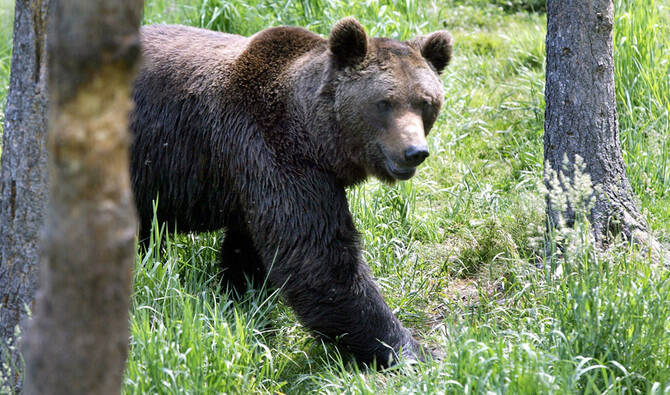
The Slovak government on Wednesday approved the shooting of 350 bears citing danger posed to people, a move conservationists slammed as unlawful. (File)
Short Url
Updated 02 April 2025
Follow

Slovakia allows culling 350 bears, riles conservationists

  • Fico’s government has also declared a state of emergency in most Slovak districts over “undesirable” bear presence
  • The Slovak parliament already eased the rules for bear culling in May 2024

BRATISLAVA: The Slovak government on Wednesday approved the shooting of 350 bears citing danger posed to people, a move conservationists slammed as unlawful.
The decision follows several bear attacks on people, including the discovery of the remains of a man in central Slovakia probably killed by a bear on Sunday.
“We can’t live in a country where people are afraid to go to the woods,” Prime Minister Robert Fico told reporters.
Fico’s government has also declared a state of emergency in most Slovak districts over “undesirable” bear presence.

The Slovak parliament already eased the rules for bear culling in May 2024, allowing exemptions from a ban in several districts.
But the country must follow an EU directive that allows culling only of problem bears damaging property or attacking people, and only if there is no other solution.
A total of 93 bears were shot in the EU member country of 5.4 million people in 2024, while 36 died in car accidents, the daily Dennik N said earlier.
But journalists from the Jan Kuciak Investigative Center said hunters probably never killed bears that had attacked people, based on a study of 50 cases from 2024.
Environment Minister Tomas Taraba said on Wednesday there were more than 1,300 bears in Slovakia, and that 800 was a “sufficient number,” as the population keeps growing.
But conservationists criticized the government, saying Wednesday’s decision was in violation of international obligations and that the environment ministry knowingly breached the law.
They called on the ministry to instead teach people how to stay safe in nature.
“Instead of ineffective solutions, we need to strengthen prevention — education, provision of garbage removal, regulation of baiting of game or informing the public about safe movement in nature,” the Aevis Foundation said on Facebook.



Recovery of missing dog Boro brings hope after Spain’s train crashes

Updated 22 January 2026
Follow

Recovery of missing dog Boro brings hope after Spain’s train crashes

  • On Thursday, forest firefighters in southern Spain found the black-and-white pooch
  • Photos of Boro, a medium-sized black dog with white eyebrows, went viral

MADRID: After back-to-back fatal train crashes sent shock waves through Spain, some good news arrived on Thursday: Boro, the missing dog, was found.
Days earlier, Boro’s owner Ana García issued a desperate plea to help find him after the dog bolted Sunday in the aftermath of the high-speed train crash in southern Spain that killed at least 45 people. García, 26, and her pregnant sister were traveling with Boro on the train that derailed.
On Thursday, forest firefighters in southern Spain found the black-and-white pooch, and posted images that showed García with one of her legs in a brace embracing Boro. Sitting inside a car, she spoke to reporters.
“Many thanks to all of Spain and everyone who has got involved so much,” she said. “It gave me great hope and we’ve done it.”
The search for Boro appeared to provide Spaniards something to hope for amid the week’s tragedy, and ultimately something to celebrate.


For days, people had rallied online to find him, amplifying García’s call by sharing video of an interview she had given to local media. Photos of Boro, a medium-sized black dog with white eyebrows, went viral alongside phone numbers for García and her family. Spanish television broadcasters and newspapers covered the search.
García, her sister and the dog had been traveling Sunday by high-speed train from Malaga, their hometown in southern Spain, to the capital Madrid, when the tail of their train car jumped the rails for reasons that remain unclear, and smashed into another train.
The collision killed dozens and injured more than 150 people. Rescue crews helped García and her sister out of the tilted train car. That’s when she briefly saw Boro before he ran. She spoke to the cameras with a blanket draped over her shoulders and a bandage on her cheek after Spain’s worst rail accident in more than a decade.
“Please, if you can help, look for the animals,” a limping García told reporters at the time, choked up and holding back tears. “We were coming back from a family weekend with the little dog, who’s family, too.”
On Thursday, she had a bruise beneath her eye but, with Boro back by her side, also a smile plastered across her face.
“Now we have him and we have him for all our life,” García told reporters. “Now let’s go home, buddy.”