TBILISI: Georgia on Thursday charged eight top opposition figures including jailed ex-president Mikheil Saakashvili with plotting to overthrow the government, sabotage and aiding foreign powers, in an intensifying crackdown on opponents.
Those targeted slammed the ruling Georgian Dream party for escalating an intense crackdown on dissent in the Black Sea nation, in what one branded a “war on democracy.”
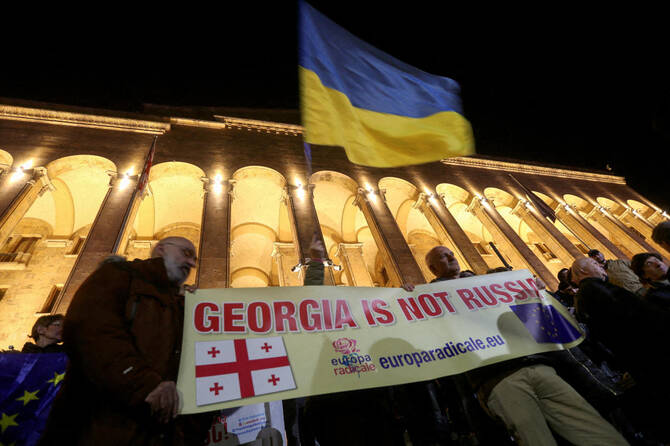
Georgia has been mired in political crisis since last year’s disputed parliamentary elections, which the opposition says were rigged in favor of Georgian Dream.
Thursday’s proceedings target Saakashvili — who is serving a 12.5-year sentence for abuse of office, a conviction denounced by rights groups as politically motivated — as well as a string of opposition leaders, Prosecutor General Giorgi Gvarakidze told reporters.
The most serious charges — “assisting a foreign state ... in hostile activities” — carries a maximum prison sentence of 15 years.
Many are already behind bars on prosecutions widely seen as political retribution, including opposition leaders Nika Gvaramia, Nika Melia and Elene Khoshtaria.
Gvaramia dismissed the charges as “absurd political theater,” and accused Georgian Dream of “waging war on democracy.”
“The oligarchy must fall,” he wrote on social media.
Another of those charged, Zurab Japaridze, a leader of the Girchi party, said the government “has crossed the final line into authoritarianism.”
Khoshtaria of the Droa party vowed: “No intimidation will stop us from defending Georgia’s European future.”
Prosecutor Gvarakidze alleged the politicians had “engaged in activities directed against Georgia’s constitutional order and national security” by providing information about energy and defense to Western governments that helped them sanction Georgian officials.
He also alleged that several of them had sought to “radicalize street protests” following elections in October last year by calling for the overthrow of the government and the seizure of state buildings.
Saakashvili, a reformist pro-Western ex-president, is accused of urging his supporters via social media “to resist and topple the regime.”
The European Union has heavily criticized Tbilisi’s democratic backsliding in recent years.
Last month, Georgian Dream asked the Constitutional Court to ban the country’s three main opposition forces.
The party, in power since 2012, originally cast itself as liberal and pro-European, but has faced accusations of drifting toward Russia and derailing Georgia’s bid to join the EU.
The party rejects the allegations, saying it is safeguarding stability in the country following Russia’s invasion of Ukraine.


Georgia charges top opposition leaders over 'coup plot'
https://arab.news/rgfdw
Georgia charges top opposition leaders over 'coup plot'

- Ex-president Mikheil Saakashvili, who is serving a 12.5-year sentence for abuse of office, is among them
- Georgia has been mired in political crisis since last year’s disputed parliamentary elections


End of US-Russia nuclear pact a ‘grave moment’: UN chief
- Guterres urged Washington and Moscow “to return to the negotiating table without delay and to agree upon a successor framework”
UNITED NATIONS, United States: UN chief Antonio Guterres on Wednesday urged the United States and Russia to quickly sign a new nuclear deal, as the existing treaty was set to expire in a “grave moment for international peace and security.”
The New START agreement will end Thursday, formally releasing both Moscow and Washington from a raft of restrictions on their nuclear arsenals.
“For the first time in more than half a century, we face a world without any binding limits on the strategic nuclear arsenals of the Russian Federation and the United States of America,” Guterres said in a statement.
The UN secretary-general added that New START and other arms control treaties had “drastically improved the security of all peoples.”
“This dissolution of decades of achievement could not come at a worse time — the risk of a nuclear weapon being used is the highest in decades,” he said, without giving more details.
Guterres urged Washington and Moscow “to return to the negotiating table without delay and to agree upon a successor framework.”
Russia and the United States together control more than 80 percent of the world’s nuclear warheads but arms agreements have been withering away.
New START, first signed in 2010, limited each side’s nuclear arsenal to 1,550 deployed strategic warheads — a reduction of nearly 30 percent from the previous limit set in 2002.
It also allowed each side to conduct on-site inspections of the other’s nuclear arsenal, although these were suspended during the Covid-19 pandemic and have not resumed since.


