WASHINGTON: Come Thursday, barring a last-minute change, the final treaty in the world that restricted nuclear weapon deployment will be over.
New START, the last nuclear treaty between Washington and Moscow after decades of agreements dating to the Cold War, is set to expire, and with it restrictions on the two top nuclear powers.
The expiration comes as President Donald Trump, vowing “America First,” smashes through international agreements that limit the United States, although in the case of New START, the issue may more be inertia than ideology.
Russian President Vladimir Putin in September suggested a one-year extension of New START.
Trump, asked afterward by a reporter for a reaction while he was boarding his helicopter, said an extension “sounds like a good idea to me” — but little has been heard since.
Putin ally Dmitry Medvedev, who as Russia’s president signed New START with counterpart Barack Obama in 2010, said in a recent interview with the Kommersant newspaper that Russia has received no “substantive reaction” on New START but was still giving time to Trump.
A White House official said on condition of anonymity that Trump would like to see “limits on nuclear weapons and involve China in arms control talks.”
The way to do that, the official said, Trump “will clarify on his own timeline.”
Daryl Kimball, executive director of the Arms Control Association, which supports reducing nuclear risks, said Trump’s second administration, which has sidelined career diplomats and entrusted decision-making only to a handful of people, is not functioning in a normal way that would allow complex negotiations.
Trump “seems to have the right instinct on this issue but has thus far failed to follow through with a coherent strategy,” Kimball said.
Jon Wolfsthal, director of global risk at the Federation of American Scientists, said Trump and Putin could pick up the phone and agree immediately at a political level to extend New START.
“This is a piece of low-hanging fruit that the Trump administration should have seized months ago,” he said.
Wolfsthal is among experts involved in the “Doomsday Clock” meant to symbolize how near humanity is to destruction. It was recently moved closer to midnight in part due to New START’s demise.
‘Empty formality’?
Trump called in October for the United States to resume nuclear testing for the first time in more than 30 years, although it is not clear he will carry it out.
Russia in 2023 already suspended a key element of New START, allowing inspections, as relations deteriorated sharply with US President Joe Biden’s administration over Russia’s invasion of Ukraine.
Alexander Khramchikhin, a Russian military analyst, said the two powers already had indicated they will do as they like.
“It’s clear that the treaty has reached its end,” he said. “It’s just an empty formality that will disappear.”
Vassily Kashin, director of the Center for Comprehensive European and International Studies in Moscow, said Russia would watch if the United States ramps up its nuclear arsenal and, if so, would decide measures in response.
“But if the Americans don’t take any drastic measures, such as installing warheads, Russia will most likely simply wait, observe and remain silent,” he said.
China factor
New START restricted Russia and the United States to a maximum of 1,550 deployed strategic nuclear warheads each — a reduction of nearly 30 percent from the previous limit set in 2002.
It also limits launchers and heavy bombers to 800 each, although the number is still easily enough to destroy Earth.
During his first term, also faced with New START’s expiration, Trump insisted a new treaty bring in China — whose arsenal is fast growing, although well below the other two powers. A US negotiator even provocatively put an empty chair with a Chinese flag.
Biden on taking office in 2021 quickly agreed to extend New START by five years to 2026.
Despite his stance on New START, Trump has enthusiastically restarted diplomacy with Russia that Biden cut off over the war, inviting Putin to an August summit in Alaska and unsuccessfully trying to broker a deal in Ukraine.
US allies France and Britain also have established nuclear arsenals on a smaller scale, while India, Pakistan, Israel and North Korea have known nuclear weapons but are not part of international agreements.

With Trump mum, last US-Russia nuclear pact set to end
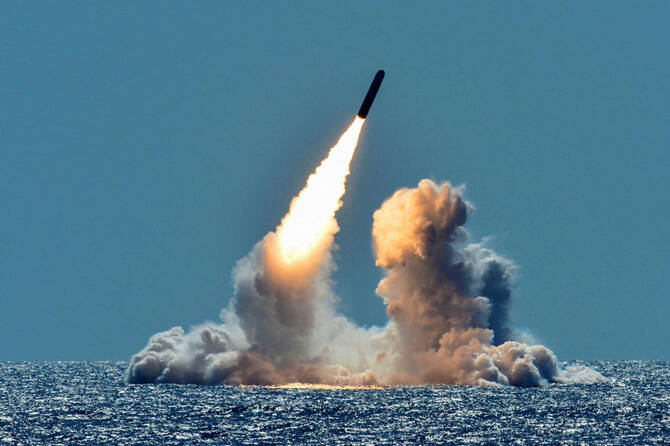
- Signed in 2010 by Putin and Obama,the treaty restricted the two superpowers to a maximum of 1,550 deployed strategic nuclear warheads each
- The treaty, called New START, also limits launchers and heavy bombers to 800 each, although the number is still easily enough to destroy Earth
Hong Kong firm begins arbitration proceedings over ruling against its Panama Canal port contract
- The Hutchison subsidiary has operated ports at both ends of the Panama Canal since 1997
- US Secretary of State Marco Rubio views the operation of the ports as a national security issue
HONG KONG: Hong Kong’s CK Hutchison Holdings said Wednesday its subsidiary started arbitration proceedings against Panama after that country’s Supreme Court ruled a concession for the subsidiary to operate Panama Canal ports was unconstitutional.
Hutchison said it strongly disagreed with last week’s ruling, and China warned Panama would pay “a heavy price” if it persisted. Panama’s president has moved to assure the public that the ports would operate without interruption after the ruling, which advanced a US aim to block any influence by China over the canal linking the Atlantic and Pacific oceans.
Hutchison’s subsidiary, Panama Ports Company, began arbitration proceedings Tuesday under the rules of the Paris-based International Chamber of Commerce, the company said in a statement.
The rules are overseen by the chamber’s International Court of Arbitration, an independent body, and it’s unclear what the impact of the proceedings would be. The Panamanian president’s office and commerce ministry did not immediately respond to requests for comment late Tuesday local time.
The ruling draws ire from China
The court ruling has drawn backlash from China, and the tensions may complicate Hutchison’s plan to sell its port assets in dozens of countries to a group that includes the US investment firm BlackRock Inc.
The planned sale has already been caught up in tensions between Beijing and Washington. US President Donald Trump, who has alleged that China interferes with the canal, initially welcomed that plan. However, it apparently angered Beijing and drew a review by Chinese anti-monopoly authorities.
On Tuesday night, Beijing’s office overseeing Hong Kong affairs criticized the Panama court ruling as legally groundless and ridiculous, saying the ruling reflected that Panamanian authorities were bowing down to hegemonic powers. It did not specify the countries but pointed to politicians from some countries who had said they were “encouraged” by the ruling, in an apparent veiled reference to US Secretary of State Marco Rubio.
In a statement shared on social media platform WeChat, the office said that China will never bow to hegemonism and has sufficient means and tools, as well as capability, to uphold justice in the international economic and trade order.
“Panama’s authorities should recognize the situation and correct their course,” it said. “If they persist in their own way and refuse to see reason, they will pay a heavy price both politically and economically!”
A company caught in US-China tensions
The Hutchison subsidiary has operated ports at both ends of the Panama Canal since 1997. The awkward position Hutchison found itself in highlights the challenges Hong Kong business elites face in navigating Beijing’s expectations of national loyalty, especially during U.S-China tension. CK Hutchison is owned by the family of Hong Kong’s richest man, Li Ka-shing.
The company said last July that it was considering seeking a Chinese investor to join as a significant member of the consortium under its sale plan, a move that some interpreted as way to please Beijing, but CK Hutchison hasn’t said more since.
The consortium also includes BlackRock subsidiary Global Infrastructure Partners and Terminal Investment Limited, which is chaired by Italian shipping scion Diego Aponte, whose family reportedly has a longstanding relationship with Li’s.
Last May, Hutchinson co-managing director, Dominic Lai told shareholders that Terminal Investment was the main investor.
Panama’s government has maintained it has full control over the canal and that the operation of the ports by Hutchison does not mean Chinese control of it. But Rubio made clear that the US viewed the operation of the ports as a national security issue.
Hutchison said it strongly disagreed with last week’s ruling, and China warned Panama would pay “a heavy price” if it persisted. Panama’s president has moved to assure the public that the ports would operate without interruption after the ruling, which advanced a US aim to block any influence by China over the canal linking the Atlantic and Pacific oceans.
Hutchison’s subsidiary, Panama Ports Company, began arbitration proceedings Tuesday under the rules of the Paris-based International Chamber of Commerce, the company said in a statement.
The rules are overseen by the chamber’s International Court of Arbitration, an independent body, and it’s unclear what the impact of the proceedings would be. The Panamanian president’s office and commerce ministry did not immediately respond to requests for comment late Tuesday local time.
The ruling draws ire from China
The court ruling has drawn backlash from China, and the tensions may complicate Hutchison’s plan to sell its port assets in dozens of countries to a group that includes the US investment firm BlackRock Inc.
The planned sale has already been caught up in tensions between Beijing and Washington. US President Donald Trump, who has alleged that China interferes with the canal, initially welcomed that plan. However, it apparently angered Beijing and drew a review by Chinese anti-monopoly authorities.
On Tuesday night, Beijing’s office overseeing Hong Kong affairs criticized the Panama court ruling as legally groundless and ridiculous, saying the ruling reflected that Panamanian authorities were bowing down to hegemonic powers. It did not specify the countries but pointed to politicians from some countries who had said they were “encouraged” by the ruling, in an apparent veiled reference to US Secretary of State Marco Rubio.
In a statement shared on social media platform WeChat, the office said that China will never bow to hegemonism and has sufficient means and tools, as well as capability, to uphold justice in the international economic and trade order.
“Panama’s authorities should recognize the situation and correct their course,” it said. “If they persist in their own way and refuse to see reason, they will pay a heavy price both politically and economically!”
A company caught in US-China tensions
The Hutchison subsidiary has operated ports at both ends of the Panama Canal since 1997. The awkward position Hutchison found itself in highlights the challenges Hong Kong business elites face in navigating Beijing’s expectations of national loyalty, especially during U.S-China tension. CK Hutchison is owned by the family of Hong Kong’s richest man, Li Ka-shing.
The company said last July that it was considering seeking a Chinese investor to join as a significant member of the consortium under its sale plan, a move that some interpreted as way to please Beijing, but CK Hutchison hasn’t said more since.
The consortium also includes BlackRock subsidiary Global Infrastructure Partners and Terminal Investment Limited, which is chaired by Italian shipping scion Diego Aponte, whose family reportedly has a longstanding relationship with Li’s.
Last May, Hutchinson co-managing director, Dominic Lai told shareholders that Terminal Investment was the main investor.
Panama’s government has maintained it has full control over the canal and that the operation of the ports by Hutchison does not mean Chinese control of it. But Rubio made clear that the US viewed the operation of the ports as a national security issue.
© 2026 SAUDI RESEARCH & PUBLISHING COMPANY, All Rights Reserved And subject to Terms of Use Agreement.


