

Georgian police clash, detain protesters as ruling party says it won local elections

1 / 3
A demonstrator stands behind a burning barricade not far from a police line during an opposition rally in the city center of Tbilisi, Georgia, on Oct. 5, 2025, boycotting the municipal elections and calling for the release of political opponents. (AP)
2 / 3
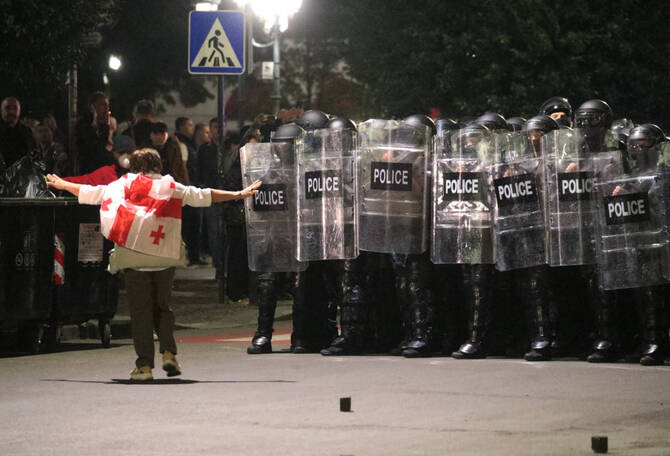
A protester wearing a Georgian flag walks towards police officers blocking the street during an opposition rally on the day of local elections in Tbilisi, Georgia, on October 4, 2025. (REUTERS)
3 / 3
Protesters clash with riot police during an opposition rally on the day of local elections in central Tbilisi on October 4, 2025. (AFP)
Short Url
Updated 05 October 2025
Follow

Georgian police clash, detain protesters as ruling party says it won local elections

  • Georgian Dream claims victory in municipal elections
  • Riot police force protesters back from presidential palace

TBILISI: Georgian riot police used pepper spray and water cannons to drive demonstrators away from the presidential palace and detained five activists on Saturday, as the opposition staged a large demonstration on a day of local elections.
The governing Georgian Dream party said it had clinched victory in every municipality across the South Caucasus country of 3.7 million people in an election boycotted by the two largest opposition blocs.
Shortly before polls closed, a group of demonstrators attempted to force entry to the presidential palace in the capital Tbilisi, a Reuters witness said, after opposition figures called for a “peaceful revolution” against GD, which they accuse of being pro-Russian and authoritarian.

Georgia’s pro-Western opposition has been staging protests since October last year, when GD won a parliamentary election that its critics say was fraudulent. The party has rejected accusations of vote-rigging.
Once one of the most pro-Western nations to emerge from the ashes of the Soviet Union, Georgia has had frayed relations with the West since Russia invaded Ukraine in 2022.
On Saturday the Health Ministry said 21 members of the security forces and six demonstrators had been injured in clashes in the center of Tbilisi, according to local media.
Georgia’s Rustavi-2 television and Russian state media quoted Deputy Interior Minister Aleksandre Darakhvelidze as saying the police detained five activists, including the opera singer Paata Burchuladze and two members of the United National Movement, Georgia’s largest opposition party.
They are charged with calling for the overthrow of the authorities and face up to nine years in prison, if convicted, Darakhvelidze said.
The government froze accession talks to the European Union soon after last year’s vote, abruptly halting a longstanding national goal and triggering large demonstrations that have continued since.
Thousands of protesters gathered on central Freedom Square and Rustaveli Avenue, waving Georgian and EU flags.
Davit Mzhavanadze, who attended the demonstration, said the protests were part of “a deep crisis which is absolutely formed by our pro-Russian and authoritarian government.”
“I think this protest will continue until these demands will be responded to properly from our government,” he said.
A smaller group of demonstrators marched to the presidential palace and were repelled by police after attempting to break into the building. Some of them then barricaded a nearby street, lighting fires and facing off with riot police.
Georgian Dream, which is widely seen as controlled by founder Bidzina Ivanishvili, the country’s richest man and a former prime minister, denies it is pro-Moscow. It says it wants to join the EU while preserving peace with Russia, its huge neighbor to the north.


Russian poisonings aim to kill — and send a message

Updated 5 sec ago
Follow

Russian poisonings aim to kill — and send a message

  • Neurotoxin epibatidine, found in Ecuadoran frogs, was identified in laboratory analyzes of samples from Navalny’s body
  • Even if a poisoning can fail — some targets survived, such as Yushchenko and Skripal — it also serves to send a message
PARIS: Polonium, Novichok and now dart frog poison: the finding that Russian opposition leader Alexei Navalny was killed with a rare toxin has revived the spectre of Moscow’s use of poisons against opponents — a hallmark of its secret services, according to experts.
The neurotoxin epibatidine, found in Ecuadoran frogs, was identified in laboratory analyzes of samples from Navalny’s body, the British, Swedish, French, German and Dutch governments said in a joint statement released on Saturday at the Munich Security Conference.
“Only the Russian state had the means, motive and opportunity to deploy this lethal toxin,” said Britain’s Foreign Office, with the joint statement pointing to Russia as the prime suspect.
The Kremlin on Monday rejected what it called the “biased and baseless” accusation it assassinated Navalny, a staunch critic of President Vladimir Putin who died on February 16, 2024, while serving a 19-year sentence in a Russian Arctic prison colony.
But the allegations echo other cases of opponents being poisoned in connection — proven or suspected — with Russian agents.
In 2006, the Russian defector Alexander Litvinenko was killed by polonium poison in London. Ukrainian politician Viktor Yushchenko, campaigning against a Russian-backed candidate for the presidency, was disfigured by dioxin in 2004. And the nerve agent Novichok was used in the attempted poisoning of former double agent Sergei Skripal in the UK in 2018.
“We should remain cautious, but this hypothesis is all the more plausible given that Navalny had already been the target of an assassination attempt (in 2020) on a plane involving underwear soaked with an organophosphate nerve agent, Novichok, which is manufactured only in Russia,” said Olivier Lepick, a fellow at the Foundation for Strategic Research specializing in chemical weapons.

Toxin ‘never been used’

“To my knowledge, epibatidine has never been used for assassinations,” Lepick added.
Until now, the substance was mainly known for its effect on animals that try to attack Ecuadoran poison dart frogs.
“It’s a powerful neurotoxin that first hyperstimulates the nervous system in an extremely violent way and then shuts it down. So you’ll convulse and then become paralyzed, especially in terms of breathing,” said Jerome Langrand, director of the Paris poison control center.
But to the scientist, using this substance to poison Navalny is “quite unsettling.”
“One wonders, why choose this particular poison? If it was to conceal a poisoning, it’s not the best substance. Or is it meant to spread an atmosphere of fear, to reinforce an image of power and danger with the message: ‘We can poison anywhere and with anything’?” he said.

Russian ‘calling card’

For many experts, the use of poison bears a Russian signature.
“It’s something specific to the Soviet services. In the 1920s, Lenin created a poison laboratory called ‘Kamera’ (’chamber’ in Russian), Lab X. This laboratory grew significantly under Stalin, and then under his successors Khrushchev and Brezhnev... It was this laboratory that produced Novichok,” said Andrei Kozovoi, professor of Russian history at the University of Lille.
“The Russians don’t have a monopoly on it, but there is a dimension of systematization, with considerable resources put in place a very long time ago — the creation of the poison laboratory, which developed without any restrictions,” he added.
Even if a poisoning can fail — some targets survived, such as Yushchenko and Skripal — it also serves to send a message, and acted as “a calling card” left by the Russian services, according to Kozovoi.
“Poison is associated in the collective imagination and in psychology with a terrible, agonizing death. The use of chemical substances or poisons carries an explicit intention to terrorize the target and, in cases such as Litvinenko, Skripal or Navalny, to warn anyone who might be tempted to betray Mother Russia or become an opponent,” said Lepick.
“A neurotoxin, a radioactive substance, or a toxic substance is much more frightening than an explosive or being shot to death.”