MOSCOW: Russia is ready for the new reality of a world with no US-Russian nuclear arms control limits after the New START treaty expires this week, Moscow’s point man for arms control said on Tuesday.
Unless the two sides reach a last-minute understanding, they will be left without any constraints on their long-range strategic nuclear arsenals for the first time in more than half a century when New START expires on Thursday.
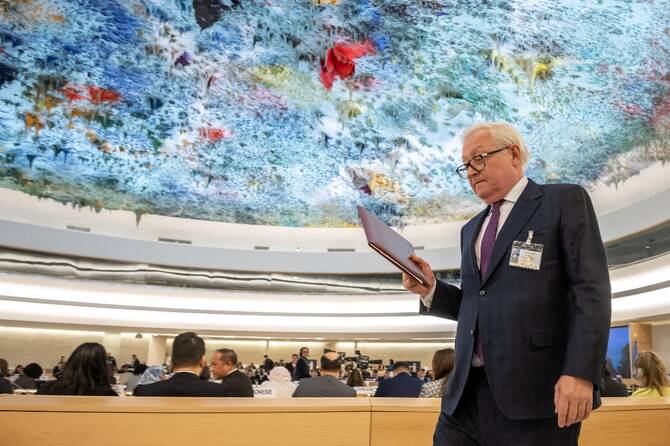
“This is a new moment, a new reality — we are ready for it,” Russian Deputy Foreign Minister Sergei Ryabkov, who oversees arms control issues, told Russian news agencies during a visit to Beijing for “strategic stability consultations.”
New START, which caps the number of deployed strategic warheads at 1,550, was signed in 2010.
In comments to the New York Times last month, US President Donald Trump indicated he will let the treaty expire. But he has not formally responded to a Russian proposal to keep observing the treaty’s missile and warhead limits for one more year to allow time to work out what to do after the pact expires.
“The lack of an answer is also an answer,” Ryabkov was quoted by TASS as saying in Beijing.
Arms control supporters in Moscow and Washington say the expiry of the treaty would not only remove limits on warheads but also damage confidence, trust and the ability to verify nuclear intentions. Some fear an unrestrained nuclear arms race.
ARMS CONTROL CRUMBLES
The web of deals crafted after the 1962 Cuban Missile Crisis to reduce the dangers of nuclear war has gradually unraveled, with confrontation growing between Moscow and the West over Ukraine and the US concerned about China.
The US has suggested China, the world’s third largest nuclear power by warheads, should join arms control talks. Beijing has shown no willingness to do so.
Ryabkov said China had a clear position on arms control and that Moscow respected it.
Former US President Barack Obama, who signed the New Start treaty in 2010 with then Russian President Dmitry Medvedev, urged the US Congress to intervene.
“If Congress doesn’t act, the last nuclear arms control treaty between the US and Russia will expire,” he said on X.
“It would pointlessly wipe out decades of diplomacy, and could spark another arms race that makes the world less safe.”
Medvedev said the world should be alarmed if the treaty expired without any understanding of what comes next, suggesting it would speed up the “Doomsday Clock.”
Ryabkov said that if the US pumped missile defense systems onto Greenland, an autonomous territory of NATO-member Denmark, then Russia would have to take military measures to compensate.


![]()

Russia is ready for new world with no nuclear limits, senior diplomat says
Short Url
https://arab.news/5zgdx
Russia is ready for new world with no nuclear limits, senior diplomat says
- Arms control supporters in Moscow and Washington say the expiry of the treaty would not only remove limits on warheads but also damage confidence, trust and the ability to verify nuclear intentions


Latest updates


© 2026 SAUDI RESEARCH & PUBLISHING COMPANY, All Rights Reserved And subject to Terms of Use Agreement.