Reduced US military presence in Europe an ‘adjustment’: NATO

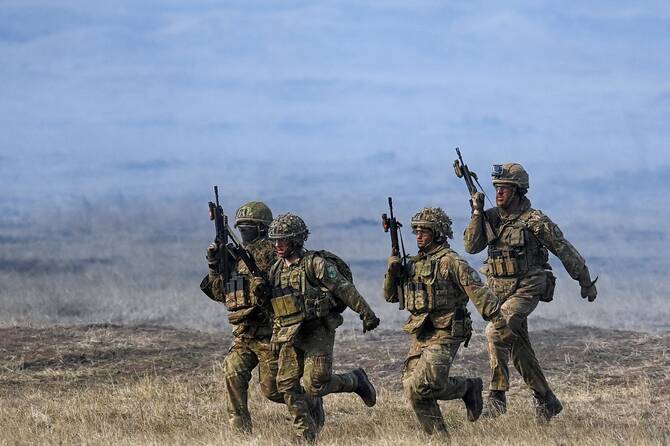
NATO troops take part in NATO's 'Steadfast Dart 2025' exercise at Smardan training range, near Galati, Romania. (Reuters)
Short Url
Updated 29 October 2025
Follow

Reduced US military presence in Europe an ‘adjustment’: NATO

  • The prospect of a US pullout is fraying the nerves of allies, especially given fears that Russia could look to attack a NATO country within the next few years if the war in Ukraine dies down

BRUSSELS: NATO said Wednesday it had been informed in advance of US plans to reduce some of its troops deployed on the alliance’s eastern flank, describing the move as an “adjustment” and nothing “unusual.”
Washington’s commitment to the alliance remained “clear” and its presence in Europe sizeable, a NATO official told AFP.
“Even with this adjustment, the US force posture in Europe remains larger than it has been for many years, with many more US forces on the continent than before 2022,” the official said.
The US has been expected to announce drawdowns in Europe following a review of its military deployments worldwide — but no move has been officially communicated yet.
Romania’s defense ministry however previewed the scale-down Wednesday, saying Washington was to halt the rotation of a brigade that had elements in several NATO countries, including Bulgaria, Romania, Slovakia and Hungary.
The prospect of a US pullout is fraying the nerves of allies, especially given fears that Russia could look to attack a NATO country within the next few years if the war in Ukraine dies down.
But NATO swiftly downplayed the significance of the planned US reduction in personnel.
“The US commitment to NATO is clear,” the official said.
“NATO has robust defense plans in place and we are working to ensure we maintain the right forces and capabilities to deter potential aggression and provide for our collective defense.”


94 million need cataract surgery, but access lacking: WHO

A Somali patient undergoes free cataract surgery at Al Nuur eye Hospital in Mogadishu, on February 16, 2015. (AFP)
Updated 11 February 2026
Follow

94 million need cataract surgery, but access lacking: WHO

  • Of the 94 million affected, fewer than 20 percent are blind, while the rest suffer from impaired vision

GENEVA: More than 94 million people suffer from cataracts, but half of them do not have access to the surgery needed to fix it, the World Health Organization said Wednesday.
Cataracts — the clouding of the eye’s lens that causes blurred vision and can lead to blindness — are on the rise as populations get older, with age being the main risk factor.
“Cataract surgery — a simple, 15-minute procedure — is one of the most cost-effective medical procedures, providing immediate and lasting restoration of sight,” the WHO said.
It is one of the most frequently performed surgeries undertaken in high-income countries.
However, “half of the world’s population in need of cataract surgery don’t have access to it,” said Stuart Keel, the UN health agency’s technical lead for eye care.
The situation is worst in the WHO’s Africa region, where three in four people needing cataract surgery remain untreated.
In Kenya, at the current rate, 77 percent of people needing cataract surgery are likely to die with their cataract blindness or vision impairment, said Keel.
Across all regions, women consistently experience lower access to care than men.
Of the 94 million affected, fewer than 20 percent are blind, while the rest suffer from impaired vision.

- 2030 vision -

The WHO said that over the past two decades, global cataract surgery coverage had increased by 15 percent.

In 2021, WHO member states set a target of a 30-percent increase by 2030.
However, current modelling predicts that cataract surgery coverage will rise by only about 8.4 percent this decade.
To close the gap, the WHO urged countries to integrate eye examinations into primary health care and invest in the required surgical equipment.
States should also expand the eye-care workforce, training surgeons in a standardised manner and then distributing them throughout the country, notably outside major cities.
The WHO was on Wednesday launching new guidance for countries on how to provide quality cataract surgery services.
It will also issue guidance to help support workforce development.
Keel said the main issue was capacity and financing.
“We do need money invested to get rid of this backlog, which is nearly 100 million people,” he told a press conference.
While age is the primary risk factor for cataracts, others include prolonged UV-B light exposure, tobacco use, prolonged corticosteroid use and diabetes.
Keel urged people to keep up regular eye checks as they get older, with most problems able to be either prevented or diagnosed and treated.
The cost of the new lens that goes inside the eye can be under $100.
However, out-of-pocket costs can be higher when not covered by health insurance.
“Cataract surgery is one of the most powerful tools we have to restore vision and transform lives,” said Devora Kestel, head of the WHO’s noncommunicable diseases and mental health department.
“When people regain their sight, they regain independence, dignity, and opportunity.”