NATO stands with Lithuania over balloon incursion: Rutte

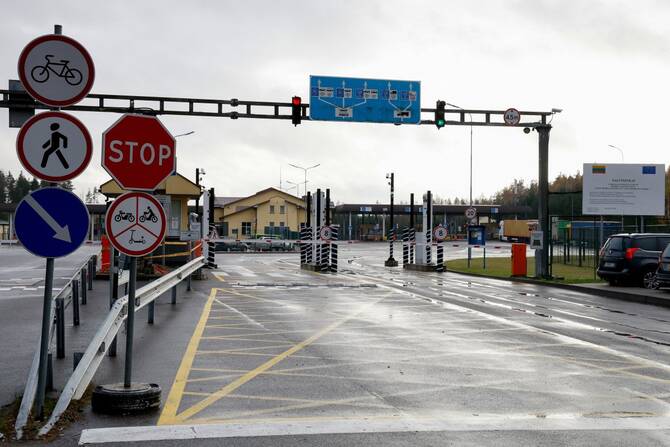
The Lithuania/Belarus border crossing near Salcininkai, south-eastern Lithuania, Oct. 28, 2025. (AFP) 
Short Url
Updated 29 October 2025
Follow

NATO stands with Lithuania over balloon incursion: Rutte

  • Dozens of balloons forced the temporary closure of two airports in Lithuania last week
  • Authorities shut its last two border crossings with neighboring Belarus over the incident

BRUSSELS: NATO voiced firm support for Lithuania Tuesday over what Vilnius condemned as a “hybrid attack” on its airspace by Russia’s ally Belarus, involving balloons filled with contraband cigarettes.
The alliance’s Secretary General Mark Rutte said he had spoken with Lithuanian President Gitanas Nauseda about the incident, in which dozens of balloons forced the temporary closure of two airports last week.
“NATO stands firmly with Lithuania — including through the air policing currently provided by Spain and Hungary as well as the NATO forces led by Germany,” Rutte wrote on X.
Lithuania, a NATO and European Union member, also shut its last two border crossings with neighboring Belarus over the incident.
EU chief Ursula von der Leyen called the balloon incident “a hybrid threat” and said the European Union supported Lithuania.
“This is destabilization. This is provocation,” she said on X, adding that Europe should speed up measures to defend its eastern flank.
The Lithuanian army has now been authorized to shoot down such balloons, Prime Minister Inga Ruginiene told journalists on Monday.
She said Belarus’s lack of action to detain those responsible for the balloons led her to believe the authorities were involved.
Black-market tobacco is a revenue source for Belarusian President Alexander Lukashenko’s government, according to the country’s opposition.
Belarusian Foreign Minister Maxim Ryzhenkov rejected Lithuania’s accusations, calling them a “provocation” aimed at justifying “measures against Belarus (and) against Russia.”


Rubio to visit eastern Europe, bolster ties with pro-Trump leaders

Updated 2 sec ago
Follow

Rubio to visit eastern Europe, bolster ties with pro-Trump leaders

  • Energy cooperation and NATO commitments will be discussed
  • Trump’s hard-right supporters view ‌Hungary’s Orban as a model
MUNICH: US Secretary of State Marco Rubio is set to begin a two-day trip on Sunday, to bolster ties with Slovakia and Hungary, ​whose conservative leaders, often at odds with other European Union countries, have warm ties with President Donald Trump.
Rubio will use the trip to discuss energy cooperation and bilateral issues, including NATO commitments, the State Department said in an announcement last week.
“These are countries that are very strong with us, very cooperative with the United States, work very closely with us, and it’s a good opportunity to go see them and two countries I’ve never been in,” Rubio told reporters before departing for Europe on Thursday.
Rubio, who in his dual role also serves as Trump’s national security adviser, will meet ‌in Bratislava on ‌Sunday with Slovak Prime Minister Robert Fico, who visited Trump ​in ‌Florida ⁠last month. The ​US ⁠diplomat’s trip follows his participation in the Munich Security Conference over the last few days.

WILL MEET VIKTOR ORBAN ON MONDAY
On Monday, Rubio is expected to meet with Hungarian leader Viktor Orban, who is trailing in most polls ahead of an election in April when he could be voted out of power.
“The President said he’s very supportive of him, and so are we,” Rubio said. “But obviously we were going to do that visit as a bilateral visit.”
Orban, one of Trump’s closest allies in Europe, is considered ⁠by many on the American hard-right as a model for the US ‌president’s tough policies on immigration and support for families and ‌Christian conservatism. Budapest has repeatedly hosted Conservative Political Action Conference ​events, which bring together conservative activists and leaders, ‌with another due in March.

TIES WITH MOSCOW AND CLASHES WITH THE EU
Both Fico and Orban have ‌clashed with EU institutions over probes into backsliding on democratic rules.
They have also maintained ties with Moscow, criticized and at times delayed the imposition of EU sanctions on Russia and opposed sending military aid to Ukraine.
Even as other European Union countries have secured alternative energy supplies after Moscow invaded Ukraine in 2022, including by buying ‌US natural gas, Slovakia and Hungary have also continued to buy Russian gas and oil, a practice the United States has criticized.
Rubio said ⁠this would be discussed ⁠during his brief tour, but did not give any details.
Fico, who has described the European Union as an institution that is in “deep crisis”, has showered Trump with praise saying he would bring peace back to Europe.
But Fico criticized the US capture of Venezuelan President Nicolas Maduro in early January.
Hungary and Slovakia have also so far diverged from Trump on NATO spending.
They have raised defense spending to NATO’s minimum threshold of 2 percent of GDP.
Fico has, however, refused to raise expenditure above that level for now, even though Trump has repeatedly asked all NATO members to increase their military spending to 5 percent. Hungary has also planned for 2 percent defense spending in this year’s budget.
On nuclear cooperation, Slovakia signed an agreement with the United States last month and Fico has said US-based Westinghouse was ​likely to build a new nuclear power ​plant.
He also said after meeting the chief of France’s nuclear engineering company Framatome during the week he would welcome more companies taking part in the project.