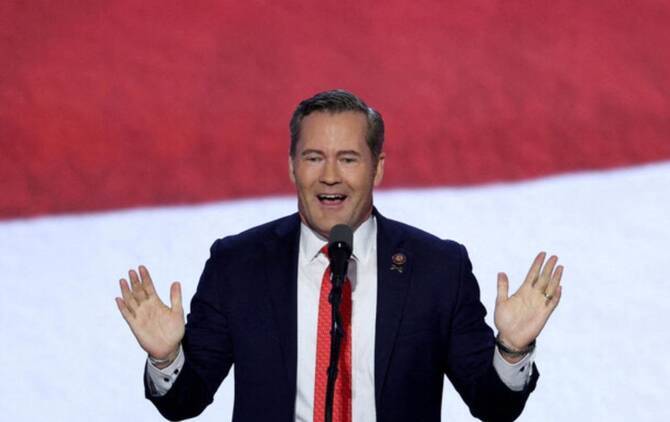
UNITED NATIONS: Mike Waltz is approaching his new role as US ambassador to the United Nations and a mandate from President Donald Trump to cut funding for what were once longtime American priorities the same way he set about representing Florida in Congress.
“I approach nearly every decision I can here with America first, with the American taxpayer first,” Waltz said virtually at a recent event at the Richard Nixon Foundation.
“So, if I had to stand up in a town hall with a group of mechanics and firemen and women and nurses and teachers and testify to them that their money is being well spent in line with our interest, that would be incredibly tough right now.”
He added, “And that’s why we’re using, quite frankly, our contribution as leverage for reform” at the UN
In recent meetings with UN officials, including Secretary-General António Guterres, Waltz and his colleagues at the US mission have made the case that the United States — the UN’s largest donor — will no longer be footing the bill the way it has since the world body’s founding eight decades ago.
Instead, US officials are taking an a la carte approach to paying UN dues, picking which operations and agencies they believe align with Trump’s agenda and which no longer serve US interests.
It is a major shift from how previous administrations — both Republican and Democratic — have dealt with the UN, and it has forced the world body, already undergoing its own internal reckoning, to respond with a series of staffing and program cuts.
Where the Trump administration is seeking changes at the UN
Shortly after being confirmed as ambassador, Waltz met with Guterres as world leaders gathered at the UN General Assembly last month. The former congressman said in a Sept. 25 interview with Larry Kudlow on Fox Business that he made it clear to the top UN official that US-backed changes would need to take place “before you start talking about taxpayer dollars.”
“Washington’s decision does send a worrying signal that powerful countries can get away with this and really try to apply more pressure through a process that is meant to give the organization the backing it needs to execute the mandates that every country agrees on,” said Daniel Forti, senior UN analyst at the International Crisis Group.
The US mission to the United Nations did not respond to requests for comment or an interview with Waltz.
The US is demanding changes to the salaries and benefits of some high-ranking UN officials until the US “can get better transparency,” and it wants the creation of an independent inspector general to oversee the complex financial system within the world body.
But some UN organizations have been written off entirely. Waltz has said in interviews that US retreats from agencies like the World Health Organization, the UN aid agency in Gaza known as UNRWA, and the Human Rights Council are permanent. In other areas, like contributions to the UN cultural agency UNESCO, the US decision to pull support won’t go into effect until December 2026.
Many UN staffers and groups are now watching to see if the Trump administration’s targeting of climate and gender initiatives also will result in significant cuts to two of the most important priorities of the UN operation.
That pressure, coupled with years of dwindling support for humanitarian aid, has forced Guterres to propose a 15 percent cut to the entire UN budget, an 18 percent cut to personnel and a repatriation of 25 percent of all peacekeepers stationed around the world.
“It is a deliberate and considered adjustment to an already conservative proposal for 2026 — reflecting both the urgency and ambition of the reforms we are undertaking,” Guterres told a UN budget committee this month.
UN peacekeeping is taking a hit
So far, one of the most drastic cuts is to UN peacekeeping, with the US pledging to pay $680 million toward various missions out of its outstanding bill of more than $2 billion, according to a senior UN official, who spoke on the condition of anonymity to discuss private negotiations. As a result, roughly 13,000 to 14,000 military and police personnel out of more than 50,000 peacekeepers deployed to nine global missions will be sent home.
UN officials have warned that the consequences of withdrawing those troops from previous conflict zones in South Sudan, Kosovo and Cyprus, among other places, will be serious and long term.
Guterres says that while “representing a tiny fraction of global military spending — around one half of 1 percent — UN peacekeeping remains one of the most effective and cost-effective tools to build international peace and security.”
UN watchers say the US cuts and changes go beyond pushing conservative financial values on an international organization and will result in a shift that will fundamentally change the way the United Nations operates around the world.
“What we’ve also found is that there’s really no other country around the world besides the US that has been willing or able to step up and take on that role of financial underwriter in any considerable way,” said Forti of the International Crisis Group. “Not China, not the European countries, not the Gulf.”
That is forcing development and humanitarian agencies to scale back “what the UN can actually deliver on the ground and with little prospect of the US returning at scale to that role at play before,” he said.
Even with these cuts underway, Waltz has pushed back on concerns that the US would completely retreat from the UN, echoing Trump’s recent speech in the General Assembly about the “great” but untapped potential of the world body.
The US wants to expand its influence in many of the standard-setting UN initiatives where there is competition with China, like the International Telecommunications Union, the International Maritime Organization and the International Labor Organization.
“We are still the largest bill payer,” Waltz said at the Nixon event last week. “China is creeping up to a very close second, and this is a key space in our competition with the People’s Republic of China.”
He said he understands those in the Republican base who say “we should just shut the place down, turn out the lights on the embassy and walk away.”
But, Waltz added, “We still need one place in the world where everyone can talk, even if it’s with the North Koreans, the Venezuelans, the Europeans, Russians, (and) the Chinese.”


![]()

How Mike Waltz is leading the Trump administration’s ‘a la carte’ approach to UN funding
Short Url
https://arab.news/vbym4
How Mike Waltz is leading the Trump administration’s ‘a la carte’ approach to UN funding
- “I approach nearly every decision I can here with America first, with the American taxpayer first,” Waltz said
- It is a major shift from how previous administrations — both Republican and Democratic — have dealt with the UN


Latest updates


© 2026 SAUDI RESEARCH & PUBLISHING COMPANY, All Rights Reserved And subject to Terms of Use Agreement.