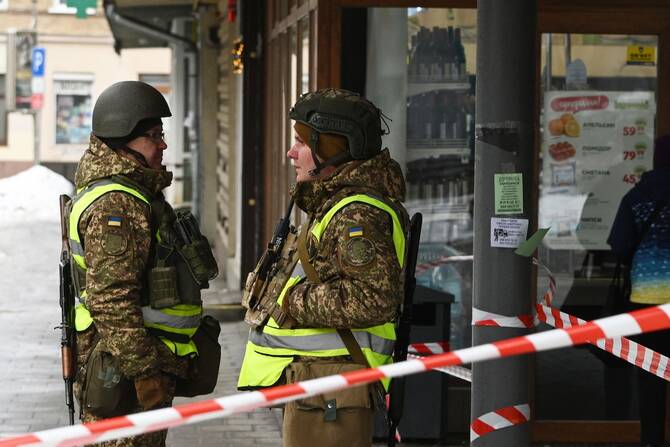
KYIV: One police officer was killed and 24 people were wounded after several explosive devices detonated at midnight in Lviv, in western Ukraine, the National Police said on Sunday, in an attack President Volodymyr Zelensky blamed on Russia.
“It has been preliminarily established that homemade explosive devices detonated,” the police said on the Telegram messaging service.
Lviv Mayor Andriy Sadovyi, writing on Telegram, described the incident as a terrorist act and said a 23-year-old policewoman had died. Twelve people remained in hospital, two in serious condition, he said.
Interior Minister Ihor Klymenko said a woman had been detained in connection with the investigation.
The police said that the first explosion occurred after a patrol crew arrived at the suspected scene of a shop break-in, while the second explosion occurred a little later.
Zelensky, speaking in his nightly video address, accused Russia of being behind the attack and said the perpetrators had been recruited online. Ukrainian intelligence believed Russia would “continue to do such things, real attacks on Ukrainians. There needs to be more protection for people,” Zelensky said.
The fourth anniversary of Russia’s full-scale invasion of Ukraine falls this week.


Police officer killed, 24 people wounded in bomb explosions in Ukraine’s Lviv
https://arab.news/pwxnk
Police officer killed, 24 people wounded in bomb explosions in Ukraine’s Lviv

- “It has been preliminarily established that homemade explosive devices detonated,” the police said on the Telegram messaging service


Guinea launches probe after nationals expelled from Germany
- The government in Conakry has been under pressure in recent days to respond to the deportations
- Ministers have summoned the charge d’affaires from Germany’s embassy to explain why the Guineans were expelled
CONAKRY: The authorities in Guinea said Thursday they were looking into why a number of its citizens had been kicked out of Germany, after an angry online response to the expulsions.
The government in Conakry has been under pressure in recent days to respond to the deportations, videos and testimony of which have been circulating on social media.
Ministers have summoned the charge d’affaires from Germany’s embassy to explain why the Guineans were expelled and to urge a halt to future deportations.
“We want our fellow citizens to have their dignity respected,” Foreign Minister Morissanda Kouyate told the diplomat before television cameras.
At a news conference on Thursday, Kouyate announced that a “bilateral commission of investigation” had been established involving both Guinea and Germany to get to the bottom of the matter.
“Instead of hurling abuse at each other... we are going to sit down at a table in the strict interest of European citizens and Guinean citizens,” he told reporters, alongside German ambassador Irene Biontino.
Some 6,000 Guineans are living irregularly in Germany, the minister said.
Biontino on Wednesday said in an interview that there had been “no offensive” recently. The deportations of irregular Guinean nationals were being conducted in line with bilateral agreements and Germany’s “sovereignty,” she added.
“A total of 30 people were deported to Guinea in January 2026. (In comparison), in January 2025, 20 people were sent back to Guinea,” a German interior ministry spokesman told AFP.
There were 169 expulsions to Guinea in 2025, they added.
In recent years, Guinea has become a key starting point for young migrants trying to smuggle themselves into north Africa and Europe in the hope of a better future.
According to a 2021 International Organization for Migration study, the Guinean diaspora was estimated at between three and five million people.
Most were living in west Africa and in France, Germany and Belgium.


