Pakistan, 13 Muslim nations condemn US envoy’s remarks on Israel’s right to Middle East land

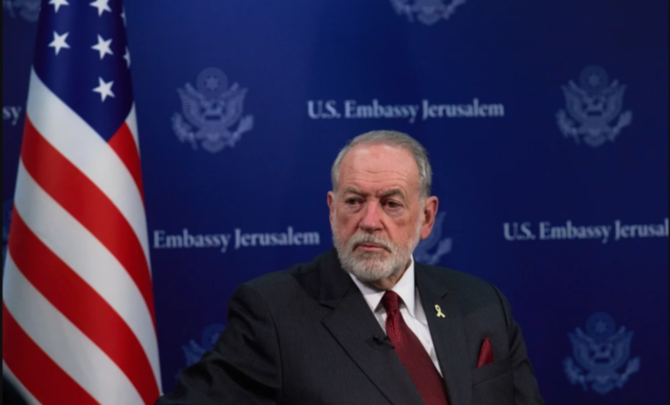
US ambassador to Israel Mike Huckabee is seen during an interview in Jerusalem on August 20, 2025. (AP/File)
Short Url
Updated 22 February 2026
Follow

Pakistan, 13 Muslim nations condemn US envoy’s remarks on Israel’s right to Middle East land

  • US ambassador to Israel Mike Huckabee suggested Israel could claim land stretching across parts of Middle East
  • Joint statement says remarks contradict US President Donald Trump’s vision to ensure peace in the Middle East

ISLAMABAD: The foreign ministers of Pakistan, 13 other Arab and Islamic nations issued a joint statement on Sunday condemning recent remarks by US ambassador to Israel Mike Huckabee, who suggested Israel had a biblical right to the Middle East.

Huckabee said on Saturday that it would be acceptable if Israel took control of the entire Middle East, including the West Bank, drawing anger and condemnation from several Muslim nations. 

The foreign ministers of Pakistan, Egypt, Jordan, UAE, Indonesia, Turkiye, Saudi Arabia, Qatar, Kuwait, Oman, Bahrain, Lebanon Syria, Palestine, and the secretariats of the Organization of Islamic Cooperation (OIC), the League of Arab States (LAS), and the Gulf Cooperation Council (GCC) expressed their” strong condemnation and profound concern” over Huckabees’ comments in a joint statement late Saturday night. 

“They affirm their countries’ categorical rejection of such dangerous and inflammatory remarks, which constitute a flagrant violation of the principles of international law and the Charter of the United Nations, and pose a grave threat to the security and stability of the region,” the joint statement read. 

The statement said that these comments were in contradiction of US President Donald Trump’s vision for peace in Gaza and his efforts to contain escalation there and create a “political horizon” for a comprehensive settlement for a separate Palestinian state.

“The Ministries reaffirmed that Israel has no sovereignty whatsoever over the Occupied Palestinian Territory or any other occupied Arab lands,” the statement said.

“They reiterated their firm rejection of any attempts to annex the West Bank or separate it from the Gaza Strip, their strong opposition to the expansion of settlement activities in the Occupied Palestinian Territory, and their categorical rejection of any threat to the sovereignty of Arab states.”

The statement warned that Israel’s continuation of its “expansionist policies” would only inflame violence and conflict in the region. 

Huckabees’ statement comes amid Israel’s move earlier this month to register lands in the West Bank, which is seen by several Muslim states and the Palestinian Authority as an attempt to annex lands in the Palestinian territory. 

The move drew sharp condemnation from several Muslim states earlier this week, who called on the international community to intervene and stop Israel from pursuing “illegal settlement” activity. 


Pakistan says defense pact with Saudi Arabia elevated brotherly ties to ‘new heights’

Updated 25 February 2026
Follow

Pakistan says defense pact with Saudi Arabia elevated brotherly ties to ‘new heights’

  • Pakistan, Saudi Arabia signed strategic defense pact last year pledging aggression against one will be treated as attack on both
  • Deputy PM Ishaq Dar says enduring bonds with Islamic and Arab nations form vital pillar of Pakistan’s foreign policy 

ISLAMABAD: Deputy Prime Minister Ishaq Dar said on Wednesday that Pakistan’s defense pact with Saudi Arabia elevated its brotherly ties with the Kingdom to “new heights,” stressing that close ties with Arab and Islamic nations form a key pillar of Islamabad’s foreign policy. 

Pakistan and Saudi Arabia signed a Strategic Mutual Defense Agreement on Sept. 17 last year, pledging that aggression against one country would be treated as an attack on both, enhancing joint deterrence and formalizing decades of military and security cooperation.

Both nations agreed in October 2025 to launch an economic cooperation framework to strengthen trade and investment ties. 

“In the Middle East, our landmark Strategic Mutual Defense Agreement with Saudi Arabia has elevated our brotherly ties to new heights,” Dar said while speaking at the Pakistan Governance Forum 2026 event in Islamabad. 

The Pakistani deputy prime minister was speaking on the topic “Navigating International Relations Amidst Changing Geo-Politics.”

Dar noted that Pakistan has reinforced partnerships with other Middle Eastern nations such as the UAE, Qatar, Jordan, Oman, Egypt and Bahrain. He said these partnerships have yielded “concrete agreements” in investment, agriculture, infrastructure, and energy sectors. 

“Our enduring bonds with Islamic and Arab nations form a vital pillar of our foreign policy, and we will continue to expand our partnerships across Asia, Latin America, and Africa,” he said. 

Dar pointed out that the presidents of Kazakhstan, Uzbekistan and Kyrgyzstan have undertaken visits to Pakistan in recent months, reflecting Central Asian nations’ desire to boost cooperation with Islamabad.

On South Asia, the Pakistani deputy PM said Pakistan has successfully transformed its fraternal ties with Bangladesh into “a substantive partnership.”

“Similarly, the trilateral mechanism involving China, Pakistan, and Bangladesh has been launched with a view to expanding and deepening regional cooperation and synergy,” the Pakistani minister said. 

He said Islamabad has strengthened its “all-weather” partnership with China via the second phase of the multi-billion-dollar China-Pakistan Economic Corridor agreement and “unwavering support” from both sides for each other’s core interests. 

Dar said Pakistan had also reinvigorated its partnership with the US, advancing cooperation in trade, technology, investment, and regional stability. 

“This calibrated approach has enhanced our ability to navigate complexity with skill and confidence, ensuring that our national interests are served without compromising our core foreign policy principles,” he said.