WASHINGTON: President Donald Trump’s removal of national security adviser Mike Waltz brings further disruption to a national security team that has already endured scrutiny over using the Signal messaging app to discuss sensitive military operations as well as mounting questions over the leadership of Defense Secretary Pete Hegseth and the firing of the four-star general who led the National Security Agency.
The staff shake-up comes as the administration confronts foreign policy issues that include Iran’s rapidly advancing nuclear ambitions, a trade fight with China and conflicts in Gaza and Ukraine that have defied easy resolutions despite Trump’s initial confidence that he could settle both wars quickly.
But Waltz’s departure also presents an opportunity for Trump to consolidate foreign policy in just a few hands, with the Republican president asserting even more power over decision-making and relying on a select group of people who have entirely embraced his “America First” agenda.
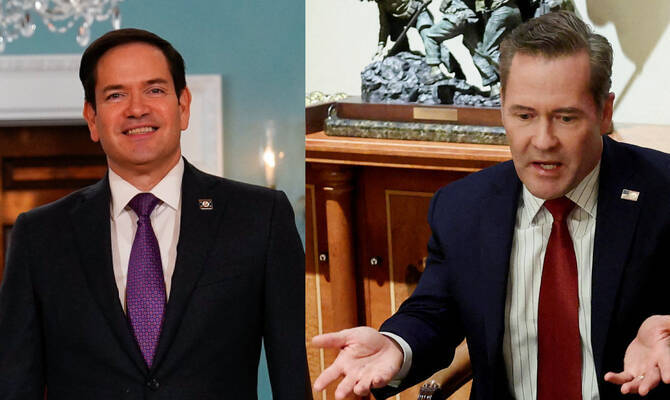
Those influential voices include special envoy Steve Witkoff and Secretary of State Marco Rubio, who on Thursday was named to replace Waltz on an acting basis while Waltz was nominated as the US ambassador to the United Nations.
“I would think he has just about what he wants” in terms of consolidated power, said William Banks, founding director of what is now called the Syracuse University Institute for Security Policy and Law. “There aren’t many outliers.”
Gaining Trump’s confidence or losing it
Rubio may once have seemed an unlikely choice for such prominent positions given that the onetime Trump rival and hawkish conservative was derided by Trump as “Little Marco” during the 2016 presidential campaign.
But since then, the former Florida senator has proved adept at aligning himself with Trump’s foreign policy positions, presiding over a massive overhaul of the State Department while steering clear of some of the pitfalls that other national security leaders have encountered.
Waltz, for instance, faced intense criticism in March after revelations that he added journalist Jeffrey Goldberg to a private text chain on an encrypted messaging app that was used to discuss planning for an airstrike against Houthi militants in Yemen.
He also was considered to be part of a neoconservative wing of the Republican Party that had supported the war in Iraq and other US military interventions abroad, including in Syria and Libya, that have now found disfavor in today’s GOP. The former Florida congressman has advocated for further diplomatically isolating Russian President Vladimir Putin, whom Trump has viewed at moments with admiration.
The Pentagon, too, has been a source of tumult, with Hegseth directing firings of top military officers and now ousting his own top civilian advisers in response to leak allegations. There are now multiple vacancies in key positions at a critical time for the military. Other missteps have included a broad edict for the military services to erase images celebrating diversity, leading to the brief removal of online content of prominent figures such as Jackie Robinson and causing a public outcry.
Reports of Elon Musk being offering a classified Pentagon briefing on China and Hegseth posting airstrike plans in two Signal chats with dozens of people have spurred calls for the defense secretary’s firing. But Trump has stood by him.
Trump’s national security team could be “charitably” described as “a work in progress,” said Daniel Fried, a former US ambassador to Poland and a National Security Council official under both the Clinton and George W. Bush administrations, citing what he said were concerns about coordination and portfolios.
“I’m not saying that the Trump foreign policy team is doomed. But the lack of coordination, the lack of consistency, the sense of chaotic decision-making isn’t just a media myth,” Fried said.
Trump’s approach to foreign policy
The national security adviser post, established in 1953, matters to the functioning of a cohesive government. That official is intended to serve as a hub in coordinating information, soliciting advice among agencies and developing policy recommendations for the president.
But the argument for balance in policymaking is unlikely to resonate with Trump. Over the course of his career, he has claimed expert knowledge on everything from Islamic militants to taxes and technology.
Heather Conley, a former deputy assistant secretary of state during the George W. Bush administration, said Trump often gives greater weight to advice and recommendations from television and social media than his senior advisers.
“There is very little role for policy coordination because the president is clearly setting the policy on a daily, hourly basis,” Conley said.
The NSC didn’t immediately respond to messages seeking comment.
Even as Trump has elevated Rubio, there are signs that Trump also has welcomed the input of a far-less conventional source: far-right activist Laura Loomer.
Last month, she appeared to take credit for Trump’s firing of Air Force Gen. Tim Haugh as head of the NSA and the Pentagon’s Cyber Command after a 33-year career in intelligence and cyber operations. Loomer said she had raised questions to Trump about Haugh’s ties to retired Gen. Mark Milley, who was chairman of the Joint Chiefs of Staff in Trump’s first term but later became a critic, and she questioned Haugh’s loyalty.
On Friday, Loomer said she recommended to Trump in a private meeting last month that he remove Waltz from his job.
Changes from the first Trump administration
The Waltz ouster notwithstanding, Trump has tried to project a more ordered administration than during his first term. Those four years were marked by big personnel changes among his national security leadership and bitter disagreements with officials he felt were trying to rein him in or box in his choices.
He replaced three national security advisers, and fired an FBI director and secretary of state. He clashed with one defense secretary who resigned after differing with Trump over the abrupt withdrawal of US troops from Syria and dismissed another who broke with him over using the military during racial justice protests in 2020.
The removal of a national security adviser with views not in perfect alignment with his own may help free Trump from some of the constraints he felt from government agencies in his first term.
Yet at a moment when Trump is trying to find endgames to the wars in Ukraine and Gaza while trying to negotiate an Iran nuclear deal and waging a global tariff war, leaning on Rubio to serve in both roles may be suboptimal.
Appearing Thursday night on Fox News Channel’s “Hannity,” Rubio centered his comments on the foreign policy news of the day — including the US role in trying to broker peace between Russia and Ukraine — rather than on a leadership transition that now has him juggling two major positions.
“The fact that Rubio has multiple titles may mean that his stock is rising, but not necessarily,” Fried said. “And that’s part of the problem. If it’s not clear who is in charge and it’s not clear where you go to get answers, that’s not a recipe for leverage. It’s a recipe for uncertainty and paralysis.”


![]()

Waltz ouster adds to tumult in Trump’s national security team but consolidates power in fewer hands
Short Url
https://arab.news/v2eqh
Waltz ouster adds to tumult in Trump’s national security team but consolidates power in fewer hands
- The staff shake-up comes as the administration confronts foreign policy issues
- The Pentagon, too, has been a source of tumult, with Hegseth directing firings of top military officers and now ousting his own top civilian advisers in response to leak allegations


Latest updates


© 2026 SAUDI RESEARCH & PUBLISHING COMPANY, All Rights Reserved And subject to Terms of Use Agreement.