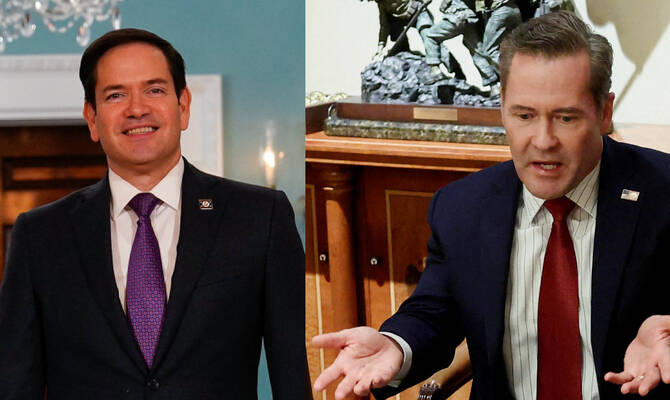
WASHINGTON: President Donald Trump said Thursday that he is nominating national security adviser Mike Waltz as United Nations ambassador while Secretary of State Marco Rubio would take over Waltz’s duties on an interim role.
He announced the major shake-up of his national security team shortly after news broke that Waltz and his deputy are leaving the administration. Waltz has been under scrutiny for weeks after reporting from The Atlantic that he had mistakenly added the magazine’s editor-in-chief to a Signal chat being used to discuss military plans.
“I am pleased to announce that I will be nominating Mike Waltz to be the next United States Ambassador to the United Nations. From his time in uniform on the battlefield, in Congress and, as my National Security Adviser, Mike Waltz has worked hard to put our Nation’s Interests first,” Trump wrote on social media.
“In the interim, Secretary of State Marco Rubio will serve as National Security Adviser, while continuing his strong leadership at the State Department. Together, we will continue to fight tirelessly to Make America, and the World, SAFE AGAIN.”
There is precedent for the secretary of state to serve simultaneously as national security adviser. Henry Kissinger held both positions from 1973 to 1975.
It’s not clear how long Rubio will hold both jobs.
But he’ll be doing double duty at a moment when the Trump administration is facing no shortage of foreign policy challenges — the wars in Ukraine and Gaza, Iran’s rapidly advancing nuclear program and an uncertain world economy in the midst of Trump’s global tariff war.
Waltz came under searing criticism in March after revelations that he added journalist Jeffrey Goldberg to a private text chain on an encrypted messaging app that was used to discuss planning for a sensitive military operation against Houthi militants in Yemen.
Trump’s decision to move Waltz to the UN comes weeks after he pulled his pick for the job, Rep. Elize Stefanik of New York, from consideration over fears about Republicans’ tight voting margins in the US House.
“I’m deeply honored to continue my service to President Trump and our great nation,” Waltz said Thursday.
His shift from national security adviser to UN ambassador nominee means he will now have to face a Senate confirmation hearing.
The process, which proved to be difficult for a number of Trump’s Cabinet picks, will give lawmakers, especially Democrats, the first chance to grill Waltz on his decision to share information about an imminent US airstrike on Signal.
Sen. Chris Coons, the top Democrat on the Senate Foreign Relations Committee, signaled that Waltz will face difficult questions.
“I look forward to a thorough confirmation hearing,” Coons said on social media.
Trump is believed to be weighing several senior aides to eventually take on the national security adviser role, including special envoys Steve Witkoff and Richard Grenell, National Security Council senior director for counterterrorism Sebastian Gorka and senior State Department official Michael Anton, according to several people familiar with the ongoing deliberations.
Witkoff, a fellow New York City real estate maverick who has known Trump for years, has played a key role in negotiations to end the Russia-Ukraine war and the Israel-Hamas conflict and has been the administration’s chief interlocutor in the Iran nuclear talks launched last month.
Witkoff has expressed no interest in taking the job, which requires hands-on management of numerous agencies, but could, if asked by Trump, assume temporary control of the NSC, according to one US official familiar with the matter.
The official, who spoke on condition of anonymity due to the sensitivity of the matter, said Witkoff would prefer to stay in his current special envoy role, which is relatively independent and not tied to any particular bureaucracy.
Grenell, in addition to being Trump’s envoy for special missions, is serving as the interim president at the Kennedy Center. He served as ambassador to Germany during Trump’s first administration, was special presidential envoy for Serbia and Kosovo peace negotiations, and did a stint as acting director of national intelligence. He’s also weighing running in next year’s California governor’s race.
Waltz had previously taken “full responsibility” for building the Signal message chain and administration officials described the episode as a “mistake” but one that caused Americans no harm. Waltz maintained that he was not sure how Goldberg ended up in the messaging chain, and insisted he did not know the journalist.
Trump and the White House — which insisted that no classified information was shared on the text chain — publicly stood by Waltz throughout the episode. But the embattled national security adviser was under siege from personalities such as Laura Loomer, who has encouraged Trump to purge aides who she believes are insufficiently loyal to the “Make America Great Again” agenda.
As reports began to circulate that Waltz could be leaving the administration, Loomer appeared to take credit in a post on the social media site X, writing: “SCALP.”
“Hopefully, the rest of the people who were set to be fired but were given promotions at the NSC under Waltz also depart,” Loomer wrote in another post.
Questions have also swirled around Defense Secretary Pete Hegseth and his role in the Signal chat.
While Waltz set it up, Hegseth posted times for aircraft launches and bomb drops into the unsecured app and shared the same information with dozens of people in a second chat, including his wife and brother.
The Associated Press reported that Hegseth also bypassed Pentagon security protocols to set up an unsecured line for a personal computer in his office –- beside terminals where he was receiving classified information. That raises the possibility that sensitive information could have been put at risk of potential hacking or surveillance.
The Pentagon inspector general is investigating Hegseth’s use of Signal, and he has faced criticism from Democrats and even some Republicans. It has added to the turmoil at the Pentagon at a time when Hegseth has dismissed or transferred multiple close advisers. Nonetheless, Trump has maintained public confidence in Hegseth.


![]()

Trump nominates Mike Waltz for UN ambassador, taps Rubio as acting national security adviser
Short Url
https://arab.news/pqm97
Trump nominates Mike Waltz for UN ambassador, taps Rubio as acting national security adviser
- Trump announced the major shake-up of his national security team shortly after news broke that Waltz was leaving the administration
- Trump had earlier pulled out his nomination to the UN of Rep. Elize Stefanik, saying she is needed to keep the Republican House majority


Latest updates


© 2026 SAUDI RESEARCH & PUBLISHING COMPANY, All Rights Reserved And subject to Terms of Use Agreement.