

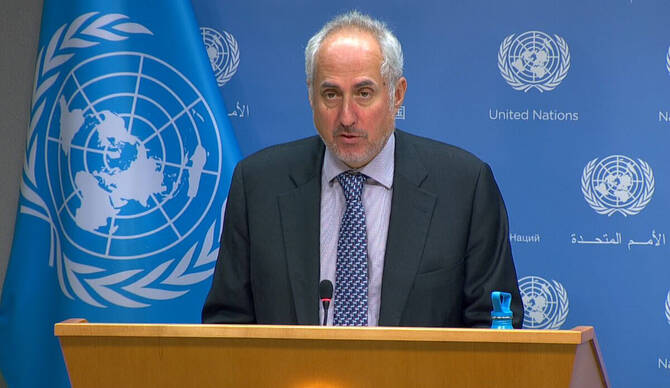

NEW YORK: The UN on Thursday rejected accusations by Yemen’s Houthi authorities that its staff were involved in espionage, calling the claims “extremely disturbing” and warning they put lives at risk.
“We categorically reject any and all accusations that UN personnel or UN operations in Yemen were involved in any form of espionage or in any activities that were not consistent with our humanitarian mandate,” said Stephane Dujarric, spokesperson for UN Secretary-General Antonio Guterres.
“Accusations, calling UN staff spies or, as we’ve seen in other contexts, calling them terrorists — all that does is it puts the lives of UN staff everywhere at risk, and it’s unacceptable.”
Dujarric’s comments came in response to a wave of detentions by Houthi authorities targeting workers from the UN and nongovernmental organizations in Yemen. At least 53 UN staff members remain arbitrarily detained, some held incommunicado for years, according to the UN.
The Houthi rebels have in recent weeks accused the UN of spying for the US and Israel, exhibiting political bias, and failing to condemn Israeli military actions. These allegations emerged after an Israeli airstrike in September killed several senior Houthi officials in Sanaa.
Following the strike, Houthi officials claimed that some of the detained UN employees were engaged in espionage, and that diplomatic immunity “should not be a cover” for such activities.
In a statement from its Houthi-run Foreign Ministry, the group claimed the UN’s silence on the Israeli attack demonstrated “double standards” and complicity.
Dujarric pushed back strongly against those narratives, insisting the UN’s presence in Yemen was solely humanitarian.
“The work that we do in Yemen and we do everywhere where we do humanitarian work is guided by our basic principles of humanity, impartiality, neutrality and independence,” he said.
“The reason our humanitarian colleagues are in Yemen is to help the Yemeni people.”
The UN has repeatedly condemned the detentions and raids on its premises in Houthi-held areas, and Guterres has called for the immediate and unconditional release of all UN personnel, NGO workers, and diplomatic staff.
Human Rights Watch has also criticized the arrests, stating that no credible evidence has been presented to support the espionage allegations, and warning that such actions are obstructing critical aid operations in the war-torn country.
The Houthis’ accusations have drawn wider scrutiny of their treatment of aid workers and engagement with international agencies.
In September, they accused UN Special Envoy Hans Grundberg of “political complicity” for condemning the detentions while allegedly ignoring what they termed Israeli “aggression” in Yemen.
Despite the criticism, the UN maintains that its operations remain grounded in neutrality. “We will continue to call for the end to the arbitrary detention of our colleagues,” Dujarric said.
“They need to be released, alongside the NGO workers and those from diplomatic missions.”
Yemen’s conflict, which escalated in 2015 after the Houthis seized the capital Sanaa, has triggered one of the world’s worst humanitarian crises. UN-led efforts to broker peace have repeatedly stalled amid growing regional instability.


