Pakistan defense minister doubts Afghan ceasefire, accuses Kabul of acting on India’s behalf

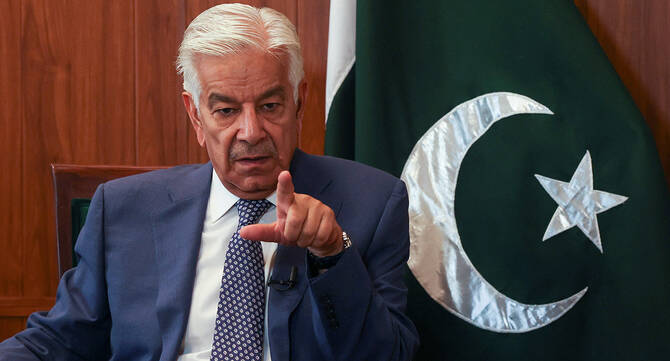
Pakistan's Defence Minister Khawaja Muhammad Asif gestures during an interview with Reuters in Islamabad, Pakistan, May 8, 2025. (REUTERS)
Short Url
Updated 16 October 2025
Follow

Pakistan defense minister doubts Afghan ceasefire, accuses Kabul of acting on India’s behalf

  • Pakistan and Afghanistan agreed to a temporary ceasefire on Wednesday after airstrikes and ground fighting ramped up tensions
  • Skirmishes have strained already frayed ties, with Islamabad viewing New Delhi’s growing influence in Afghanistan as a regional security threat

ISLAMABAD: Pakistani Defense Minister Khawaja Asif has cast doubt over Islamabad’s ceasefire with Afghanistan after heavy cross-border clashes between the neighbors in recent days, accusing Kabul of fighting India’s “proxy war.”

Asif’s remarks came shortly after Pakistan and Afghanistan agreed to a 48-hour-long ceasefire on Wednesday after airstrikes and ground fighting ramped up tensions between the South Asian neighbors, leaving more than a dozen civilians dead and 100 wounded. The fighting was the worst between them since the Afghan Taliban seized power in Kabul in 2021. 

The latest skirmishes coincided with Afghan Foreign Minister Amir Khan Muttaqi’s first visit to Pakistan’s arch-rival, India, during which New Delhi said it would reopen its Kabul embassy and the Afghan Taliban said it would send its diplomats to India.

“I have my doubts that this [ceasefire] will hold, because the Taliban, as I have told you, right now all their decisions are being sponsored by Delhi,” Asif told a private news channel on Wednesday night.

“Muttaqi sahib has been sitting there [in India] for a week and has now returned, what plan he has brought, so, I think that Kabul is currently fighting Delhi’s proxy war.”

Asif said Pakistan would respond positively to any constructive dialogue, but it would not tolerate ceasefire violations or attacks on its territory.

“We have the capability, and we will attack them, god willing, if they escalate or widen the radius of this war,” he said.

There was no immediate response from New Delhi or Kabul to Asif’s remarks.

Earlier on Wednesday, Pakistan carried out an airstrike on the Afghan border province of Kandahar and hit the town of Spin Boldak, officials in both countries said.

Pakistani security officials said the airstrike had targeted a brigade of Afghan Taliban troops and that dozens were killed. Enayatullah Khowarazmi, Afghanistan’s defense ministry spokesperson, said residential areas of Spin Boldak were hit.

Pakistan carried out another airstrike in Kabul, the officials said. It was not clear what the target of the strike was in Kabul.

Last weekend, Pakistan said 23 of its soldiers were killed in cross-border fighting while Afghan authorities claimed to have killed 58 Pakistani troops and lost 9 of their own.

Relations between Islamabad and Kabul have sharply deteriorated in recent years, with Pakistan accusing the Afghan Taliban of sheltering fighters from the banned Tehreek-e-Taliban Pakistan (TTP) and allowing them to stage cross-border attacks from Afghan soil. Kabul denies the allegation, saying it does not permit its territory to be used against other countries.

With inputs from Reuters


Pakistan offers Kyrgyzstan Arabian Sea access as two states sign 15 cooperation accords

Updated 05 December 2025
Follow

Pakistan offers Kyrgyzstan Arabian Sea access as two states sign 15 cooperation accords

  • Pakistan and Kyrgyzstan sign MOUs spanning trade, energy, agriculture, ports, education, security cooperation
  • Kyrgyz president is on first visit to Pakistan in 20 years as both sides push connectivity and CASA-1000 power links

ISLAMABAD: Pakistan on Thursday offered Kyrgyzstan the shortest and most economical route to the Arabian Sea as the two countries signed 15 agreements and memoranda of understanding aimed at boosting cooperation across trade, energy, agriculture, education, customs data-sharing and port logistics.

The accords were signed during a visit to Islamabad by President Sadyr Zhaparov, the first by a Kyrgyz head of state to Pakistan in two decades, and part of Islamabad’s renewed push to link South Asia with landlocked Central Asian economies through ports, power corridors and transport routes.

For Pakistan, Kyrgyzstan offers access to hydropower through CASA-1000, a $1.2 billion regional electricity transmission project designed to carry surplus summer electricity from Kyrgyzstan and Tajikistan through Afghanistan into Pakistan. For Bishkek, Pakistan provides overland access to warm-water ports on the Arabian Sea, creating a shorter commercial route to global markets.

“President Asif Ali Zardari has reiterated Pakistan’s readiness to offer Kyrgyzstan the shortest and most economical route to the Arabian Sea,” Radio Pakistan reported after Zhaparov met the Pakistani president. 

The two leaders also discussed expanding direct flights to deepen business, tourism and people-to-people ties.

Zardari welcomed Kyrgyzstan’s completion of its segment of the CASA-1000 project and “reaffirmed Pakistan’s commitment to completing its part of the project, which is now at an advanced stage,” the state broadcaster said. 

Zhaparov thanked Islamabad for supporting Bishkek’s candidacy for a non-permanent UN Security Council seat and invited Zardari to visit Kyrgyzstan at a time of his convenience. Both sides expressed satisfaction with progress under the Quadrilateral Traffic in Transit Agreement, designed to facilitate road movement between Pakistan, Kyrgyzstan, Kazakhstan and China.

Earlier, both governments exchanged 15 sectoral cooperation documents covering commerce, mining, geosciences, power, agriculture, youth programs, the exchange of convicted persons, customs electronic data systems and a sister-city linkage between Islamabad and Bishkek.

According to APP, the MOUs were signed by ministers representing foreign affairs, commerce, economy, energy, power, railways, interior, culture, health and tourism. Agreements also covered cooperation between Pakistan’s Foreign Service Academy and the Diplomatic Academy of Kyrgyzstan, as well as collaboration between universities, youth ministries and cultural institutions.

“Our present mutual trade, comprising of about $15–16 million will be enhanced to $200 million in the next two years,” Prime Minister Shehbaz Sharif said after the agreements were signed, calling them “a framework for structured, result-oriented engagement and closer institutional linkages.”

Sharif said Pakistan was ready to serve as a maritime outlet for the landlocked Central Asian republic, offering access to Karachi, Port Qasim and Gwadar to help Kyrgyz goods reach regional and global markets.