NAIROBI: Tanzania’s white beaches and safari lodges are emptier than usual as the country counts the cost to its crucial tourism sector from the mass killing of protesters during recent election unrest.
The election on October 29 erupted into days of violent protests over allegations that President Samia Suluhu Hassan had rigged the vote.
Police responded by shooting dead more than 1,000 people, according to the opposition, though the government has still not given a final body count.
With fresh protests called for December 9, there are fears of more disruption to come.
“The current situation is very disturbing,” said a hotel manager in Arusha, one of the cities serving as a gateway to the Serengeti safari park.
“In my hotel, 150 bookings and four international events that were planned for December have been canceled so far,” the manager said, adding the hotel was below 30 percent full, compared to two-thirds or higher for that period normally.
The government has insisted there is nothing for tourists to fear.
“Our nation remains peaceful, calm, and open to all,” spokesman Gerson Msigwa told reporters.
Beyond the Internet blackout and canceled flights at the height of the unrest, tourists have indeed been largely unaffected.
“I don’t think it’s having a real impact on us foreigners,” said French tourist Jeremy Fuzel, shopping for handicrafts with his wife and young daughter on the island of Zanzibar.
But business has been noticeably slow, said shopkeepers in the island’s capital, Stone Town.
“Sometimes there are a few slow days, but not two weeks in a row like this,” said Nazir Adam, a jeweller. “It’s the topic everyone is talking about here right now.”
- ‘Fear to speak’ -
That is a problem in the east African country where tourism has become the biggest revenue source, attracting a record 2.14 million international visitors last year and projected to make nearly $4 billion this year.
“Many people may fear to speak about the real situation but almost half of the tourism business is disrupted,” said a tour operator in Arusha, speaking on condition of anonymity for fear of violent reprisals by the police.
Activists say tourists should stay away to punish the government for its violence.
“If you go snorkelling or swimming you might find body parts as we received solid information that bodies were dumped into the Indian Ocean,” said exiled activist Maria Sarungi Tsehai on X.
But others say tourism’s real problems stem from recent counter-productive government policies.
Nora Suleiman, founder of the Nakupenda Tours agency on Zanzibar, blamed a new $44 insurance fee and $90 passenger tax on plane tickets for putting off tourists.
Patrice Caradec, head of French tour operators union SETO, said the biggest problem was a ban on Tanzanian airlines flying in the European Union this year over a lack of safety personnel.
“Tanzania has been a hit with the French for several years,” but it dropped by 15-18 percent this summer, he said, largely because of the airline ban.
- ‘Rebuilding confidence’ -
The most frustrating aspect, Caradec said, was that SETO sent a team to help Tanzania deal with the paperwork to get the ban removed, but it was ignored by the Tanzanian government.
“Between the blacklisted airlines... and the riots, I can confirm that quite a few of our compatriots have decided not to go,” he said.
Mabrian, a consultancy using artificial intelligence to measure global sentiment about countries and industries, made a more direct link to the election unrest.
It found there was a 14 percent drop in its perception-of-security index for Tanzania in November among international travelers year-on-year. Hotel prices were also down 14 percent.
“Even once the political situation stabilizes, rebuilding confidence in travelers’ safety and security will remain a crucial and urgent challenge for Tanzania,” said Mabrian analyst Carlos Cendra.

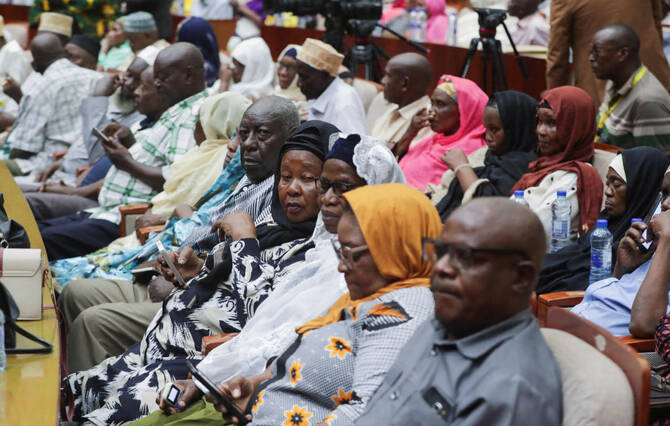
Tanzania tourism suffers after election killings
https://arab.news/bgcn9
Tanzania tourism suffers after election killings
- Tanzania’s white beaches and safari lodges are emptier than usual as the country counts the cost to its crucial tourism sector from the mass killing of protesters during recent election unrest
Trump is fighting the Institute of Peace in court. Now, his name is on the building
- State Department said it renamed the organization to the Donald J. Trump Institute of Peace to “reflect the greatest dealmaker in our nation’s history.”
- The takeover of the Peace Institute was also anything but peaceful, with his administration seizing the independent entity and ousting its board before affixing his name to the building
State Department said it renamed the organization to the Donald J. Trump Institute of Peace to “reflect the greatest dealmaker in our nation’s history.”
WASHINGTON: The Trump administration has renamed the US Institute of Peace after President Donald Trump and has planted the president’s name on its headquarters despite an ongoing fight over control of the institute.
It’s the latest twist in a seesaw court battle over who controls the US Institute of Peace, a nonprofit think tank that focuses on peace initiatives. It was an early target of the Department of Government Efficiency this year.
On Wednesday, the State Department said it renamed the organization to the Donald J. Trump Institute of Peace to “reflect the greatest dealmaker in our nation’s history.” The new name could be seen on its building, which is near the State Department.
Trump has spent months openly lobbying for a Nobel Peace Prize even though he was passed over for this year’s installment, arguing he had a hand in easing a series of conflicts around the world. But Trump has also ordered strikes on suspected drug vessels off the coast of Venezuela and threatened that attacks on land could be coming.
The takeover of the Peace Institute was also anything but peaceful, with his administration seizing the independent entity and ousting its board before affixing his name to the building.
Anna Kelly, a White House spokesperson, said: “The United States Institute of Peace was once a bloated, useless entity that blew $50 million per year while delivering no peace. Now, the Donald J. Trump Institute of Peace, which is both beautifully and aptly named after a President who ended eight wars in less than a year, will stand as a powerful reminder of what strong leadership can accomplish for global stability.”
She added, “Congratulations, world!”
George Foote, a lawyer for the institute’s former leadership and staff, said the renaming “adds insult to injury.”
“A federal judge has already ruled that the government’s armed takeover was illegal. That judgment is stayed while the government appeals, which is the only reason the government continues to control the building,” Foote said.
Since March, the headquarters has switched hands multiple times in court actions related to the DOGE takeover. A final decision on its fate is pending in federal appeals court.
USIP has maintained it is an independent creation of Congress and outside the president’s executive authority. The administration argues it is an executive branch organization.
After Trump fired the institute’s board in the the spring, the staff was fired as well and the building was turned over to the General Services Administration.
A federal district court overturned the action in May, putting the headquarters back into the hands of USIP leadership. But that action was reversed weeks later by a federal appeals court.
Employees have been fired twice, and the building is no longer in GSA’s possession. The State Department and the institute have an agreement that allows the State Department to occupy and use the building.
The building is expected to be the backdrop for the signing of a peace agreement Thursday between Congo’s President Felix Tshisekedi and Rwanda’s President Paul Kagame. High-ranking officials from the African Union, Angola, Burundi, Kenya, Togo, Qatar, Uganda and the United Arab Emirates are also expected to attend the signing, according to Yolande Makolo, a senior adviser to Kagame.
The USIP website remained unchanged Wednesday night, but its lead item was headlined, “President Donald J. Trump to Sign Historic Peace Agreement at USIP Headquarters,” followed by a write-up of the deal between Congo and Rwanda that Trump was overseeing at the institute on Thursday.
The Institute of Peace was created by Congress in the 1980s. President Ronald Reagan signed the bill into law in 1985. Described as an independent, nonprofit think tank funded by Congress, its mission has been to work to promote peace and prevent and end conflicts while working outside normal channels such as the State Department. It was operating in 26 conflict zones, including Pakistan, Afghanistan, Mali and Burkina Faso, when DOGE shut the operation down.
As had been broadly speculated, Trump was awarded a new peace prize from FIFA on Friday, on the sidelines of the World Cup draw. FIFA president Gianni Infantino had made it clear that he thought Trump should have won the Nobel for his efforts to broker a ceasefire in Gaza.
“This is your prize, this is your peace prize,” Infantino said. He has repeatedly spoken about soccer as a unifier for the world, but the prize is a departure from the federation’s traditional focus on sport.


