

India’s pollution refugees fleeing Delhi’s toxic air

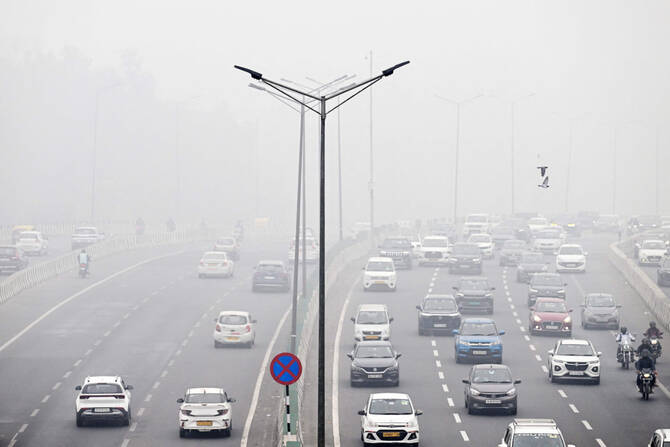
Commuters drive amid dense smog in New Delhi on November 13, 2024. Home to more than 30 million people, New Delhi and the surrounding metropolitan area consistently tops world rankings for air pollution. (AFP)
Short Url
Updated 16 October 2025
Follow

India’s pollution refugees fleeing Delhi’s toxic air

  • New Delhi and the surrounding metropolitan area, home to more than 30 million people, consistently tops world rankings for air pollution
  • Natasha Uppalt, founder of maternal health support group Matrescence India, said leaving the heavily polluted capital city was the “best decision”

BENGALURU, India: Pollution levels in India’s capital shaped Natasha Uppal and her husband’s decision on parenthood — either raise their child away from the city, or stay put and remain childless.
New Delhi and the surrounding metropolitan area, home to more than 30 million people, consistently tops world rankings for air pollution.
Uppal, who grew up in the city, often considered leaving — especially on days spent indoors with air purifiers humming, or when she battled severe migraines.
The turning point came when the couple decided to try for a baby.
“When we thought about what we can curate for our child in Delhi,” she told AFP, “the air just became such a blocker for so many of those things.”
In 2022, they relocated to Bengaluru and, days later, she discovered she was pregnant.
They are among a small but growing number of families leaving Delhi because of health risks linked to air pollution.
Uppal, the 36-year-old founder of maternal health support group Matrescence India, said leaving was the “best decision.”
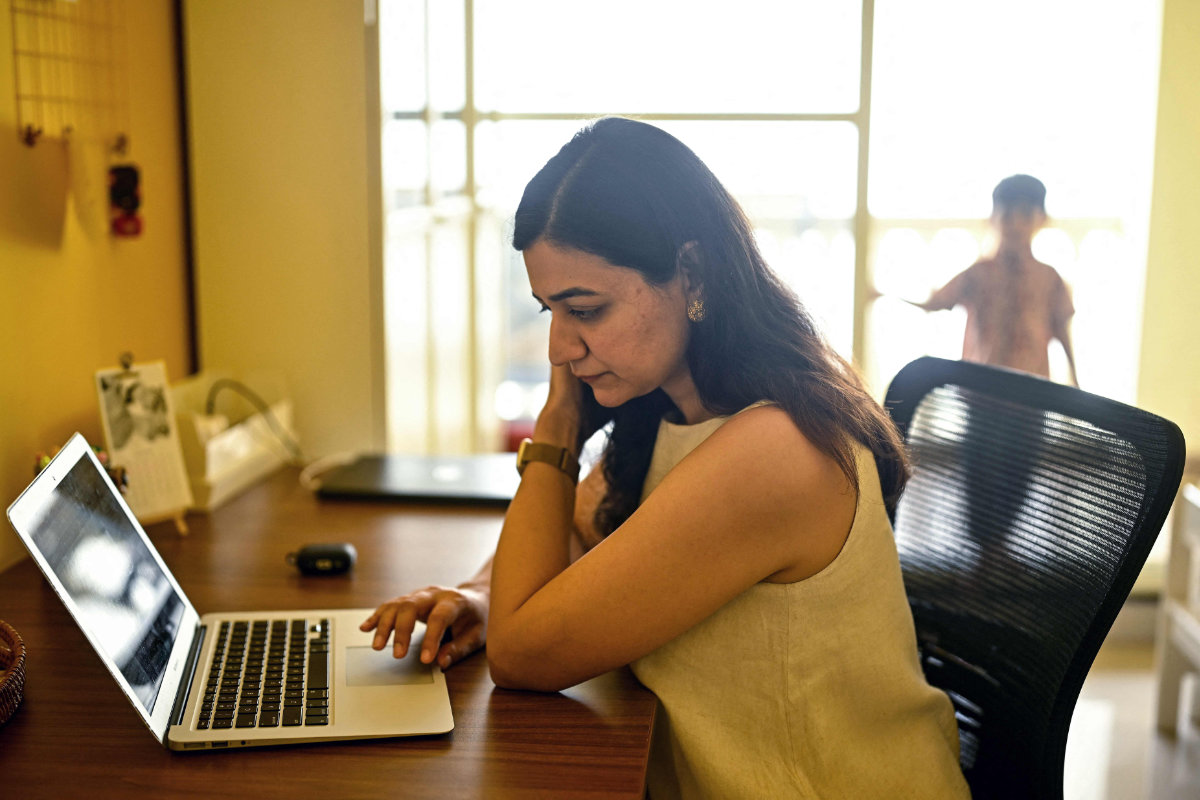


This photograph taken on September 27, 2025 shows Natasha Uppal, a pollution refugee and founder of maternal health support group Matrescence India, reading news articles about air pollution on a laptop at her residence in Bengaluru. (AFP)

Air pollution in Bengaluru can still sometimes hit three times World Health Organization (WHO) limits.
But that is far below Delhi’s months-long haze — and means her son “is in and out of the house as many times as he likes.”
Clean air is “something that is a basic human right,” she said. “Everyone should be able to take (it) for granted.”

3.8 million deaths 

Each winter, Delhi is blanketed in acrid smog, a toxic mix of crop-burning, factory emissions and choking traffic.
Levels of PM2.5 — cancer-causing microparticles small enough to enter the bloodstream — have surged to as much as 60 times WHO limits.
Despite pledges of reform, measures such as partial vehicle bans or water trucks spraying mist have done little to clear the air.
This year, authorities promise cloud-seeding trials to cut pollution.
A study in The Lancet Planetary Health last year estimated 3.8 million deaths in India between 2009 and 2019 were linked to air pollution.
The UN children’s agency warns that polluted air puts children at heightened risk of acute respiratory infections.
For Vidushi Malhotra, 36, the breaking point came in 2020 as her two-year-old son fell ill repeatedly.
“We had three air purifiers running continuously, and then I needed more,” she said.
A year later, Malhotra, her husband and son moved to Goa. She urged friends to follow, starting what she calls a “mini-movement.” A few did.
“I have to keep going back and see my loved ones go through this,” she added. “That really makes me sad.”

Nebulizers, inhalers 

Others, like Delhi resident Roli Shrivastava, remain but live in constant anxiety.
The 34-year-old keeps inhalers for her smoke allegies and nebulizers ready for her toddler, whose cough worsens each winter.
“The doctor told us winter will be difficult,” she said. “He just told us, ‘When your kid starts coughing at night, don’t even call me — just start nebulising.’“
As winter nears, Shrivastava is preparing for another season indoors — restricting outdoor play for her son, running air purifiers and checking air quality daily.
When the family visits relatives in the southern city of Chennai, her son’s health improves “drastically.”
“His nose stops running, his cough goes away,” she said.
Shrivastava and her husband, who both work with a global advocacy group, say they would have left Delhi long ago if not for the “jobs we love and the opportunities.”
Relocation, she admits, is never far from their minds.
“I don’t think at the rate it’s going, Delhi is a good place to raise kids — when it comes to air pollution at least.”


Italian suspect questioned over Bosnia ‘weekend sniper’ killings

Updated 7 sec ago
Follow

Italian suspect questioned over Bosnia ‘weekend sniper’ killings

  • The octogenarian former truck driver from the Friuli-Venezia Giulia region of northeast Italy, is suspected by Milan prosecutors of “voluntary homicide aggravated by abject motives,” according to Italian news agency ANSA

ROME: An 80-year-old man suspected of being a “weekend sniper” who paid the Bosnian Serb army to shoot civilians during the 1990s siege of Sarajevo was questioned Monday in Milan, media reported.

The octogenarian former truck driver from the Friuli-Venezia Giulia region of northeast Italy, is suspected by Milan prosecutors of “voluntary homicide aggravated by abject motives,” according to Italian news agency ANSA.

Lawyer Giovanni Menegon told journalists that his client had answered questions from prosecutors and police and “reaffirmed his complete innocence.”

In October, prosecutors opened an investigation into what Italian media dubbed “weekend snipers” or “war tourists“: mostly wealthy, gun-loving, far-right sympathizers who allegedly gathered in Trieste and were taken to the hills surrounding Sarajevo where they fired on civilians for sport.

During the nearly four-year siege of Sarajevo that began in April 1992 some 11,541 men, women and children were killed and more than 50,000 people wounded by Bosnian Serb forces, according to official figures.

Il Giornale newspaper reported last year that the would-be snipers paid Bosnian Serb forces up to the equivalent of €100,000 ($115,000) per day to shoot at civilians below them.

The suspect — described by the Italian press as a hunting enthusiast who is nostalgic for Fascism — is said to have boasted publicly about having gone “man hunting.”

Witness statements, particularly from residents of his village, helped investigators to track the suspect, freelance journalist Marianna Maiorino said.

“According to the testimonies, he would tell his friends at the village bar about what he did during the war in the Balkans,” said Maiorino, who researched the allegations and was herself questioned as part of the investigation.

The suspect is “described as a sniper, someone

who enjoyed going to Sarajevo to kill people,” she added.

The suspect told local newspaper Messaggero Veneto Sunday he had been to Bosnia during the war, but “for work, not for hunting.” He added that his public statements had been exaggerated and he was “not worried.”

The investigation opened last year followed a complaint filed by Italian journalist and writer Ezio Gavanezzi, based on allegations revealed in the documentary “Sarajevo Safari” by Slovenian director Miran Zupanic in 2022.

Gavanezzi was contacted in August 2025 by the former mayor of Sarajevo, Benjamina Karic, who filed a complaint in Bosnia in 2022 after the same documentary was broadcast.

The Bosnia and Herzegovina prosecutor’s office confirmed on Friday that a special war crimes department was investigating alleged foreign snipers during the siege of Sarajevo.

Bosnian prosecutors requested information from Italian counterparts at the end of last year, while also contacting the International Residual Mechanism for Criminal Tribunals in The Hague, it said. That body performs some of the functions previously carried out by the International Criminal Tribunal for the former Yugoslavia.

Sarajevo City Council adopted a decision last month authorizing the current mayor, Samir Avdic, to “join the criminal proceedings” before the Italian

courts, in order to support Italian prosecutors.