

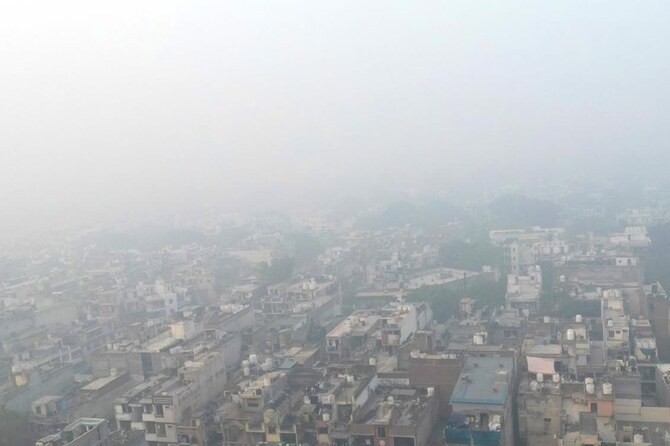

NEW DELHI: New Delhi woke to a thick layer of toxic smog engulfing the city on Thursday, with residents afraid to step outside as the air quality deteriorated to severe levels.
Pollution in the Indian capital and surrounding areas was in the severe category for the second day in a row, with some areas reaching an Air Quality Index score of 461, according to the Central Pollution Control Board. On the AQI scale from 0 to 500, good air quality is represented by levels below 50, while levels above 300 are dangerous.
The severe pollution forced many residents to remain indoors to avoid getting sick.
“For the past two days, it has been particularly bad. I have stopped working out and walking in the open. I am doing basic exercises at home. Children are also falling sick,” said Sunieta Ojha, a lawyer in Delhi.
Bhavreen Kandhari, an activist in south Delhi, said it was “heartbreaking” that her children had to grow up in such conditions.
“It feels so disappointing, it is getting worse. I am trying to make things better so that my children don’t face this,” she said.
“There is no running, no walking. Because of the pollution, I withdrew my teenage girls some years back from playing basketball.”
According to IQAir, a Swiss-based Air Quality Index, monitoring group, the Indian capital was the world’s second most polluted city on Thursday, after nearby Lahore, the capital of Punjab province in Pakistan.
“The air pollution levels are already in the severe category and it’s highly toxic to breathe in,” said Shambhavi Shukla, clean air and sustainable mobility program manager at the Centre for Science and Environment, New Delhi.
The main pollutant, she said, was PM 2.5, particulate matter measuring less than 2.5 microns — about 30 times smaller than the width of a human hair.
“The concentration of these particles is extremely high right now,” she said. “Even a healthy person exposed to this kind of air will have trouble in breathing, so that’s a common thing that they will start developing some breathing issues.”
The sources of Delhi pollution were local — vehicles, construction sites, residential cooking, and waste burning — and those from neighboring areas — mainly the annual fires in India’s northwest and southeast, as farmers clear stubble to prepare fields to plant wheat.
“In the last two days what is also happening is that there is no wind, so there is no movement (of the air),” Shukla said, explaining that the pollution brought earlier from Punjab and Uttar Pradesh, which had accumulated in Delhi, was also trapped as a result of the colder weather, which prevented the pollutants from rising and dispersing.
“There is a prediction that in the next three days we will again go back to the very poor air category ... As soon as the wind picks up, this pollution will start dispersing.”


