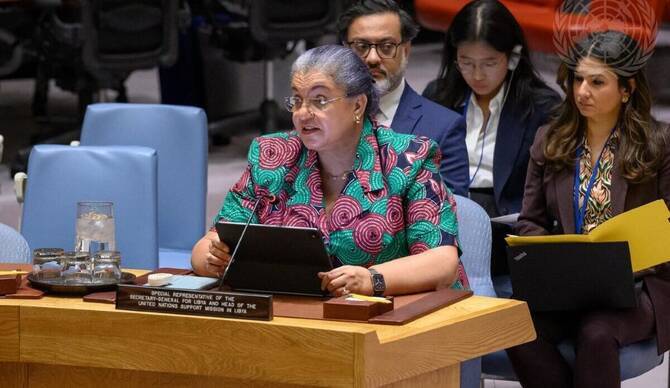
NEW YORK CITY: Hanna S. Tetteh, the UN’s special representative for Libya, told the UN Security Council on Tuesday that progress on a political road map for the reunification of state institutions in Libya and national elections remains stalled, as she urged leaders of the divided country to act swiftly and avoid further delays.
Tetteh outlined the challenges facing the implementation of the political plan for restoring national legitimacy through presidential and legislative elections.
The first milestone of the road map, the reconstitution of the board of the High National Elections Commission by Libya’s House of Representatives and High Council of State, has yet to be completed amid disagreements over the appointment process.
“The two institutions have yet to achieve this objective and have not jointly addressed the constitutional and legal framework for elections,” Tetteh said. “Achieving political consensus will be challenging but Libya cannot afford continued delays or disruptions.”
She called on Libya’s leaders to expedite their efforts to achieve the initial milestones of the road map, warning that the UN Support Mission in Libya would seek the backing of the Security Council for alternative approaches if consensus cannot be reached.
“While the current Libyan leaders and institutions have expressed their commitment to engage constructively, their actions have not sufficiently matched their words and I wish to encourage them to work with UNSMIL, noting that we are ready for discussion and constructive engagement to achieve the stated objectives of the road map,” Tetteh said.
“Should UNSMIL current engagement fail to reach sufficient consensus between the (House of Representatives and High Council of State) to move forward with the road map implementation, UNSMIL will adopt an alternative approach and seek the support of this council to advance the Libyan political transition to reach a meaningful conclusion.”
Libya has been engulfed by political turmoil and national divisions since the 2011 Arab Spring protests that led to the overthrow and killing of Muammar Qaddafi, who ruled for 42 years.
The North African nation is split between two rival governments backed by armed militias and international patrons. In the west of the country, Prime Minister Abdul Hamid Dbeibah heads the internationally recognized Government of National Unity. In the east, Prime Minister Ossama Hamad heads the Government of National Stability, backed by powerful military commander Khalifa Haftar’s Libyan National Army.
In parallel with the political process involving the House of Representatives (aligned with the GNS) and High Council of State (aligned with the GNU), UNSMIL is also organizing a so-called “structured dialogue process” that is due to begin in November. This will engage with broader segments of Libyan society on issues including governance, the economy, security, reconciliation, and human rights, with a special emphasis on the participation of women and youth.
Tetteh said there was a “fragile but improved” security situation in Western Libya, particularly Tripoli, as tensions between the GNU and the Deterrence Apparatus for Combating Organized Crime and Terrorism, a powerful armed force, have eased thanks to mediation efforts, including by Turkiye.
On the issue of the Libyan economy, she sounded the alarm over dysfunctional financial governance, citing in particular the recent discovery by the Central Bank of unregistered dinar notes worth the equivalent of about $1.2 billion, underscoring persistent risks to economic stability and the urgent need for anticorruption measures.
Highlighting ongoing efforts to support national reconciliation, Tetteh noted preparatory meetings involving the African Union and Libya’s Presidential Council. She also highlighted UN initiatives to address mass graves and enforced disappearances, especially in Tarhuna, Murzuq, Misrata and Tawergha, including meetings involving victims’ groups and authorities “to advance truth and reparations — steps critical to help victims deal with the loss of loved ones. Draft legislation on missing persons is under review by Libyan experts to ensure compliance with international standards before submission to parliament.”
Tetteh emphasized the need for regional and international unity in support of the political process in Libya, and affirmed the UN’s commitment to aligning its resources behind efforts to achieve a credible and inclusive political transition.
“Libya’s people deserve political stability and long-term peace,” she said. “The UN stands ready to support the road map and its objectives but decisive political will is indispensable.”

UN urges Libya’s leaders to quit stalling and disrupting political road map for reunification
https://arab.news/jdeny
UN urges Libya’s leaders to quit stalling and disrupting political road map for reunification
- Envoy says UN’s mission in Libya will seek Security Council backing for alternative approaches if rival political factions cannot reach consensus
- Security situation in Western Libya, particularly Tripoli, is ‘fragile but improved thanks in part to international mediation efforts, including by Turkiye
Israeli army takes journalists into a tunnel in a Gaza city it seized and largely flattened
- Israel and Hamas are on the cusp of finishing the first phase of the truce, which mandated the return of all hostages, living and dead, in exchange for Palestinians held by Israel
- Hamas has said communication with its remaining units in Rafah has been cut off for months and that it was not responsible for any incidents occurring in those areas
RAFAH, Gaza Strip: One by one, the soldiers squeezed through a narrow entrance to a tunnel in southern Gaza. Inside a dark hallway, some bowed their heads to avoid hitting the low ceiling, while watching their step as they walked over or around jagged concrete, crushed plastic bottles and tattered mattresses.
On Monday, Israel’s military took journalists into Rafah — the city at Gaza’s southernmost point that troops seized last year and largely flattened — as the 2-month-old Israel-Hamas ceasefire reaches a critical point. Israel has banned international journalists from entering Gaza since the war began more than two years ago, except for rare, brief visits supervised by the military, such as this one.
Soldiers escorted journalists inside a tunnel, which they said was one of Hamas’ most significant and complex underground routes, connecting cities in the embattled territory and used by top Hamas commanders. Israel said Hamas had kept the body of a hostage in the underground passage: Hadar Goldin, a 23-year-old soldier who was killed in Gaza more than a decade ago and whose remains had been held there.
Hamas returned Goldin’s body last month as part of a US-brokered ceasefire in the war triggered by the militants’ Oct. 7, 2023, attack on southern Israel in which 1,200 people were killed and hundreds taken hostage. Israel’s retaliatory offensive has killed more than 70,000 Palestinians, according to Gaza’s Health Ministry, which operates under the Hamas-run government. The ministry does not differentiate between civilians and combatants, but says roughly half the dead have been women and children.
Israel and Hamas are on the cusp of finishing the first phase of the truce, which mandated the return of all hostages, living and dead, in exchange for Palestinians held by Israel. The body of just one more hostage remains to be returned.
Mediators warn the second phase will be far more challenging since it includes thornier issues, such as disarming Hamas and Israel’s withdrawal from the strip. Israel currently controls more than half of Gaza.
Israeli Prime Minister Benjamin Netanyahu is set to travel to Washington this month to discuss those next steps with US President Donald Trump.
Piles of rubble line Rafah’s roads
Last year, Israel launched a major operation in Rafah, where many Palestinians had sought refuge from offensives elsewhere. Heavy fighting left much of the city in ruins and displaced nearly one million Palestinians. This year, when the military largely had control of the city, it systematically demolished most of the buildings that remained standing, according to satellite photos.
Troops also took control of and shut the vital Rafah crossing, Gaza’s only gateway to the outside world that was not controlled by Israel.
Israel said Rafah was Hamas’ last major stronghold and key to dismantling the group’s military capabilities, a major war aim.
On the drive around Rafah on Monday, towers of mangled concrete, wires and twisted metal lined the roads, with few buildings still standing and none unscathed. Remnants of people’s lives were scattered the ground: a foam mattress, towels and a book explaining the Qur’an.
Last week, Israel said it was ready to reopen the Rafah crossing but only for people to leave the strip. Egypt and many Palestinians fear that once people leave, they won’t be allowed to return. They say Israel is obligated to open the crossing in both directions.
Israel has said that entry into Gaza would not be permitted until Israel receives all hostages remaining in the strip.
Inside the tunnel
The tunnel that journalists were escorted through runs beneath what was once a densely populated residential neighborhood, under a United Nations compound and mosques. Today, Rafah is a ghost town. Underground, journalists picked their way around dangling cables and uneven concrete slabs covered in sand.
The army says the tunnel is more than 7 kilometers (4 miles) long and up to 25 meters (82 feet) deep and was used for storing weapons as well as long-term stays. It said top Hamas commanders were there during the war, including Mohammed Sinwar — who was believed to have run Hamas’ armed wing and was the younger brother of Yahya Sinwar, the Hamas leader who helped mastermind the Oct. 7 attack. Israel has said it has killed both of them.
“What we see right here is a perfect example of what Hamas did with all the money and the equipment that was brought into Gaza throughout the years,” said Lt. Col. Nadav Shoshani. “Hamas took it and built an incredible city underground for the purposes of terror and holding bodies of hostages.”
Israel has long accused Hamas of siphoning off money for military purposes. While Hamas says the Palestinians are an occupied people and have a right to resist, the group also has a civilian arm and ran a government that provided services such as health care, a police force and education.
The army hasn’t decided what to do with the tunnel. It could seal it with concrete, explode it or hold it for intelligence purposes among other options.
Since the ceasefire began, three soldiers have been killed in clashes with about 200 Hamas militants that Israeli and Egyptian officials say remain underground in Israeli-held territory.
Hamas has said communication with its remaining units in Rafah has been cut off for months and that it was not responsible for any incidents occurring in those areas.
Both Israel and Hamas have accused each other of repeated violations of the deal during the first phase. Israel has accused Hamas of dragging out the hostage returns, while Palestinian health officials say over 370 Palestinians have been killed in continued Israeli strikes since the ceasefire took effect.