Clans, armed groups are challenging Hamas in Gaza Strip

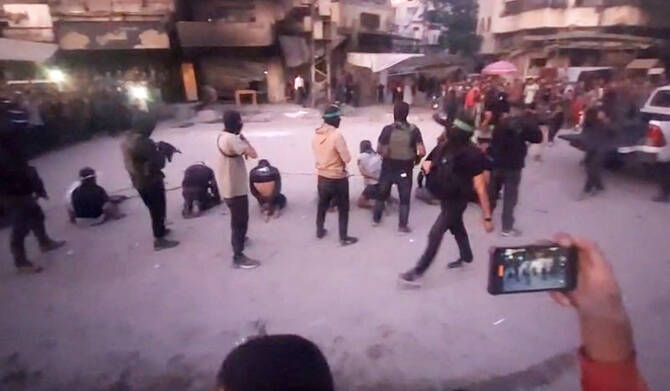
This image grab from a handout video released by the Hamas-run al-Aqsa TV's Telegram channel on October 13, 2025, shows armed Hamas fighters standing behind blindfolded, bound and kneeling men as a crowd surrounds them in a street in Gaza City. (AFP)
Short Url
Updated 14 October 2025
Follow

Clans, armed groups are challenging Hamas in Gaza Strip

  • Mumtaz Doghmosh, a key clan leader, previously led the Popular Resistance Committees’ armed wing in Gaza City. He later formed the “Army of Islam,” which declared allegiance to Daesh

GAZA STRIP: As the Gaza war dragged on, a diminished Hamas faced growing internal challenges to its control of Gaza from long-standing rivals, many of them affiliated with powerful local clans. 
Since Friday’s ceasefire took hold, Hamas has sought to reassert itself, killing dozens of opponents in a crackdown after appearing to get a US nod to temporarily police the shattered enclave.
The following are some of the key clans and figures whose members have clashed with Hamas forces over the past two years.
Abu Shabab clan: Yasser Abu Shabab, based in the Rafah area, is the most prominent anti-Hamas clan leader. He operates in a part of southern Gaza still occupied by Israeli forces.
According to a source, his group has recruited hundreds of fighters by offering attractive salaries. Hamas accuses him of collaborating with Israel, a charge he denies.
His personal force is estimated to be around 400 men.
Doghmosh clan: The Doghmosh clan is one of the largest and most powerful in the Gaza Strip and has historically been well-armed. 
Mumtaz Doghmosh, a key clan leader, previously led the Popular Resistance Committees’ armed wing in Gaza City.  He later formed the “Army of Islam,” which declared allegiance to Daesh. 

BACKGROUND

Yasser Abu Shabab, based in Rafah, is the most prominent anti-Hamas clan leader.

Mumtaz Doghmosh’s whereabouts have been unknown since before the war erupted on Oct. 7, 2023. Hamas fighters clashed with members of Doghmosh on Sunday and Monday. 
Al-Majayda clan: This large and powerful clan is centered in Khan Younis in the southern Gaza Strip. Its members have clashed with Hamas fighters in recent months.
Earlier this month, Hamas raided the clan’s area to arrest men it said were wanted for killing Hamas members. A shootout ensued, resulting in several deaths on both sides, Hamas and clan members said.
On Monday, the head of the clan issued a statement on social media affirming support for the security campaign launched by Hamas to maintain law and order in Gaza, urging clan members to cooperate. 
Rami Hellis: The Hellis clan is a large clan in Gaza City, centered in the Shejaia suburb. A few months ago a senior member of the clan, Rami Hellis and Ahmed Jundeya, a member of another large Shejaia clan, formed a group that operates in defiance of Hamas within parts of Shejaia that are still under Israeli army control. 


UK slaps sanctions on Sudan RSF paramilitary deputy, other commanders

Updated 45 min 58 sec ago
Follow

UK slaps sanctions on Sudan RSF paramilitary deputy, other commanders

  • The Foreign Office in London said those targeted include RSF second-in-command Abdelrahim Hamdan Dagalo
  • They are accused of “mass killings, systematic sexual violence and deliberate attacks on civilians”

LONDON: The UK Friday imposed sanctions on senior commanders of Sudan’s Rapid Support Forces (RSF) suspected of “heinous violence” in the Darfur hub of El-Fasher, which the paramilitary group captured in October.
The Foreign Office in London said those targeted include RSF second-in-command Abdelrahim Hamdan Dagalo, whose brother Mohammad Hamdan Dagalo is the group’s leader, as well as three other commanders.
They are accused of “mass killings, systematic sexual violence and deliberate attacks on civilians” when the RSF dislodged the Sudanese army from El-Fasher, its last stronghold in the western Darfur region.
They now face UK asset freezes and travel bans.
The government said the RSF’s actions in El-Fasher were “not random” but instead “part of a deliberate strategy to terrorize populations and seize control through fear and violence.”
It added satellite imagery showed evidence of mass graves where victims have been burned and buried, and the sanctions send “a clear message that those who commit atrocities will be held to account.”
The European Union last month also slapped sanctions on Abdelrahim Hamdan Dagalo.
In a statement unveiling the UK curbs, Foreign Secretary Yvette Cooper said the atrocities taking place in Sudan “are so horrific they scar the conscience of the world.”
“The overwhelming evidence of heinous crimes — mass executions, starvation, and the systematic and calculated use of rape as a weapon of war — cannot and will not go unpunished,” she added.
“The UK will not look away, and we will always stand with the people of Sudan.”
Minni Minawi, the army-aligned governor of Darfur, welcomed the UK sanctions “as an important step toward holding accountable those responsible for the crimes and violations witnessed in Sudan in recent times.”
But he added the measures “remain incomplete” unless they also target Mohammad Hamdan Dagalo, “as he is the decision-maker and the direct architect of the violence system.”
London also announced Friday £21 million ($28 million) in additional aid to provide food, clean water, health care, and protection for women and children in areas of Sudan hardest hit by violence.
It said the financial package took UK aid spending in Sudan this year to £146 million.