

Arafat’s nephew returns to West Bank with plan for post-war Gaza

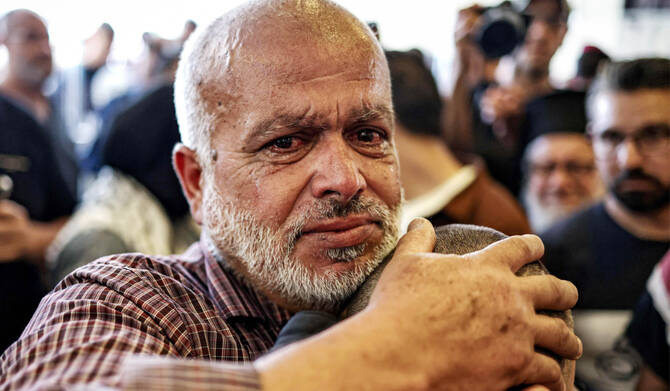
One (R) of the Palestinian prisoners, who was released in a prisoner-hostage swap and ceasefire deal between Israel and Hamas, is embraced by his father upon arrival by bus at Ramallah Cultural Centre in Ramallah in the occupied West Bank, on October 13, 2025, coming from Ofer military prison in the Israel-occupied Palestinian territories. (AFP)
Short Url
Updated 14 October 2025
Follow

Arafat’s nephew returns to West Bank with plan for post-war Gaza

  • Nasser Al-Qudwa says Fatah needs deep reform, must do more to counter settler violence

RAMALLAH: A nephew of late Palestinian leader Yasser Arafat has returned to the West Bank after four years of self-exile, outlining a roadmap to secure peace in Gaza with Hamas transforming into a political party and declaring his readiness to help govern.

Nasser Al-Qudwa, a prominent critic of the current Palestinian leadership, also urged “a serious confrontation of corruption in this country.” 
He said President Mahmoud Abbas’s Fatah Movement needed deep reform and must do more to counter Jewish settler violence in the Israeli-occupied West Bank.


A Palestinian politician Nasser al-Qudwa speaks during an interview with Reuters in Ramallah in the Israeli-occupied West Bank October 13, 2025. (REUTERS)

“The first duty ... is to regain confidence of the street — something that we lost — and we have to be brave enough and say that we don’t have it anymore, and without it, frankly, it’s useless,” Qudwa said.
Qudwa left the West Bank in 2021 after he was expelled from Fatah, the movement founded by his uncle, over his decision to field his own list in elections, defying Abbas who canceled the vote.
Abbas, 89, readmitted Qudwa to Fatah last week, after offering an amnesty for expelled members. His return coincides with renewed pressure on Abbas to enact long-delayed reforms in the Palestinian Authority as it presses for a role in Gaza, lost to Hamas in 2007, despite Israeli objections and being sidelined in President Donald Trump’s plan.
Palestinian analysts say Qudwa could have a role, citing his ties to Arab states, his contacts with Hamas, standing as Arafat’s nephew and his Gazan origins: he was born in Khan Younis. “If I’m needed, I’m not going to hesitate,” Qudwa, 72, said.
He said existing PA assets in Gaza should be used in a new police force, and that Gaza’s current police could be vetted and used as well.
“Hamas needs to understand that nobody is coming after them, that some of these employees will be given another opportunity, that they will not be assassinated, that there will be an opportunity for them to participate in the political life.” He said a Palestinian “council of commissioners” could run Gaza. While Abbas could appoint its head, keeping a link between the West Bank and Gaza, Qudwa said he was not suggesting the “return of the (Palestinian) Authority as is to govern Gaza.”
He said that international supervision would be “fine,” but Gaza must be run by Palestinians and they must be able to hold elections, last held in 2006.


UK slaps sanctions on Sudan RSF paramilitary deputy, other commanders

Updated 45 min 58 sec ago
Follow

UK slaps sanctions on Sudan RSF paramilitary deputy, other commanders

  • The Foreign Office in London said those targeted include RSF second-in-command Abdelrahim Hamdan Dagalo
  • They are accused of “mass killings, systematic sexual violence and deliberate attacks on civilians”

LONDON: The UK Friday imposed sanctions on senior commanders of Sudan’s Rapid Support Forces (RSF) suspected of “heinous violence” in the Darfur hub of El-Fasher, which the paramilitary group captured in October.
The Foreign Office in London said those targeted include RSF second-in-command Abdelrahim Hamdan Dagalo, whose brother Mohammad Hamdan Dagalo is the group’s leader, as well as three other commanders.
They are accused of “mass killings, systematic sexual violence and deliberate attacks on civilians” when the RSF dislodged the Sudanese army from El-Fasher, its last stronghold in the western Darfur region.
They now face UK asset freezes and travel bans.
The government said the RSF’s actions in El-Fasher were “not random” but instead “part of a deliberate strategy to terrorize populations and seize control through fear and violence.”
It added satellite imagery showed evidence of mass graves where victims have been burned and buried, and the sanctions send “a clear message that those who commit atrocities will be held to account.”
The European Union last month also slapped sanctions on Abdelrahim Hamdan Dagalo.
In a statement unveiling the UK curbs, Foreign Secretary Yvette Cooper said the atrocities taking place in Sudan “are so horrific they scar the conscience of the world.”
“The overwhelming evidence of heinous crimes — mass executions, starvation, and the systematic and calculated use of rape as a weapon of war — cannot and will not go unpunished,” she added.
“The UK will not look away, and we will always stand with the people of Sudan.”
Minni Minawi, the army-aligned governor of Darfur, welcomed the UK sanctions “as an important step toward holding accountable those responsible for the crimes and violations witnessed in Sudan in recent times.”
But he added the measures “remain incomplete” unless they also target Mohammad Hamdan Dagalo, “as he is the decision-maker and the direct architect of the violence system.”
London also announced Friday £21 million ($28 million) in additional aid to provide food, clean water, health care, and protection for women and children in areas of Sudan hardest hit by violence.
It said the financial package took UK aid spending in Sudan this year to £146 million.