At least 20 killed in Myanmar junta attack as paramotors widen air war

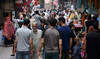
This UGC photo courtesy of Facebook user Yebaw Hlyat Cee taken on October 7, 2025 and received on October 8 shows damage to a building next to the site of a military strike on a protest in central Myanmar’s Chaung U township. (AFP)
Short Url
Updated 09 October 2025
Follow

At least 20 killed in Myanmar junta attack as paramotors widen air war

  • The military has previously rejected accusations that it targets civilians
  • A spokesperson for the US State Department said it was deeply disturbed by reports of the attack

NAYPYIDAW: A 30-year-old protester was taking part in a gathering against Myanmar’s ruling junta on a festival day in the central region of Sagaing on Monday when he heard the distinctive noise of fan blades cutting through the air.
Minutes later, explosives were dropped by a motorized paraglider, also known as a paramotor.
“I was thrown away,” said the protester, asking not to be named for fear of retribution from the junta.
“Initially, I thought the whole lower part of my body had been severed. I touched it and I realized the legs are still there.”
At least 20 people were killed in the attack by the junta, according to the eyewitness, Amnesty International, the shadow National Unity Government and an armed resistance group in the area. It is also the latest instance of Myanmar’s well-armed military using paramotors as part of its widening range of aerial weaponry, including aircraft and drones, deployed in an expanding civil war.
A spokesperson for Myanmar’s junta did not respond to calls seeking comment.
The military has previously rejected accusations that it targets civilians. A spokesperson for the US State Department said it was deeply disturbed by reports of the attack. “We urge the military regime to cease its violence and bombing civilians, release all unjustly detained prisoners, allow unhindered humanitarian access, and begin genuine dialogue with opposition groups,” the spokesperson said.
The Southeast Asian nation has been gripped by protests and a nationwide armed rebellion since 2021 following the military’s ouster of an elected civilian government.

PARAMOTORS DEPLOYMENT ON THE RISE
The attack at Sagaing’s Chaung-U township took place just before 8 p.m. local time on Monday as local residents gathered in a field, said the eyewitness and a spokesman for a local anti-junta armed resistance group.
“The military has used paramotors to bomb this area approximately six times before this latest incident,” Ko Thant, an information officer for the Chaung-U Township People’s Defense Force, told Reuters.
The junta’s first recorded use of paramotors, which can seat up to three soldiers to drop bombs or fire at targets, was in December 2024 and they have since been deployed more widely, according to the Armed Conflict Location & Event Data Project. The military also used paramotors to carry out attacks in parts of Myanmar hit by a deadly earthquake in March, the United Nations said in April.
“Paramotors are typically deployed in areas of mixed control or where resistance groups have minimal equipment, such as lacking access to the 7.62 cartridges and weapons required to shoot them down,” ACLED Senior Analyst Su Mon said in a July report.
In some areas rebels have claimed to have shot down a junta paramotor, according to a statement issued by the Burma Revolution Rangers group in April. With frontlines stretching from the northern Kachin hills to the western coastal state of Rakhine, the junta is increasingly relying on aerial power, with 1,134 airstrikes between January and May, far higher than corresponding figures of 197 and 640 in 2023 and 2024, according to ACLED.
In the aftermath of the strike in Chaung-U township, the 30-year-old protester said he crawled into a nearby ditch and hid there until his friends pulled him out.
“This is mass murder,” he said, referring to the junta’s attack. “They are committing it openly.”


Lufthansa adds more flights to Asia, Africa as Middle East war reshapes air travel

Updated 5 sec ago
Follow

Lufthansa adds more flights to Asia, Africa as Middle East war reshapes air travel

  • Airlines across Europe have been redirecting capacity after suspending services in the Middle East
  • Lufthansa said the move also helps meet demand on long-haul routes that Middle Eastern carriers cannot currently serve

LONDON: Lufthansa said on Friday it was shifting capacity from 10 canceled Middle Eastern destinations to routes such as Singapore and Bangkok as it contends with disruption from the US-Israeli war on Iran.
Airlines across Europe, including budget carrier Wizz Air , have been redirecting capacity after suspending services in the Middle East.
Lufthansa said the move also helps meet demand on long-haul routes that Middle Eastern carriers cannot currently serve.
Airline stocks have slumped this week as US and Israeli airstrikes on Iran — and retaliatory strikes by Iran across the Middle East — have disrupted long-haul flights and sent oil prices soaring.
“The war in the Middle East proves once again how exposed air traffic is and ⁠how vulnerable it ⁠remains,” Lufthansa CEO Carsten Spohr said in a statement. He added the outlook was uncertain, particularly for jet fuel costs.
The schedule changes came as the German group reported better-than-expected 2025 results, saying stricter financial management and fleet renewal had helped contain costs and lift profits. Its shares rose as much as 4 percent, before reversing to trade down 1.2 percent at 1246 GMT.
The company said demand on routes to and from Asia and Africa had risen strongly since the conflict began ⁠on Saturday, and it would stick with its focus on expanding long-haul services. Spohr said new flights to Asia would launch in days.
Lufthansa did say how many services it had canceled because of the conflict.
While carriers face costs for rescheduling and rerouting, the biggest impact for those outside the Middle East is expected from surging fuel prices. Brent crude futures have jumped more than 20 percent this week.
Spohr said Lufthansa was well hedged in the short term. The group hedges fuel up to 24 months ahead and was 85 percent hedged as of December 31, according to its annual report.
RESILIENCE
European carriers, including Lufthansa, benefited from slightly lower fuel bills in 2025. Lufthansa’s fuel bill fell 7 percent, helping support earnings as passenger demand stayed firm.
“Last ⁠year we were able ⁠to significantly increase the Group’s operating profit and achieved the highest revenue in our history. Our results demonstrate the resilience and stability of the Group,” Spohr said.
Lufthansa reported an adjusted operating profit of 2 billion euros ($2.3 billion), compared with 1.9 billion euros forecast in a company-compiled analyst poll and up from 1.6 billion euros in 2024. The group also posted an operating margin of 4.9 percent, up from 4.4 percent a year earlier.
Lufthansa aims to lift operating margins to 8 percent-10 percent between 2028 and 2030 from 4.4 percent in 2024, but strikes by workers, including the most recent on February 12, have made it harder to boost profitability.
Bernstein analyst Alex Irving said ongoing weakness in the passenger airline segment persisted, but that strong performances in Cargo and Lufthansa Technik helped lift profits.
The carrier said the outlook for 2026 was unclear due to geopolitical uncertainty. It projected capacity growth of 4 percent, alongside increased revenue and profit margin.