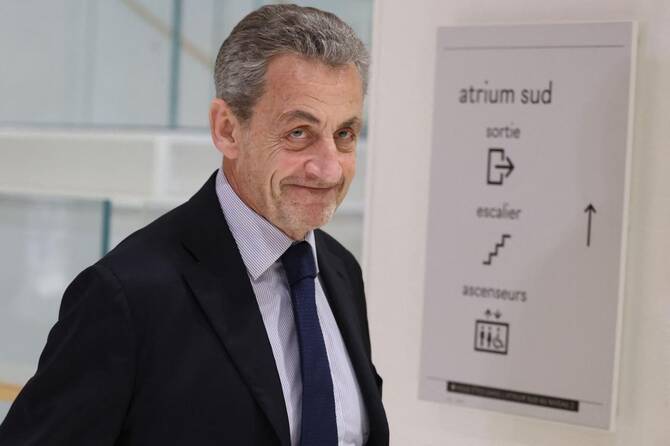
PARIS: France’s top court said Wednesday it will rule in November on embattled former president Nicolas Sarkozy’s final appeal over illegal campaign financing in 2012, in a case that could cement his second criminal conviction.
Sarkozy, who remains an influential figure on the right, has been embroiled in legal problems since losing the 2012 presidential election.
Last month, Sarkozy was sentenced to five years in prison over a scheme for late Libyan dictator Muammar Qaddafi to fund his 2007 presidential run. He will be the first French postwar leader to serve jail time.
Sarkozy has denied the charges and appealed that conviction, though under French law his sentence will be implemented even as his appeal plays out. He will learn on Monday when his prison term will begin.
Separately, the right-wing politician in 2021 received a one-year jail sentence in the so-called “Bygmalion affair” for the financing of his 2012 presidential campaign.
An appeals court in 2024 confirmed the conviction but lightened his sentence to six months with another six months suspended. He has appealed that ruling.
In November, Sarkozy will learn if his conviction is overturned or confirmed.
On Wednesday, the country’s highest appeals court examined his final appeal in the case.
If the Court of Cassation upholds Sarkozy’s conviction in its ruling expected on November 26 — as demanded by the prosecutor’s office at the hearing Wednesday — he will serve a six-month term with an electronic bracelet.
The former head of state was sentenced on charges that his right-wing party worked with a public relations firm, Bygmalion, to hide the true cost of his 2012 re-election bid.
Prosecutors said Sarkozy spent nearly 43 million euros on his 2012 campaign, almost double the permitted amount of 22.5 million euros.
Sarkozy has accused Bygmalion of having enriched itself behind his back and dismissed the allegations against him as “lies.”
His lawyers on Wednesday reiterated that stance.
“Nothing was materially established by the court of appeal regarding active involvement of President Sarkozy” in the overspending of campaign accounts, said one of Sarkozy’s lawyers, Emmanuel Piwnica.
Sarkozy’s latest hearing comes at a sensitive moment for France, with the country thrown into uncertainty by the shock resignation of Prime Minister Sebastien Lecornu after less than a month in power.

French court sets November ruling in Sarkozy campaign finance appeal
https://arab.news/mer55
French court sets November ruling in Sarkozy campaign finance appeal
- Sarkozy has been embroiled in legal problems since losing the 2012 presidential election
- In November, Sarkozy will learn if his conviction is overturned or confirmed
Indian police carry out sweeping raids in disputed Kashmir
- There has been no confirmation that the searches this week are connected to Monday’s explosion which killed at least 12 people in New Delhi
- The blast was the most significant security incident since April 22 attack in Pahalgam which killed 26 people, triggered clashes with Pakistan
New Delhi: Indian police have carried out sweeping raids targeting a banned political party in Indian-administered Kashmir, days after the deadliest blast in the Indian capital for more than a decade.
There has been no confirmation that the searches this week are connected to Monday’s explosion — which killed at least 12 people near the historic Red Fort in the capital’s Old Delhi quarter.
But the raids represent a renewed effort by police to tighten security after the explosion, which the government called “a heinous terror incident” and blamed on “anti-national forces.”
Many of the raids have taken place since Wednesday, according to district police statements from across the Indian-administered part of the Himalayan territory.
Kashmir has been divided between India and Pakistan since their independence from British rule in 1947, and both claim the Himalayan territory in full. Tensions remain high between New Delhi and Islamabad.
Police, including in Kashmir’s Awantipora, Bandipora, Ganderbal, Shopian and Sopore districts, issued statements about the raids, which they said targeted the Jamaat-e-Islami (JeI) party.
Indian Prime Minister Narendra Modi’s Hindu-nationalist government banned the Kashmir branch of Jamaat-e-Islami in 2019 as an “unlawful association.”
'Large-scale operations'
Officers carried out “extensive raids at multiple locations” to “dismantle the terror ecosystem and its support structures,” the police in Awantipora said in a statement.
The department in Bandipora said they had seized “incriminating material,” while the Sopore police said it had carried out “large-scale operations against Jamaat-e-Islami-linked networks,” adding that more than 30 locations were searched.
Officers also raided Al-Falah University in Faridabad, on the southern outskirts of the capital, while security forces on Friday demolished a house in Kashmir’s Pulwama district.
Police have not commented on the demolition, although law enforcement agencies have carried out such destruction against those accused of launching attacks in the past.
India’s anti-terrorism National Investigation Agency is leading the probe into Monday’s blast, and the government has vowed to bring the “perpetrators, their collaborators, and their sponsors” to justice.
But officials, so far, have given little further information on who that might be — and whether it was a homegrown group or had links from abroad.
Indian media have widely connected the November 10 blast with a string of arrests just hours before, when they seized explosive materials and assault rifles.
Police said those arrested were linked with Jaish-e-Mohammed (JeM), an Al-Qaeda linked group, and Ansar Ghazwat-ul-Hind, a Kashmir offshoot linked to JeM.
Concerning those arrests, India’s Jammu and Kashmir police said on Monday — shortly before the explosion — that their investigations had “revealed a white collar terror ecosystem, involving radicalized professionals and students in contact with
foreign handlers, operating from Pakistan and other countries.”
The blast in Delhi was the most significant security incident since April 22, when 26 mainly Hindu civilians were killed at the tourist site of Pahalgam in Indian-administered Kashmir, triggering clashes with Pakistan.


