

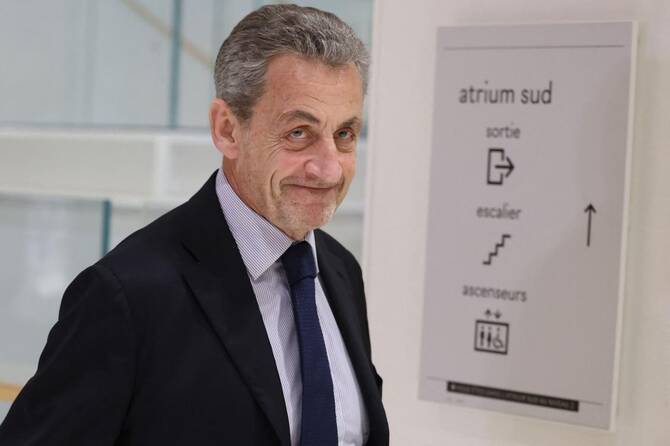
Sarkozy conviction exposes political divide in crisis-hit France

The dramatic decision to send former president Nicolas Sarkozy to prison for criminal conspiracy has laid bare France's stark political divisions, with the move cheered by the left but slammed by the ascendant right. (AFP/File)
Short Url
Updated 26 September 2025
Follow

Sarkozy conviction exposes political divide in crisis-hit France

  • The conviction comes at a deeply sensitive moment, with France in political deadlock and the far-right sensing its best ever chance to come to power
  • Henri Guaino, a former special adviser to Sarkozy, called the conviction “a humiliation for the state and its institutions“

PARIS: The dramatic decision to send former president Nicolas Sarkozy to prison for criminal conspiracy has laid bare France’s stark political divisions, with the move cheered by the left but slammed by the ascendant right.
Sarkozy, seen as a mentor to many conservative politicians, was convicted on Thursday over a scheme enabling late Libyan dictator Muammar Qaddafi to fund his 2007 presidential run.
He must serve his sentence while awaiting the outcome of his appeal, and will be the first French postwar leader to serve jail time.
The conviction comes at a deeply sensitive moment, with France in political deadlock and the far-right sensing its best ever chance to come to power.
Speaking to broadcaster RTL, Henri Guaino, a former special adviser to Sarkozy, called the conviction “a humiliation for the state and its institutions.”
Guaino urged President Emmanuel Macron to pardon Sarkozy, who was president of France from 2007 to 2012, allowing him to avoid prison.
There was no immediate reaction from Macron’s office.
Despite his legal troubles, Sarkozy still enjoys considerable influence and popularity on the French right and has on occasion had private meetings with Macron.

- ‘It’s Nicolas who pays’ -

In an editorial, conservative French daily Le Figaro denounced the court ruling as “absurd and incomprehensible,” claiming there was no “tangible evidence” of Sarkozy’s wrong-doing.
Left-leaning Liberation featured Sarkozy’s face on its front page, with the words “The slammer” printed over it.
Far-right leader Marine Le Pen, who has herself been convicted of embezzlement and insists she is a target of a “witch hunt,” criticized Thursday’s ruling.
She argued on X that the use of provisional enforcement represented “a great danger, in view of the fundamental principles of our law, foremost among which is the presumption of innocence.”
In France, provisional enforcement means that a judicial decision will be implemented even as the appeals process plays out.
Le Pen drew parallels between her own case — which saw her banned from standing for office for five years, scuppering her chances of running in France’s 2027 presidential election unless she wins her appeal — and that of Sarkozy.
“A number of magistrates have a kind of scorecard where they try to pin down as many politicians as possible,” she told broadcaster LCI.
But some on the left expressed their satisfaction.
“In the end, it’s Nicolas who pays,” quipped hard-left lawmaker Anais Belouassa-Cherifi, referring to a right-wing viral meme denouncing the tax burden on ordinary French people.
But Liberation daily said it did not see the conviction as a cause for celebration.
In an editorial, the newspaper said Sarkozy’s case as well as various other political scandals only serve to widen the gap between the French people and the elites.
There is “only one winner in the long run: the far right.”
The court ordered that Sarkozy should be placed in custody at a later date, with prosecutors to inform him on October 13 when he should go to prison.
He has already been convicted in two separate trials but always avoided jail.


Afghan barbers under pressure as morality police take on short beards

Updated 4 sec ago
Follow

Afghan barbers under pressure as morality police take on short beards

KABUL: Barbers in Afghanistan risk detention for trimming men’s beards too short, they told AFP, as the Taliban authorities enforce their strict interpretation of Islamic law with increasing zeal.
Last month, the Ministry for the Propagation of Virtue and Prevention of Vice said it was now “obligatory” to grow beards longer than a fist, doubling down on an earlier order.
Minister Khalid Hanafi said it was the government’s “responsibility to guide the nation to have an appearance according to sharia,” or Islamic law.
Officials tasked with promoting virtue “are obliged to implement the Islamic system,” he said.
With ministry officials patrolling city streets to ensure the rule is followed, the men interviewed by AFP all spoke on condition of anonymity due to security concerns.
In the southeastern province of Ghazni, a 30-year-old barber said he was detained for three nights after officials found out that one of his employees had given a client a Western-style haircut.
“First, I was held in a cold hall. Later, after I insisted on being released, they transferred me to a cold (shipping) container,” he said.
He was eventually released without charge and continues to work, but usually hides with his clients when the patrols pass by.
“The thing is that no one can argue or question” the ministry officials, the barber said.
“Everyone fears them.”
He added that in some cases where both a barber and clients were detained, “the clients have been let out, but they kept the barber” in custody.
Last year, three barbers in Kunar province were jailed for three to five months for breaching the ministry’s rules, according to a UN report.

‘Personal space’

Alongside the uptick in enforcement, the religious affairs ministry has also issued stricter orders.
In an eight-page guide to imams issued in November, prayer leaders were told to describe shaving beards as a “major sin” in their sermons.
The religious affairs ministry’s arguments against trimming state that by shaving their beards, men were “trying to look like women.”
The orders have also reached universities — where only men study because women have been banned.
A 22-year-old Kabul University student said lecturers “have warned us... that if we don’t have a proper Islamic appearance, which includes beards and head covering, they will deduct our marks.”
In the capital Kabul, a 25-year-old barber lamented that “there are a lot of restrictions” which go against his young clients’ preference for closer shaves.
“Barbers are private businesses, beards and heads are something personal, they should be able to cut the way they want,” he said.
Hanafi, the virtue propagation minister, has dismissed such arguments, saying last month that telling men “to grow a beard according to sharia” cannot be considered “invading the personal space.”

Business slump

In Afghanistan, the majority are practicing Muslims, but before the Taliban authorities returned to power in 2021, residents of major cities could choose their own appearance.
In areas where Taliban fighters were battling US-backed forces, men would grow beards either out of fear or by choice.
As fewer and fewer men opt for a close shave, the 25-year-old Kabul barber said he was already losing business.
Many civil servants, for example, “used to sort their hair a couple of times a week, but now, most of them have grown beards, they don’t show up even in a month,” he said.
A 50-year-old barber in Kabul said morality patrols “visit and check every day.”
In one incident this month, the barber said that an officer came into the shop and asked: “Why did you cut the hair like this?“
“After trying to explain that he is a child, he told us: ‘No, do Islamic hair, not English hair’.”