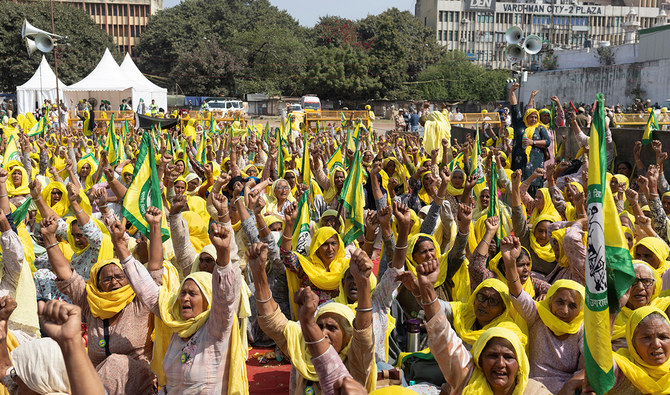
NEW DELHI: Thousands of farmers crowding buses and trains traveled to the Indian capital on Thursday to press their demand for new legislation to guarantee minimum profitable crop prices, after weeks of being blocked from the city.
They avoided using their tractors after authorities barricaded highways into New Delhi with cement blocks and barbed wire. A condition of allowing their rally in the capital were that the farmers not use their farm vehicles. They were also barred from carrying sticks or swords to avoid clashes with police.
The protesters carried placards demanding free electricity for farming. They contended that without guarantees for their crop prices, they would be at the mercy of the markets and that would spell disaster, especially for the more than two-thirds of them who own less than 1 hectare (2 1/2 acres) of land.
The rally, organized by the United Farmers Front, was held at Ramlila Ground, which is used for religious festivals, major political meetings and entertainment events.
The police permitted the rally also on the condition that the farmers wouldn’t bring in more than 5,000 people, the Press Trust of India news agency said.
The protests come at a crucial time for India, which has a national election in April-May, with Prime Minister Narendra Modi’s ruling party widely expected to secure a third successive term. Farmers are a particularly influential voting bloc in India with their sheer numbers. More than 60 percent of India’s 1.4 billion people depend on farming for their livelihoods.
The farmers are also pressing the government to keep its promises to waive loans and withdraw legal cases brought against them during their 2021 protests. Several talks so far have failed to break the deadlock.
Thousands of farmers have been protesting separately in Shambhu, a town some 200 kilometers (120 miles) from the capital, since Feb. 13.
Authorities have barricaded highways leading to New Delhi with cement blocks, metal containers, barbed wire and iron spikes to prevent the farmers from entering. The farmers have brought in bulldozers and excavators to try and push through.
On Feb 21, clashes between farmers and police left one protester dead as the farmers tried to resume their march to the Indian capital after talks with the government failed to end an impasse over their demands for guaranteed crop prices.
Haryana police said 12 officers were injured after protesters attacked them with sticks and pelted them with stones.
The farmers paused their protest and hunkered down near the town of Shambhu, close to the border between Punjab and Haryana states, as their unions engaged in discussions with government ministers.
They rejected a proposal offering them five-year contracts of guaranteed prices on a set of certain crops, including maize, grain legumes and cotton.
Two years ago, tens of thousands of farmers camped out on the outskirts of New Delhi forcing Modi to repeal new agriculture laws in a major reversal for his government.
Jagjit Singh Dallewal, one of the farmers leading the march, said they did not want any violence, but condemned the federal government over the massive security measures.
The protest organizers say the farmers are seeking new legislation that would guarantee minimum prices for 23 crops. The farmers believe this would help stabilize their income.
The government protects agricultural producers against sharp falls in farm prices by setting a minimum purchase price for certain essential crops, a system that was introduced in the 1960s to help shore up food reserves and prevent shortages. The system can apply up to 23 crops, but the government usually offers the minimum price only for rice and wheat.


Indian farmers protest in New Delhi demanding new legislation for minimum crop prices
https://arab.news/mnnqq
Indian farmers protest in New Delhi demanding new legislation for minimum crop prices

- Condition of allowing rally in the capital was that farmers not use farm vehicles
- They were also barred from carrying sticks or swords to avoid clashes with police

Brazil’s Lula urges Trump to treat all countries equally
NEW DELHI: Brazil’s President Luiz Inacio Lula da Silva urged Donald Trump on Sunday to treat all countries equally after the US leader imposed a 15 percent tariff on imports following an adverse Supreme Court ruling.
“I want to tell the US President Donald Trump that we don’t want a new Cold War. We don’t want interference in any other country, we want all countries to be treated equally,” Lula told reporters in New Delhi.
The conservative-majority Supreme Court ruled six to three on Friday that a 1977 law Trump has relied on to slap sudden levies on individual countries, upending global trade, “does not authorize the President to impose tariffs.”
Lula said he would not like to react to the Supreme Court decisions of another country, but hoped that Brazil’s relations with the United States “will go back to normalcy” soon.
The veteran leftist leader is expected to travel to Washington next month for a meeting with Trump.
“I am convinced that Brazil-US relation will go back to normalcy after our conversation,” Lula, 80, said, adding that Brazil only wanted to “live in peace, generate jobs, and improve the lives of our people.”
Lula and Trump, 79, stand on polar opposite sides when it comes to issues such as multilateralism, international trade and the fight against climate change.
However, ties between Brazil and the United States appear to be on the mend after months of animosity between Washington and Brasilia.
As a result, Trump’s administration has exempted key Brazilian exports from 40 percent tariffs that had been imposed on the South American country last year.
‘Affinity’
“The world doesn’t need more turbulence, it needs peace,” said Lula, who arrived in India on Wednesday for a summit on artificial intelligence and a bilateral meeting with Prime Minister Narendra Modi.
Ties between Washington and Brasilia soured in recent months, with Trump angered over the trial and conviction of his ally, the far-right former Brazil president Jair Bolsonaro.
Trump imposed sanctions against several top officials, including a Supreme Court judge, to punish Brazil for what he termed a “witch hunt” against Bolsonaro.
Bolsonaro was sentenced to 27 years in prison for his role in a botched coup bid after his 2022 election loss to Lula.
Lula said that, as the two largest democracies in the Americas, he looked forward to a positive relationship with the United States.
“We are two men of 80 years of age, so we cannot play around with democracy,” he said.
“We have to take this very seriously. We have to shake hands eye-to-eye, person-to-person, and to discuss what is best for the US and Brazil.”
Lula also praised Modi after India and Brazil agreed to boost cooperation on critical minerals and rare earths and signed a raft of other deals on Saturday.
“I have a lot of affinity with Prime Minister Modi,” he said.
Lula will travel to South Korea later on Sunday for meetings with President Lee Jae Myung and to attend a business forum.