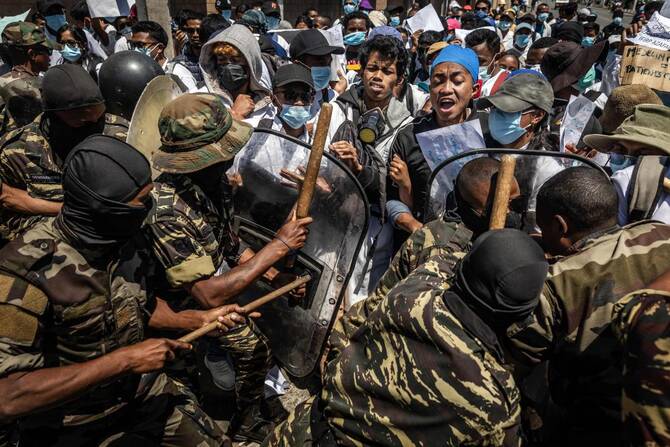
ANTANANARIVO: Youth protesters in Madagascar on Wednesday rejected an offer to join President Andry Rajoelina’s “national dialogue” with various groups, accusing his government of repression after weeks of demonstrations in the African island nation.
Inspired by similar “Gen Z” movements in Kenya and Nepal, the protests that started on September 25 pose the biggest challenge to Rajoelina’s government since his re-election in 2023, giving voice to widespread discontent over rampant poverty and high-level corruption.
Rajoelina fired his cabinet last week in a bid to quell the unrest, appointing a new prime minister and announcing plans for a national dialogue due to commence on Wednesday afternoon. He said the talks would be attended by spiritual leaders, students, youth representatives, and others.
But the moves have failed to ease public anger, and the so-called Gen Z movement said they would not hold talks with the government as long as authorities respond to their demonstrations with force.
“We reject this mockery of dialogue,” the protesters said in the statement posted on their verified Facebook page.
“We refuse the president’s invitation to talks. We will not engage in dialogue with a regime that represses, assaults, and humiliates its youth in the streets.”
University students were expected to take to the streets again on Wednesday following a 48-hour ultimatum issued by the protesters on Monday night for Rajoelina to agree to their demands or face a national strike.
Although the demonstrations were initially sparked by water and electricity shortages, demands have now expanded to include calls for Rajoelina to leave office, apologize to the nation, and dissolve the senate and the election commission.
At least 22 people have been killed while 100 others have been injured in the unrest, according to the United Nations. The government has rejected those figures, without offering any of its own.
Late on Tuesday Rajoelina appointed new ministers for defense and public security and asked them to restore public order.
“Do not tolerate the incitement of unrest,” he said, without elaborating further on possible measures.
Madagascar’s protests are taking place at a vulnerable time for its export-reliant economy. While the country is best known for producing most of the world’s vanilla, other exports, including of nickel, cobalt, textiles and shrimp – are also vital to foreign earnings and employment.
The country’s per capita GDP plunged by 45 percent between 1960 and 2020, according to the World Bank.


![]()

Madagascar protesters reject president’s offer of talks
Short Url
https://arab.news/mgbsr
Madagascar protesters reject president’s offer of talks
- Demonstrations sparked by water and power shortages
- Threat of national strike looms after ultimatum by protesters


Latest updates


© 2026 SAUDI RESEARCH & PUBLISHING COMPANY, All Rights Reserved And subject to Terms of Use Agreement.