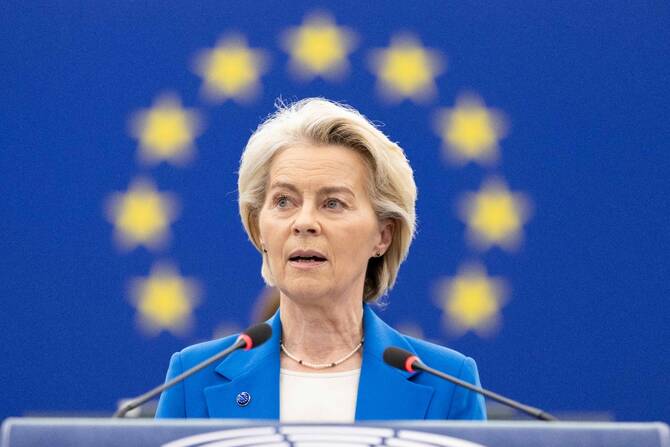
STRASBOURG: EU chief Ursula von der Leyen on Wednesday said Europe must ramp up its defenses to deter Russia’s “hybrid warfare,” after a catalogue of air incursions, cyberattacks and damage to undersea cables.
“These incidents are calculated to linger in the twilight of deniability. This is not random harassment. It is a coherent and escalating campaign,” the European Commission head said in a speech to EU lawmakers.
“Two incidents are coincidence, but three, five, 10 — this is a deliberate and targeted grey zone campaign against Europe, and Europe must respond,” she said.
EU countries Poland, Estonia and Romania have recently been rattled by Russian air incursions, while unidentified drones have been spotted in Denmark, Germany and Belgium.
European countries have already increased defense spending to post-Cold War highs in the face of Moscow’s war in Ukraine and doubts over US support under President Donald Trump.
Now the EU is seeking to hammer out plans for joint projects that could be built by the 27-nation bloc — including a “wall” of anti-drone defenses.
“We must not only react. We must deter because if we hesitate to act, the grey zone will only expand,” von der Leyen said.
“The founding mission of the European Union is to preserve peace, and today that means having the capacity to deter aggression and provocation.”
EU leaders will seek at a summit in Brussels later this month to agree on a “road map” aimed at getting the bloc ready to ward off threats from Russia in the coming years.
“This will not only set common objectives, but also very concrete milestones and timelines on the way to 2030 because we all know only what gets measured gets really done,” von der Leyen said.
The commission president insisted that tackling “Russia’s hybrid war” requires “a completely new mindset for all of us.”
“The choice before us is very simple. We either can shy away and watch Russian threats escalate, or we meet them with unity, deterrence and resolve,” von der Leyen said.


![]()

EU ‘must respond’ to Russia’s ‘hybrid warfare’: von der Leyen
Short Url
https://arab.news/2dbyj
EU ‘must respond’ to Russia’s ‘hybrid warfare’: von der Leyen
- EU leaders will seek at a summit in Brussels later this month to agree on a “road map” aimed at getting the bloc ready to ward off threats from Russia in the coming years
- The commission president insisted that tackling “Russia’s hybrid war” requires “a completely new mindset for all of us”

Latest updates


© 2026 SAUDI RESEARCH & PUBLISHING COMPANY, All Rights Reserved And subject to Terms of Use Agreement.