

Pakistani business body urges traders to boost security as extortion threats rise in Karachi

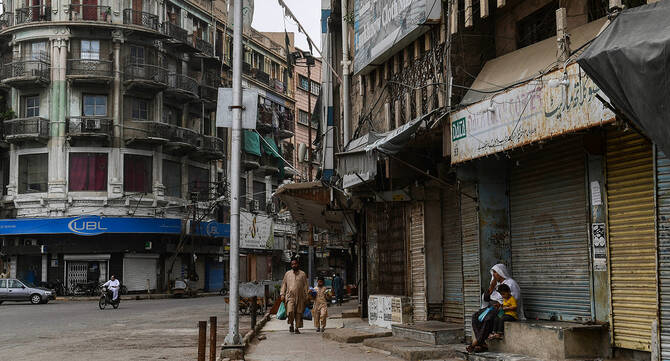
People walk along a path next to closed shops at a partially deserted market area during an evening lockdown imposed to curb the spread of Covid-19 coronavirus cases in Karachi on July 30, 2021. (AFP)
Short Url
Updated 07 October 2025
Follow

Pakistani business body urges traders to boost security as extortion threats rise in Karachi

  • Traders report receiving extortion notes accompanied by bullets and threats to family members
  • Security experts say organized criminal gangs, not militants, are behind the latest extortion wave

ISLAMABAD: A top business body in Pakistan’s commercial capital, Karachi, has issued an urgent security advisory to its members following a sharp uptick in extortion threats, warning traders to install CCTV systems as cases of intimidation and violence rise across the city.

In a circular dated October 4 and seen by Arab News, the Karachi Chamber of Commerce and Industry (KCCI) said business owners have reported receiving “extortion chits accompanied by bullets, with demands for heavy extortion money,” describing the situation as “extremely alarming.”

“The recordings of such CCTV footage may be shared with KCCI, enabling the Chamber to escalate the matter to the concerned authorities with concrete evidence to ensure swift action and the arrest of those involved in such heinous crimes,” the letter read.

The advisory comes amid growing concerns from Karachi’s trader and industrialist community, many of whom say extortion attempts once quelled by years of security operations have made a troubling comeback in recent weeks.

“There has been a surge in the incidents of extortion in recent weeks, which prompted us to bring the issue to the attention of the authorities as well as alert our members and ask them to install CCTV cameras,” Javed Bilwani, President of

KCCI, told Arab News. “But we believe that the menace of extortion cannot be eliminated until the Safe City project is completed.”

Bilwani said complaints had been received from a broad cross-section of Karachi’s business community, including traders, builders and industrialists, with extortion threats targeting both commercial and residential premises.

“They advised us to issue a circular and raise awareness among our members,” Bilwani said, referring to security officials without naming anyone. “That they should install cameras in their houses, in their businesses, in their industries. Builders should install cameras in their buildings.”

In a video statement shared with the media, Atiq Mir, President of the Karachi Tajir Ittehad (Traders Alliance), warned that Karachi’s merchants were again “at the mercy of extortionists.”

“Most of the shops and shopkeepers are getting calls. Bullets are being wrapped in sheets and sent,” Mir said, adding that the callers even threaten children of members of the business community.

Mir called on senior officials, including the Sindh chief minister and the Inspector General of Police, to take urgent action.

 “In the past, thousands of people left Karachi and went away,” he added. “Even now, it should not be the case that relocation resumes and this city becomes a complete jungle.”

Former senior counterterrorism officer Raja Umar Khattab said authorities must investigate such calls systematically.

“The police should not simply label these incidents as hoax calls. They need to classify and investigate them,” Khattab told Arab News. “Questions the police should ask include how genuine the threat is, how the money was demanded, what was delivered, and what message was received.”

Khattab noted that while modern-day extortionists often operate on a smaller scale than in the past, they still pose a serious challenge.

“Nowadays, they sometimes simulate violence,” he said. “They may show a picture of a bullet to intimidate people.”

According to Khattab, many threats are now issued through WhatsApp using foreign SIMs, especially from Iran and Afghanistan, making them harder to trace.

“Calls from Iranian or Afghan SIMs are hard to stop at the source, but local operatives, the ‘foot soldiers’ who collect money here can be caught.”

He dismissed any current involvement of militant groups, saying the extortion racket is being driven by organized criminal gangs, some led by known ringleaders who have rebuilt networks after being released from jail.

 “These are criminal gangs,” he emphasized. “This is an extortion and organized crime issue, not terrorism.”

A Karachi police spokesperson did not respond to repeated requests for comment.


Pakistan’s Punjab to hold Basant kite festival from Feb. 6-8 after 25-year ban

Updated 7 sec ago
Follow

Pakistan’s Punjab to hold Basant kite festival from Feb. 6-8 after 25-year ban

  • Province to start safety antenna installation campaign on all motorbikes from tomorrow
  • Basant ban began in the mid-2000s after fatal incidents involving metal-coated kite strings

ISLAMABAD: Pakistan’s most populous Punjab province will hold the iconic spring kite-flying Basant festival from Feb. 6-8 next year after the provincial government lifted its long-running 25-year ban earlier this month, a senior minister said on Wednesday.

The ban due to fatal kite-string accidents was lifted after the provincial administration passed the Punjab Kite Flying Ordinance 2025, marking a cautious comeback for a festival that once symbolized the arrival of spring in the region.

Basant, one of Punjab’s most celebrated cultural festivals, used to draw thousands to rooftops across Lahore and other cities. However, from 2005 onward, it was repeatedly banned after dozens of people were killed or injured by dangerous metal and chemically coated kite strings that could slash motorcyclists and pedestrians, many of them children.

Courts and provincial administrations upheld these prohibitions for years, making the revival of Basant one of Punjab’s most politically sensitive cultural decisions.

“[Chief Minister] Punjab Maryam Nawaz Sharif has approved the revival of our beloved Heritage Basant Festival on February 6th, 7th and 8th celebrated across Lahore after 25 years, a tradition rooted in history and admired worldwide,” Punjab Senior Minister Marriyum Aurangzeb said in a post on X.

“The Basant Ordinance 2025 will be fully enforced and implemented. Every kite string and seller registered, QR coded and monitored. Basant belongs to the people, its success is our collective responsibility.”

Aurangzeb added that a citywide campaign to install safety antennas on all motorbikes will begin tomorrow.

“Every motorbike in Lahore will have Antenna for safety before and during Basant Inshallah,” Aurangzeb added. “Safety is CM Punjab’s priority. Let every kite soar and every ride be safe together, we’ll make Lahore happy historic and secure!“

Under new regulations, the government has made it mandatory for anyone making or selling kites to register. Each kite must carry a QR code linking to the seller’s identity.

The rules also prohibit children under the age of 18 from flying kites, making their guardians responsible for any violations. Fines for minors are set at Rs 50,000 ($179) for a first offense and Rs 100,000 ($358) for a second offense. Kite flying will only be allowed with formal authorization.

In Punjab, kite flying will require permission from the deputy commissioners, and kites may only be purchased from registered vendors.

The ordinance introduces strict penalties for adults as well, including three to five years in prison and a fine of Rs 2 million ($7,160) for violations.

The government has said the new regulatory framework was intended to revive the Basant festival in a controlled and safe manner, balancing public enthusiasm for the celebration with longstanding concerns over fatal injuries caused by unsafe kite strings.

Officials say that the ordinance also aims to formalize the small but extensive economy surrounding Basant, which includes kite manufacturing, string production, dyes, paper supply, bamboo cutting, wholesalers and thousands of seasonal vendors.

For decades, this value chain has operated informally, with no licensing, safety regulations, or tax registration, generating minimal direct revenue for the provincial government.

By bringing manufacturers and sellers into a documented system through mandatory registration and QR-coded products, officials argue that the government can expand its tax base, ensure safer production standards and create more predictable business opportunities for cottage-industry workshops that rely on the Basant season for income.