

Oman’s non-oil exports climb 11.3% to over $10bn by July   

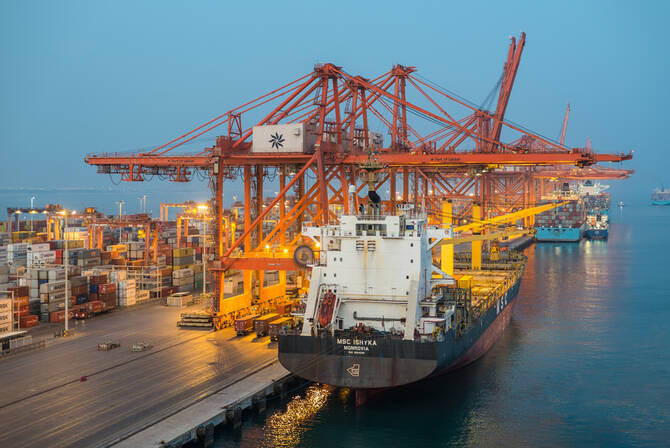
Port of Salalah in Oman. Shutterstock
Short Url
Updated 06 October 2025
Follow

Oman’s non-oil exports climb 11.3% to over $10bn by July   

RIYADH: Oman’s non-oil exports rose 11.3 percent to 3.89 billion Omani rials ($10.12 billion) by the end of July compared to the same period last year, new data has revealed.

According to preliminary figures from the National Centre for Statistics and Information, as reported by the Oman News Agency, the country’s overall trade surplus narrowed to 3.55 billion rials in the January–July period, down 34.6 percent compared to 5.43 billion rials during the same period last year. 

The decline is attributed mainly to a 17 percent drop in oil and gas exports, which fell to 8.58 billion rials, from 10.34 billion rials a year earlier.   

The increase in non-oil merchandise reflects growing demand for Omani industrial and manufacturing goods across key regional and international markets. 

As part of Oman Vision 2040, the government is actively working to reduce the economy’s dependence on hydrocarbons by promoting non-oil industries, enhancing local production capabilities, and expanding access to global markets. 

“The statistics revealed that Oman’s non-oil merchandise exports achieved notable growth of 11.3 percent, reaching a value of RO 3.890 billion by the end of July 2025, compared to RO 3.497 billion during the corresponding period in 2024,” the ONA report stated. 

The latest trade figures highlight the dual nature of Oman’s economic landscape. While the country remains exposed to volatility in energy markets, its diversification agenda is beginning to yield measurable results. 

This mirrors similar diversification efforts in regional peers such as Saudi Arabia’s Vision 2030 and the UAE’s industrial and logistics strategies, though Oman’s smaller economy and resource base present unique challenges and opportunities. 

The report also shed light on the composition of Oman’s non-oil trade. Re-exports rose marginally by 0.5 percent to 1.4 billion rials, while total imports increased by 5.5 percent to 9.92 billion rials, reflecting resilient domestic demand and ongoing infrastructure development. 

The UAE emerged as Oman’s top non-oil trading partner, with non-oil exports to the Emirates climbing 27.8 percent to 698 million rials. Saudi Arabia ranked second with 653 million rials, followed by India at 398 million rials.  

On the re-exports front, Iran and Saudi Arabia followed the UAE, while China and Kuwait were among the top import sources into Oman. 

The sustained growth in non-oil exports signals a slow but steady transformation in Oman’s trade structure, supporting long-term efforts to build a more balanced and resilient economy. 


Saudi Arabia boosts global 3D printing presence amid 20% annual growth

Updated 13 sec ago
Follow

Saudi Arabia boosts global 3D printing presence amid 20% annual growth

RIYADH: Saudi Arabia aims to become the world’s fifth-largest 3D printing market by 2030, placing it at the center of global competition, Faisal Adnan, founder and CEO of Namthajah, told Al-Eqtisadiah.

Founded in 2015, Namthajah is a Saudi company specializing in 3D printing, with investments in the sector totaling around SR30 million ($8 million).

Adnan said the industry is experiencing rapid global growth, with the market valued at roughly $20 billion and an annual growth rate of 20 percent, adding that the sector is expected to expand to $100 billion over the next five years.

The CEO emphasized that this trend represents a strategic opportunity to expand Saudi industrial leadership and enhance the global competitiveness of its products, noting that the Ministry of Industry and Mineral Resources is working to build advanced industries with added value based on knowledge and intellectual property.

Adnan added that Fourth Industrial Revolution technologies have become central to global industrial transformation, as highlighted at the current industrial exhibition focused on these advancements.

Modular production lines

Namthajah announced it has received a grant from the Innovative Factories Promotion Initiative to develop a modular production line for manufacturing 3D-printed structures, making it one of the first specialized production lines of this scale globally.

The company aims to expand to 200 advanced manufacturing centers worldwide over the coming years, up from 11 centers currently in Saudi Arabia, with its first international expansion to be announced before year-end.

Strategic partnerships 

Namthajah signed a partnership agreement with the Ministry of Industry to serve as an innovation partner with the Advanced Manufacturing Center, providing consulting services and support programs to promote 3D printing adoption across the local industrial sector.

The company is also preparing to announce a new agreement with China’s Enigma, one of the world’s largest 3D printing technology firms, to establish a center of excellence for developing metal part manufacturing applications for the energy sector.

This collaboration is expected to transfer advanced knowledge and develop high-quality industrial solutions, strengthening the Kingdom’s position as a regional hub for advanced tech industries.

Promising sector

These rapid initiatives highlight Saudi Arabia’s ambition to build a sophisticated 3D printing sector capable of enhancing the national economy and creating new industrial opportunities.

With international strategic partnerships and the development of innovative production lines, the Kingdom is paving the way for a new era of leadership in advanced manufacturing technologies regionally and globally.