WASHINGTON: Defense Secretary Pete Hegseth said Friday that he ordered another strike on a small boat he accused of carrying drugs in the waters off Venezuela, expanding what the Trump administration has declared is an “armed conflict” with cartels.
In a post on social media, Hegseth asserted that the “vessel was trafficking narcotics” and those aboard were “narco-terrorists.” He said the strike killed four men but offered no details on who they were or what group they belonged to, following the US designation of several Latin American cartels as foreign terrorist organizations.
President Donald Trump said in his own social media post that the boat was “loaded with enough drugs to kill 25 TO 50 THOUSAND PEOPLE” and implied it was “entering American Territory” while off the coast of Venezuela.
It is the fourth deadly strike in the Caribbean and the latest since revelations that Trump told lawmakers he was treating drug traffickers as unlawful combatants and military force was required to combat them. That assertion of presidential war powers sets the stage for expanded action and raises questions about how far the administration will go without sign-off from Congress.
“Blowing them up without knowing who’s on the boat is a terrible policy, and it should end,” said Republican Sen. Rand Paul of Kentucky, a consistent and harsh critic of the US strikes.
The Trump administration laid out its justification for the strikes in a memo obtained by The Associated Press this week.
“The President determined that the United States is in a non-international armed conflict with these designated terrorist organizations,” according to the memo sent to Congress. Trump directed the Pentagon to “conduct operations against them pursuant to the law of armed conflict,” the document says.
Sen. Jim Risch, Republican chairman of the Senate Foreign Relations Committee, said the president had the authority to go after the cartels without further authorization from Congress under “his general powers under the Constitution as the commander in chief.”
“What could be a bigger defense of this country than keeping out this poison that’s killing thousands of Americans every year?” Risch said Friday.
Paul said only Congress has the authority to declare war and characterized the memo as “a way to pretend like” the administration is notifying lawmakers with a justification for the strikes.
“If they want to declare war, come to Congress and say they want to declare war,” he told the AP. “But you can’t just say it yourself and say, Oh, well, we sent them a note and now we’re at war with unnamed people who we won’t even identify before we kill.”
Hours after Hegseth announced the latest strike, Venezuelan Vice President Delcy Rodríguez said the “warlike aggression” by the US affects the greater Caribbean, not just Venezuela.
“We see it and feel it, as they murder our countries’ citizens in summary extrajudicial executions,” she said during a conference in Venezuela’s capital, Caracas, focused on colonialism in the West.
Meanwhile, President Nicolás Maduro did not explicitly mention the strikes, but he told conference attendees that his country is ready to defend itself.
“Venezuela has the right to peace, to sovereignty, to existence, and no empire in this world can take it away,” he said. “And if it is necessary to move from an unarmed struggle to an armed struggle, this people will do so. … Colonialism no more.”
Colombian President Gustavo Petro, a leftist leader who has clashed with the Trump administration, accused the US of committing “murder” and urged the victims’ families to “join forces.”
“There are no narco-terrorists on the boats,” he posted on X after the strike was announced. “Drug traffickers live in the US, Europe and Dubai. On that boat are poor Caribbean youth.”
Video of Friday’s strike posted online showed a small boat moving in open water when it suddenly explodes, with water splashing all around it. As the smoke from the explosion clears, the boat is visible, consumed with flames, floating motionless on the water.
With it, at least three of the strikes have now been carried out on vessels that US officials said had originated from Venezuela. The strikes followed a buildup of US maritime forces in the Caribbean unlike any seen in recent times.
The Navy’s presence in the region — eight warships with over 5,000 sailors and Marines — has been pretty stable for weeks, according to two defense officials, who spoke on condition of anonymity to discuss ongoing operations.
In a post about the first strike last month, Trump claimed the vessel was carrying members of the Tren de Aragua gang. Posts about all the subsequent strikes, including Friday’s, have not provided any details about what organizations have been targeted. The four strikes have killed 21 people, the administration says.
Pentagon officials who briefed senators on the strikes this week could not provide a list of the designated terrorist organizations at the center of the conflict.
Officials in the Pentagon, when asked for more details about the strike, referred The Associated Press back to Hegseth’s post.


![]()
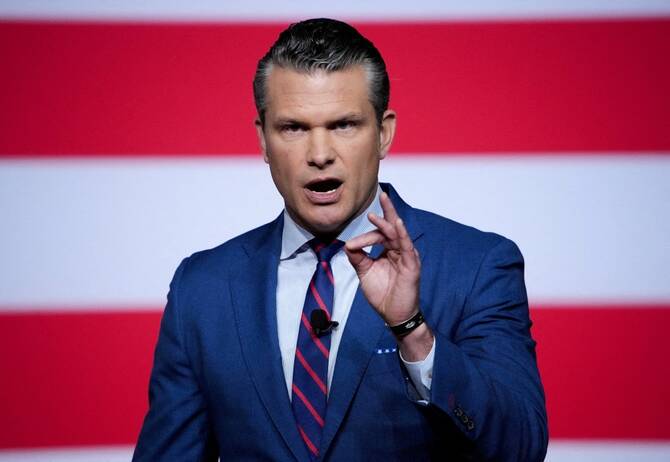
Hegseth announces latest strike on boat near Venezuela he says was trafficking drugs

Short Url
https://arab.news/8ckz6
Hegseth announces latest strike on boat near Venezuela he says was trafficking drugs
Latest updates


© 2026 SAUDI RESEARCH & PUBLISHING COMPANY, All Rights Reserved And subject to Terms of Use Agreement.